Tag: style

  • Losing Her Religion: Nigeria’s Faith Unveiled In The Face Of COVID-19 By R. Evon Benson-Idahosa

    Losing Her Religion: Nigeria’s Faith Unveiled In The Face Of COVID-19 By R. Evon Benson-Idahosa

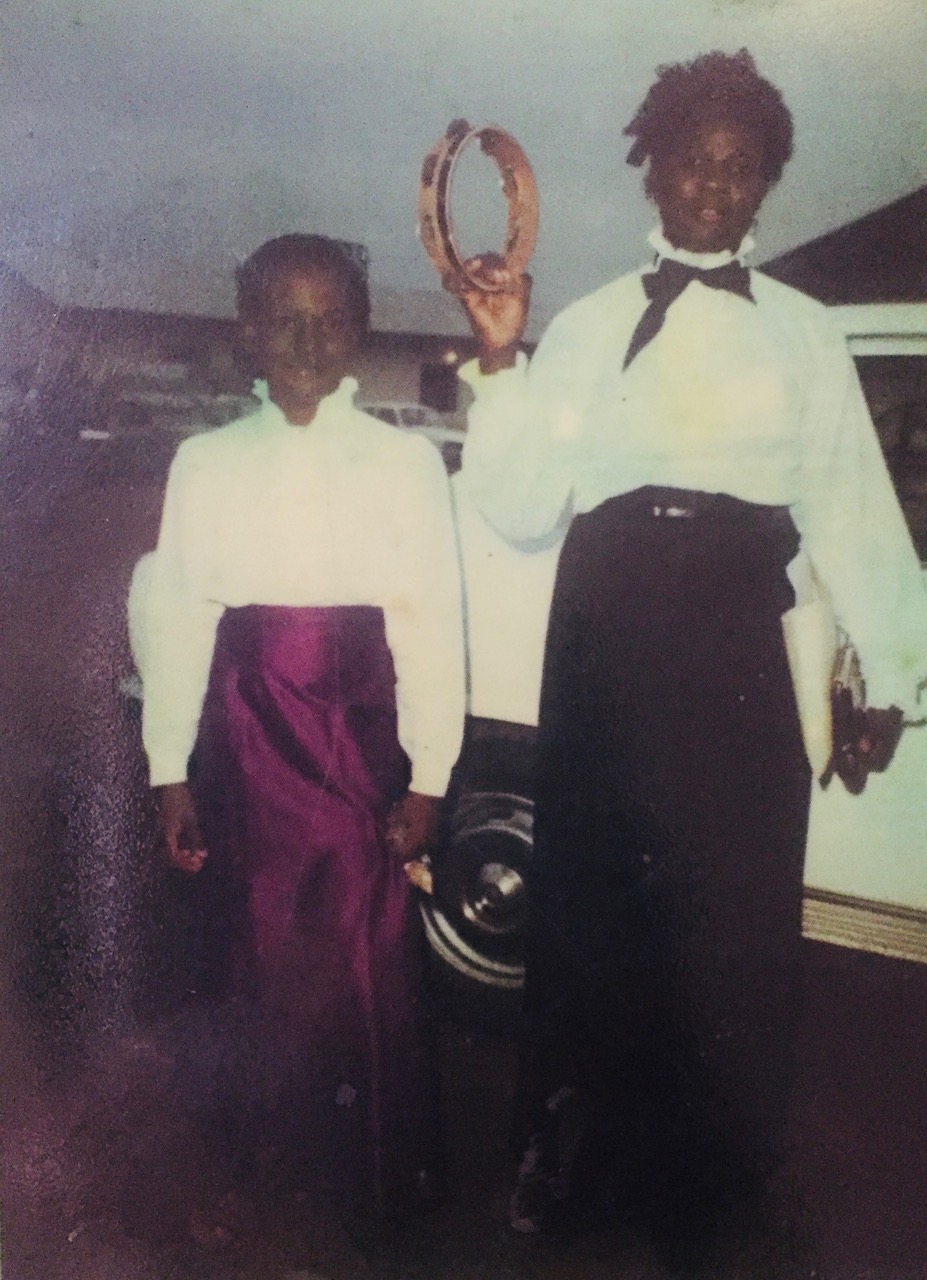
    Me, circa 1984, in my choir uniform and what was possibly the now infamous tambourine.

    Me, circa 1984, in my choir uniform and what was possibly the now infamous tambourine.

    R. Evon Benson-Idahosa, Esq
    R. Evon Benson-Idahosa, Esq

    Losing Her Religion: Nigeria’s Faith Unveiled In The Face Of COVID-19 By R. Evon Benson-Idahosa 1R. Evon Benson-Idahosa, Esq


    I remember falling asleep at a Tuesday evening church service as a 9 year old child. I had a tambourine on my lap and as I fell to the floor, it reverberated thunderously throughout the hall, drawing the attention of everyone who had been attentively listening to the dynamic preacherman. I awakened to piercing stares and side eyes- particularly from my father- whose message I had disrupted. Every Nigerian child knows that stare, that glare that silently speaks a thousand words, cloaks you in debilitating fear and assures your quivering being that there will be consequences. Needless to say, it was a quiet ride home and for the rest of the revival week, I was ushered to the front row where I forced my eyes open, humming tunes to myself to stay awake.

    Losing Her Religion: Nigeria’s Faith Unveiled In The Face Of COVID-19 By R. Evon Benson-Idahosa 2Me, circa 1984, in my choir uniform and what was possibly the now infamous tambourine.


    Saying that I literally grew up in church would be an understatement. Week long revival services, such as the one I reference above, were customary. I was also in the choir, went to Sunday school before church services on Sunday, Agape Force Children’s meetings on Saturdays, mid-week services and the occasional 6:30 am morning prayer services, followed by our home bible study with Auntie B. And because my father was Archbishop Benson Idahosa, there were no negotiations. It just was.

    At the age of10, shortly after the infamous “tambourine experience,” the truth of those messages became real and I earnestly became a follower of The Way. And so, as news began to sweep the globe of the novel corona virus and its import, I found myself immediately turning to my faith as a source of comfort and peace. I also called my mother, who now heads CGMI, the global ministry my father left when he passed away 22 years ago. Her words of encouragement and the tone of her voice assured me that, as we like to say in Nigeria, ‘it is well.’

    And it will be.

    But for now, the pandemic continues to rage, as thousands succumb to its will. First China. Then South Korea. Japan. An epidemic. Then Italy, the UK, the US. Thousands upon thousands of cases were being reported and every day brought the reality closer to home. Then it became a global pandemic and as it stands, the WHO estimates that there are 719,700 confirmed cases globally, with almost 34,000 deaths.

    On February 28th, Nigeria, Africa’s most populous nation, confirmed its index case of the corona virus which arrived the country via an Italian businessman. As I write, her Centre for Disease Control is reporting a total of 135 confirmed cases and two deaths, having conducted just several hundred tests, even though thousands of passengers have arrived from varying countries since the index. Self isolation has been deemed an advisory, not mandatory measure.

    Nigeria has taken what some would consider drastic, yet in this writer’s opinion, insufficient and strikingly Western style measures to address what is likely to come in the absence of a miracle. In addition to finally closing her borders from international travelers, including Nigerians, schools have been shut down, civil servants are being asked to work from home, “social distancing” policies are being enacted and several states, including my home state of Edo, have prohibited religious, social and public gatherings of more than 20 persons.

    In a country where over 90% of her citizens profess to be religious, most Nigerians are accustomed to turning to their faith in times of crisis. The corona virus pandemic is no exception. Many who had strayed from God are now repenting of their sins and brandishing the sign of the cross as they leave their homes. Others are praying for a “Passover,” as CNN and other news outlets flood us with “end of the world,” doomsday messaging. As a result, many of us are yearning to collectively gather to pray.

    Whether the desire to collectively gather is buttressed by denial (“coronavirus is not here” — “the spirit of corona virus is dead in Nigeria”) or stems from a deep seeded longing for God to show mercy to a healthcare system that is wholly unprepared to handle the worst case scenario, the fact remains that Nigeria’s religious faithfuls are unaccustomed to missing gatherings for anything. Services are considered sacred times to commune with God and to be encouraged by the brethren. Others hang on to every word of their clerics who, in some cases, insist on serving as a religious crutch- intermediaries between their congregants and God. Many believers who engage with God on a transactional basis come bearing tithes and/or offerings in the hopes that God will hear their prayers. (He hears them regardless.)

    As such, the prohibition on religious gatherings of more than 20 (which essentially translates to a prohibition of services in general) has resulted in many Nigerian believers losing their ‘religion,’ i.e., left bewildered as to how to make the adjustment to a God who potentially exists outside the four walls of their churches; to a God who speaks directly to them in God’s long forgotten voice. Who, precisely, are Nigerian believers without our religions and religious houses of worship?

    Could it be that for the first time in a long time, Nigerian believers are being presented with a church-less opportunity to develop even more meaningful personal relationships with their God; to ‘lay hands’ on themselves and speak words of healing into their children from a God who has always heard them? Could this pandemic serve as an opportunity for believers to be what Murray Bowen describes as a ‘non-anxious presence’ to those who may be paralyzed by fear? Or as a practical example, to give our hired staff the much deserved paid time off to assuage the fears of their own elderly parents? As we creatively consider our individual responses, it is imperative that we recognise that our actions are a reflection of what we truly believe about our faith and the One who implores us to be salt and light.

    As the Church, however, it is unhelpful that some of our pastors are refusing to comply. The other day, I was tagged on a rather unfortunate video of a pastor irresponsibly screaming to congregants that the corona virus cannot withstand Nigeria’s “corrosive anointing.” However, even Jesus instructed us to obey the law of the land (render unto Caesar what is Caesar’s). This blatant refusal to consider the reality that may most aggressively affect those on the margins begs the question of why some churches are so adamant against temporarily closing their doors.

    Sure, we all need hope and encouragement in these perilous and uncertain times, but have we not, after all these years, fed the flock enough “meat” to trust that they can and will turn to God for themselves? Or are we, draped in our own egos, more selfishly concerned that they may not return to our fold and thus, affect our financial bottom line?

    It is not a lack of faith to use wisdom or to be practical. Even Jesus reached out his hand to save Peter when he could easily have let him drown and then used his “corrosive anointing” to raise him from the dead. Wisdom is profitable to direct and I believe my father, who I consider one of the greatest men of faith to ever walk this earth, would have done the needful to protect the sheep. My mother most certainly is.

    To this end, some larger churches are offering their services online. However, for the working poor who faithfully make up the backbone of most Nigerian churches, internet connectivity and/or live streaming of an entire service make that option impractical and/or unaffordable. They are the ones, who because they live day to day, cannot afford to practice social distancing, “stay at home” and for some, even “wash your hands,” because soap becomes a luxury when one’s ‘daily bread’ is devoid of the ‘daily.’ If our government does not step up to courageously seek support that is tailored to our unique realities and then provide that support to those on the margins, the import of the corona virus in our beloved Nigeria could be felt by generations to come.

    As such, could this pandemic present an opportunity for churches to fill the glaring gaps and practically serve the last and the least in a manner that reveals who we profess to be as followers of The Way? Might this be an opportunity for the church to put our egos aside and creatively heed Jesus’ instructions to ‘feed my sheep’, to apply the Balm of Gilead, by serving those who will be most physically, mentally and economically impacted? Practically speaking, could we convert our sanctuaries to temporary hospitals or food pantries where those in need can obtain essentials? Can we use the funds of those who have faithfully donated over the years to buy ventilators and personal protective gear for our hospitals and health workers on the front lines? Can we purchase hygiene products and distribute them to those who may be confined to their homes? This, I believe, is our mandate.

    At the end of the day, my faith in God runs deep. It has guided my life since I was 10 and I prayerfully trust that we will get through this. But as the Nigerian Church temporarily loses her ‘religion’ and her faith is unveiled in the face of COVID-19, she is presented with an opportunity to reverberate thunderously and rise up to be who she professes for such a novel time as this. After all, in the words of Dietrich Bonhoeffer, ‘the church is the church only when it exists for others…not dominating, but helping and serving.’

    WRITTEN BY

    R. Evon Benson-Idahosa, Esq.

    Lead table turner and expert troublemaker at Pathfinders Justice Initiative (www.pathfindersji.org); creating more space for women at the table.


    Opinion

    AddThis

    : 

    Featured Image

    : 

    Losing Her Religion: Nigeria’s Faith Unveiled In The Face Of COVID-19 By R. Evon Benson-Idahosa 3

    Original Author

    : 

    R. Evon Benson-Idahosa, Esq

    Disable advertisements

    : 
    Losing Her Religion: Nigeria’s Faith Unveiled In The Face Of COVID-19 By R. Evon Benson-Idahosa
    Read More
    http://saharareporters.com/2020/03/31/losing-her-religion-nigeria%E2%80%99s-faith-unveiled-face-covid-19-r-evon-benson-idahosa

    Views: 0

  • What My Zumba Instructor Can Teach You About Your Biz

    My Zumba instructor, Tiger, was born to teach Zumba. Her passion and love for it are infectious plus she’s an excellent teacher (in fact she’s been honored at a statewide level she’s such a fabulous teacher.) Her classes are packed, and her teaching methods and style has influenced all the Zumba instructors at the YMCA.

    Read More
    http://www.associationofmarketing.org/articles/view.php?article_id=7454

    Views: 0

  • Monty Python’s Silly Walk is exactly 6.7 times more silly than normal

    Monty Python’s Silly Walk is exactly 6.7 times more silly than normal

    An analysis of a classic Monty Python sketch suggests the Minister of Silly Walks has a walking style 6.7 times more variable, or silly, than normal walking
    Monty Python's Silly Walk is exactly 6.7 times more silly than normal
    Read More
    https://www.newscientist.com/article/2236891-monty-pythons-silly-walk-is-exactly-6-7-times-more-silly-than-normal/?utm_campaign=RSS%7CNSNS&utm_source=NSNS&utm_medium=RSS&utm_content=home

    Views: 0

  • From ‘Sam-suck’ to Apple rival: the Samsung transformation

    From ‘Sam-suck’ to Apple rival: the Samsung transformation

    Military-style management and an unquestioning reverence for the founding Lee family have fuelled Samsung’s transition from the world’s most ridiculed phonemaker to its biggest, says the author of a new book.

    Read More
    https://techxplore.com/news/2020-03-sam-suck-apple-rival-samsung.html

    Views: 0

  • PedestriANS: A bipedal robot that adapts its walking style in response to environmental changes

    PedestriANS: A bipedal robot that adapts its walking style in response to environmental changes

    Humans are generally able to adapt their walking style based on the environment they are moving in, for instance, speeding up if the consistency of the ground below their feet allows it, slowing down when the floor is slippery, changing direction to avoid puddles or holes in the ground, and so on. To navigate a variety of environments, robots should be able to adapt their walking behavior in a similar way, adjusting their structure in response to environmental changes.

    Read More

    Views: 0

  • Spinoza’s Ethics of Strength of the Emotions in W Somerset Maughm’s Of Human Bondage

    [ad_1]

    The writer probes on the complex world of W. Somerset Maughm’s protagonist in the novel Of Human Bondage, using the propositions the Jewish Portuguese philosopher Baruch Spinoza postulated in his book Ethics in 1674. Some of Spinoza’s propositions are as follows( Morgan, 2006, pp 108-120):

    The following propositions of Spinoza enlighten the changing character of Philip in his own bildungsromans of his life. The force and increase of any passive emotion and its persistence in existing is defined not by the power whereby we ourselves endeavour to persist in existing, but by the power of external causes compared with our own power;

    The force of any passive emotion can surpass the rest of man’s activities or power so that the emotion stays firmly fixed in him;

    An emotion cannot be checked or destroyed except by a contrary emotion which is stronger than the emotion which is to be checked;

    Knowledge of good and evil is nothing other than the emotion of pleasure or pain insofar as we are conscious of it;

    An emotion whose cause we think to be with us in the present is stronger than it would be if we did not think the said cause to be with us;

    We are affected toward a future thing which we imagine to be imminent mo intensely than if we were to imagine its time of existence tofarther away from the present. We are also affected by a remembrance of a thing we imagine to belong to the near past more intensely if we were to imagine it to belong to the distant past;

    An emotion toward a thing which we think of as inevitable [necessarius] is more intense, other things being equal, than emotion toward a thing possible or contingent, that is, not inevitable;

    Emotion toward a thing which we know not exist in the present, and which we imagine to be possible, is, other things being equal, more intense than emotion toward a contingent thing;

    Emotion toward a contingent thing which we know not to exist in the present, is, other things being equal, feebler than emotion toward a thing past;

    No emotion can be checked by the true knowledge of good and evil, insofar as it is true, but only insofar as it is;

    Desire that arises from the true knowledge of good and evil can be extinguished or checked by many other desires that arise from the emotions by which we are assailed;

    The desires that arises from a knowledge of good and evil insofar as this knowledge has regard to to the future can be the more easily checked or extinguished by desire of things that are attractive in the present;

    Desire that arises from the true knowledge of good and evil insofar as this knowledge is concerned with contingent things can be even more easily checked by desire for things which are present;

    Desire arising from pleasure is, other things being equal, stronger than desire arising from pain;

    Every man, from the laws of his nature, necessarily seeks or avoids what he judges to be good or evil.

    The more every man endeavours and is able to seek advantage, that is, to preserve his own being, the more he is endowed with virtue. On the other hand insofar as he neglects to preserve what is to his advantage, that is, his own being to that extent he is weak.

    Philip is highly affected by nature. There is in Nature no individual thing that is surpassed in strength and power by some other thing. Whatsoever thing there is, there is another more powerful by which the said thing can be destroyed. And he was able to surpass all his problems because of the incoming different emotions, problems which proved to make him stronger if not released from “Human Bondage”.

    The force whereby a man persist in existing is limited, and infinitely surpassed by the power of external causes.

    Philip’s deformity limits his own persistence to live. But his meeting with Hayward, Clutton and Lawson, his former classmates in France, who taught him that life is all about passion and the pursuit of it, he became engross in his art. France did not also care about his clubfoot. Cronshaw taught him more philosophy in life about living in let live. Cronshaw even on his death bed, defied doctors’ prohibition. His life is anyway to end just like any other’s lives.

    Set in Kent, England, a sub-urban near London, the novel presents the multifaceted personal, social, political and religious experiences of Philip carey from his childhood to his middle age of thirty. A bildungsroman (1991, Smiley) in style, which highlights the formation of a youngman’s character through education, travels and early life experiences. Philip at the age of nine, as a young boy, is set apart from his peers by some misfortune and undergoes a humiliating experience that later proves strengthening. his first experience of love is unsuccessful or problematic one that nevertheless paves the way to a happy marriage with a suitable mate. The novel has ample observation, if not criticism, with the character’s institutions such as schools, churches and class structures.

    Philip’s personal life is truly an amalgam of life’s tragedies. But how he surpassed the seemingly insurmountable heap of oppressing weight, if not the meaninglessness or nothingness of life, is the focus of this attempt anchored on Spinoza’s propositions. To enumerate, at an early age, his mother died of tuberculosis and his father, a medical doctor, died of lung cancer. His innocence never understood the situation. He has only the temporary joy of travelling to Blackstable to live with his uncle William and childless Auntie Louisa. Forcibly liking his second family as an orphan, he is left reading his books without noise for his uncle, a Vicar in the community, is irated with children’s unruly behaviour. Aunt Louisa is incapable of understanding Philip. he is left with the care of the governess. His personal disability or deformity, being born with a club-foot, proves to be the stigma of his life forever. His early education in Kingston School, caused his early childhood bitter as his peers laughed at him, mocked and physically abused him because of his physical abnormality. Then, his adolescence which brings him to Heidelberg, Germany to study foreign languages, is never sweet. Girls chided him for his deformity. the consolation is meeting friends like Hayward and Miss Wilkinson, who flirted with him, to his disgust. His sojourn to France, albeit, his uncle’s disappointment, proves to be annihilating. His lack of talent in painting plus his deformity, made him a mediocre student. His classmate Fanny Price, who fell in love with him, on the pretext of sharing the same abnormality (hers is lack of beauty), committed suicide out of hunger and wretchedness.

    Then everything escalated to its height, when realizing that painting is not his passion, he goes back to England. He decides to change again to pursue what his uncle William tells him to do: to follow the footsteps of his father. To be a doctor. feeling he has nothing to do, he embraces the new idea. Sauntering along the Parliamentary Street of London, he is driven to dine in a cafe where he meets the slatternly waitress Mildred Rogers who awakens his sexual desire. But his languid mien, caused by his club-foot proves to be a disadvantage. the waitress prefers rugged and rich men. But his desire to pursue the pale, anaemic, aloof Mildred, beomes a challenge to him. Gradually, the two becomeclose. But the ambitious and materialistic waitress always insults him because of his deformity. to slander him cripple, would totally “cripple” his mood and emotion. Even when Philip is generous to the moody Mildred, she hurt him by marrying a German businessman Miller. His desperation is tantamount to his yearning for Mildred. He is left believing that one day, he would see Mildred again. His concentration with his medical study is forlorned. And Mildred came back,looking sickly, with a child. His generosity and forgiveness for his first love, who hurts him the most, is even greater than life. The ingrate waitress after a little recovery from poverty, elopes with Griffith, Philip’s handsome and robust classmate. That is the height of Mildred’s shamelessness. So her expected return is welcomed with derision by the newly awakened Philip. Even when Mildred turns into a prostitute, Philip is only capable of compassion, without passion or sexual desire. She is freed at last. And Philip is extricated from the pains excruciatingly caused by the destitute Mildred.

    His obsession to Mildred costs Philip his fortune and gradually his savings is left with seven pounds. He is forced to stop from his medical studies that brings him to experience unbelievable poverty. He meets the generous Athelneys who fed and sheltered him in his misery. His uncle’s death, leaving an average fortune, helps him to finish his medical studies. His fateful shelter with the Athelneys brings him to his final, harmonious and peaceful resolution to marry Sally Athelney and go on with his life beautifully. Shakespeare is affirmed by saying that “all is well that ends well.

    At this juncture, it is noteworthy to enumerate Spinoza’s propositions to elucidate Philip’s “bondage” and his strength of his emotion. Spinoza in his preface to his philosophical treatise wrote:

    I assign the term “bondage” to man’s lack of power to control and check the emotions. For a man at the mercy of his emotions is not his own master but is subject to fortune, in whose power he so lies that he is often compelled, although he sees the better course, to pursue the worse. In this Part I have set myself the task of demonstrating why is so, and also what is good and what is bad in emotions. But before I begin, I should like to make a few preliminary observations on perfection and imperfection, and on good and bad ( Morgan, 2006).

    In the beginning, Philip is a slave if not a victim of his emotion. His physical deformity, his club-foot, caused him too much pain. He learned to hate his classmates and,worst, abandoned his belief in God. He could not appreciate the God of his uncle vicar when God cannot give him the miracle he wanted to have normal feet. His painful childhood in school changed him to be rough character. He never wanted to become a vicar anymore. His obsession to Mildred indeed showed his real weakness as a man, and even wretchedness as a human being because of his deformity. he would always think that women cannot love him as he is because of his deformity.

    He who has undertaken something and has brought it to completion will say that the thing is completed; and not only he but everyone who rightly knew, or thought he knew, the intention and aim of the author of that work. For example, if anyone sees a work (which I assumed is not yet finished) and knows that the aim of author is to build a house, he will say the house is imperfect. On the other hand, as soon as he sees that the work has been brought to the conclusion that its author had intended to give it, he will say that the house is perfect. But if anyone sees a work whose like he had never seen before, and he does not know the artifecer’s intention, he cannot possibly know whether the work is perfect or imperfect.

    This appears to have been the original meaning of these terms. But when men began to form general ideas and to devise ideal type of houses, buildings, towers, and so on, and to prefer some models to others, it came about that each called “perfect” that which he saw at variance with his own preconceived ideal, although in the artifecer’s opinion it had been fully completed. There seems to be no other reason why even natural phenomena (those not made by human hand) should commonly be called perfect or imperfect. For men there are wont to form general ideas both natural phenomena and artifacts, and these ideas they regard as models, and they believed that Nature (which they consider does nothing without an end in view) looks to this ideas and holds them before herself as models. So when they see something occurring in Nature at variance with their preconceived ideal of the thing in question, they believed that Nature has then failed or blundered and has left that thing imperfect from their own preconceptions rather than from true knowledge.

    So perfection and imperfection are in reality only models of thinking, notions which we are wont to invent from comparing individuals of the same species or kind; and it is for this reason that I previously said (Def. 6, II) that by reality and perfection I mean the same thing. For we are wont to classify all the individuals in Nature under one genus which is called the highest genus, namely, the notion of Entity, which pertains to all the individuals in Nature without exception. Therefore insofar as we classify individuals in Nature under this genus and compare them with one another and find that some have more being or reality than others, to that extent we say that some are more perfect than the others. And insofar as we attribute to them something involving negotiation, such as limit, end, impotence and so on, to that extent we call them imperfect because they do not affect our minds as much as those we call perfect, and not because they lack something of anything except that which follows from the necessity of nature of its efficient cause; and whatever follows from the necessity of the nature of its efficient cause must be necessarily be so.

    To be a master of his emotion is to attain perfection. It may not be physical but spiritual, mental and emotional. His challenges may have hardened him but enlightened him to loosen up and later, embrace the beauty of life. The unattainable perfection, was answered, through his friend Cronshaw, a poet whom he met in France, that the meaning of life cannot be answered unless one lives it. he realized that men are born, study, work, marry, have children and die is the most beautiful pattern that the Persian rug edifies.

    As for the terms “good” and “bad,” they likewise indicate nothing positive in things considered in themselves, and nothing but models of thinking, or notions which we form from comparing things with one another. For one and the same thing can at the same time be good and bad, and also indifferent. For example, music is good for one who is melancholy, bad for one in mourning, and neither good or bad for the deaf. However, although this is so, these terms ought to be retained. For since we desire to form the idea of man which we may look to as model of human nature, we shall find it useful to keep these terms in the sense I have indicated. So in what follows I shall mean by “good” that which we certainly know to be the means for our approaching nearer to the model of human nature that we set before ourselves, and by “bad” that which we certainly know prevents us from reproducing the said model. For it is important to note that when I say somebody passes from a state of less perfection, to a state of greater perfection, and vice versa, I do not mean that he changes from one essence or to form to another (for example, a horse is as completely destroyed if it changes into a man as it would be if it were to change into an insect), but that we conceive his power of activity, insofar as this is understood through his nature, to be increased or diminished.

    Philip may have been both good and bad due to circumstances. he was good in the Blackstable with his Auntie Louisa and Uncle William. he became bad in school because his classmates taunted him because of his clubfoot. In Heidelberg, he is good to all the people even if he did not understand their silence and even their insolence. In France, was forced to become bad, to protect himself from the looming abuses of other foreigners. The death of an anti-social fanny Price, showed him to be the only compassionate painting student.

    Hence, after a series of Philip’s tragedy, his experiences, his meeting with different people, his education, his travel to Heidelberg, to Paris and to London, his affluence and reversal of his fortune to poverty taught him greatest lessons in life. That life can be beautiful if man knows to master his emotion, moderate his desire and be reasonable in every decision. A man is finally freed from the chains and cufflinks ” Of Human Bondage”.

    References:

    Maughm, Somerset W. (1991). Of Human Bondage.

    Canada: Bantam Book Doubleday.

    Morgan, Michael (ed.). (2006). The Essential Spinoza: Ethics And Related Writings.

    Cambridge: Hackett Publishing, Inc.

    [ad_2]

    Source by Wilfredo M. Valois

    Views: 0

  • Anal Sex: Here’s How To Make Your Woman BEG YOU For It – YES, Really – BEG YOU FOR IT

    [ad_1]

    You may think that the title of this article sounds too good to be true – but it’s 100% serious. You are about to discover exactly how to make your woman beg you for anal sex.

    If you want to do your woman ‘up the back door’ but she isn’t currently too happy about the idea, here is how to make her want anal sex.

    Most guys approach the issue of anal sex with their woman totally the wrong way. Here are a few examples of common methods that men use to try to get their woman to have anal sex with them.

    If you are currently using any of the following ideas, stop it straight away:

    Mistake #1: They try to persuade their woman to have anal sex with them by using logical arguments. For a woman sex is virtually 100% emotional. Therefore, logical arguments are a total waste of time.

    Mistake #2: Some men just try to ‘slip it in the back door’ when they are making love to them and hope their woman just lets them carry on with it. This is a terrible idea and one that you must avoid because it will probably hurt your woman and this could turn her off the idea of anal sex for a very long time.

    Worse still, it may break the sexual trust that you have with your woman. And when you lose that all important trust, you can say goodbye to your woman doing the really dirty, naughty stuff (like ‘back door action’) with you.

    So now that you know how not to try to get your woman to have anal sex with you, I can share the secret of how to make your woman beg you for anal sex.

    Pay attention, this is going to be fun…

    For starters, stop viewing anal sex as something that you need to ‘win’ from your woman and something that at best she’ll tolerate in order to allow you to have a good time. There isn’t a real man on the planet who thinks like that.

    Instead, adopt the belief that you are going to cause your woman to link massive amounts of pleasure to anal sex.

    That is the most important step, so I’ll repeat it – you are going to cause your woman to link massive amounts of pleasure to anal sex.

    And they way you do this is in very small steps.

    You cannot expect her to go from having never had anything up her butt, to taking your whole ‘tool’ all in one night.

    It ain’t gonna happen.

    No, no, no – your game plan for back door action has to be much cleverer than that. But don’t worry; I have already got the game plan for you, so all you have to do it put it into action…

    The 5 Step Plan To Make Your Woman Beg You For Anal Sex

    – Step 1: Use your tongue to give your woman oral pleasure, wait until she is just about to come and then gently rub her asshole with your finger. Keep rubbing it as she comes and you have started the process of getting her to link pleasure to her ass.

    – Step 2: Do the same as step one, but this time insert the tip of your finger into her butt as she is about to come and carry on doing it during her orgasm.

    – Step 3: Repeat the process again, this time inserting much more of your finger (all of it if possible), into her ‘back door’ as she gets on the verge of orgasm and during her orgasm

    – Step 4: Get a butt plug (start with a small one) and get her used to taking this up her ass. Be sure to insert the butt plug as she is about to come and during her orgasm. This way she links massive pleasure to her ass being touched by you

    – Step 5: Get your woman extremely turned on and wet. Give her a clitoral orgasm (with anal fingering) and then give her a deep spot orgasm. Next, bring out the lube and attempt to put your tool in her back door (use the doggy style position).

    Chances are that she’ll help you get inside her and totally enjoy the process. If she struggles to take you, repeat steps 3 and 4 and then retry step 5. Sooner or later she will beg you to take her in her butt.

    I’m the first to admit that this process is not set in stone.

    You have to be flexible in your approach. But this IS the way to do it if you want your woman to absolutely LOVE it when you take her in the butt.

    After-all, do you really want her to just oblige you because you begged for it, OR do you want to expertly and patiently make her crave back door action?

    If you want to make her crave it, use this 5 step process and be ready to repeat certain steps if need be. At the end of the day, it’s all good fun!

    Let me know how you get on.

    [ad_2]

    Source by Adam A Armstrong

    Views: 0

  • Book Review: Breaking Through, Being Healthy In Mind, A 250 Pound Weight Loss Story

    [ad_1]

    I recently finished two of this author’s eBooks: Breaking Bad, Overstanding Behavior from an Abusive Father, Breaking Point 1, and Understanding Manifestation, Create a Vision and Hold on Tight, Overstanding Book 1. The author, Jason Criddle, is a product of mixed race and broken home. His father, a black man, severely beat him when he was young, and when Jason was nine-years-of-age his father left him and his white mother to their own devices.

    I was impressed with this author’s writing style as well as his forthright openness about his childhood and the insights into his eventual success. Consequently, I just had to read this book too. But the primary reason I looked for this weight loss reading in particular is the personal journey that I’ve experienced with obesity.

    I was a slender youth, an active athlete in high school, and well-muscled – “lean and mean” while in the Marine Corps. However, about fifteen years ago I came to the realization that I’d gained from 3 to 5 lbs. annually for the past twenty-five years. When I was in the Corps I weighed 185 lbs. Since then, the high-water mark for me was 308 lbs. I felt terrible, it hurt to sit with that large belly in the way, and each of my joints ached when I walked. So, I’ve been searching for diets to bring me back to my optimum weight.

    Slim Fast and other supplements didn’t help. Atkins, liquid, and a number of other diets didn’t help. I’ve read a few books that have helped to some degree… books about quinoa, healthy slushies, juicing, paleo-diet, even hypnosis, and self-affirmations, all have helped. But I needed to find something that was all-encompassing, something that would touch all aspects of life. I found it in Breaking Through. Our author has presented us with a change in living, a change in life, and a new method of thinking. It’s not just diet and, in fact, this is not a diet book. It’s about keeping active, eating smart at correct intervals, and thinking positively.

    I’m proud to say that I’ve lost 21 pounds, down to 287, about a pound or two over each of the past three months. That is in fact the best way to lose weight – slowly, but consistently. If you tend to gain weight over the holidays and need to start a healthier lifestyle this, of course, isn’t the answer to everything, but it’s certainly a start and it’s an inspiring read!

    [ad_2]

    Source by Christopher E Gregory

    Views: 0