The WannaCry ransomware attack was a May 2017 worldwide cyberattack by the WannaCry ransomware cryptoworm, which targeted computers running the Microsoft Windows operating system by encrypting data and demanding ransom payments in the Bitcoin cryptocurrency.
The attack began on Friday, 12 May 2017, and within a day was reported to have infected more than 230,000 computers in over 150 countries. Parts of the United Kingdom’s National Health Service (NHS) were infected, causing it to run some services on an emergency-only basis during the attack,Spain’s Telefónica, FedEx and Deutsche Bahn were hit, along with many other countries and companies worldwide. Shortly after the attack began, Marcus Hutchins, a 22-year-old web security researcher from North Devon in England then known as MalwareTech discovered an effective kill switch by registering a domain name he found in the code of the ransomware. This greatly slowed the spread of the infection, effectively halting the initial outbreak on Monday, 15 May 2017, but new versions have since been detected that lack the kill switch. Researchers have also found ways to recover data from infected machines under some circumstances.
WannaCry propagates using EternalBlue, an exploit of Windows’ Server Message Block (SMB) protocol. Much of the attention and comment around the event was occasioned by the fact that the U.S. National Security Agency (NSA) had already discovered the vulnerability, but used it to create an exploit for its own offensive work, rather than report it to Microsoft. Microsoft eventually discovered the vulnerability, and on Tuesday, March 14, 2017, they issued security bulletin MS17-010, which detailed the flaw and announced that patches had been released for all Windows versions that were currently supported at that time, these being Windows 7, Windows 8.1, Windows 10, Windows Server 2008, Windows Server 2012, and Windows Server 2016, in addition to Windows Vista (which had recently ended support). However, many Windows users had not installed the patches when, two months later on May 12, 2017, WannaCry used the EternalBlue vulnerability to spread itself. The next day, Microsoft released emergency security patches for Windows 7 and Windows 8. Organizations were advised to patch Windows and plug the vulnerability in order to protect themselves from the cyber attack.
Those still running older, unsupported versions of Microsoft Windows, such as Windows XP and Windows Server 2003, were initially at particular risk, but Microsoft released an emergency security patch for these platforms as well. Almost all victims of the cyberattack were running Windows 7, prompting a security researcher to argue that its effects on Windows XP users were “insignificant” in comparison.
Within four days of the initial outbreak, new infections had slowed to a trickle.
Several organizations released detailed technical writeups of the malware, including Microsoft, Cisco, Malwarebytes, Symantec and McAfee.
The “payload” works in the same fashion as most modern ransomware: it finds and encrypts a range of data files, then displays a “ransom note” informing the user and demanding a payment in bitcoin. It is considered a network worm because it also includes a “transport” mechanism to automatically spread itself. This transport code scans for vulnerable systems, then uses the EternalBlue exploit to gain access, and the DoublePulsar tool to install and execute a copy of itself.
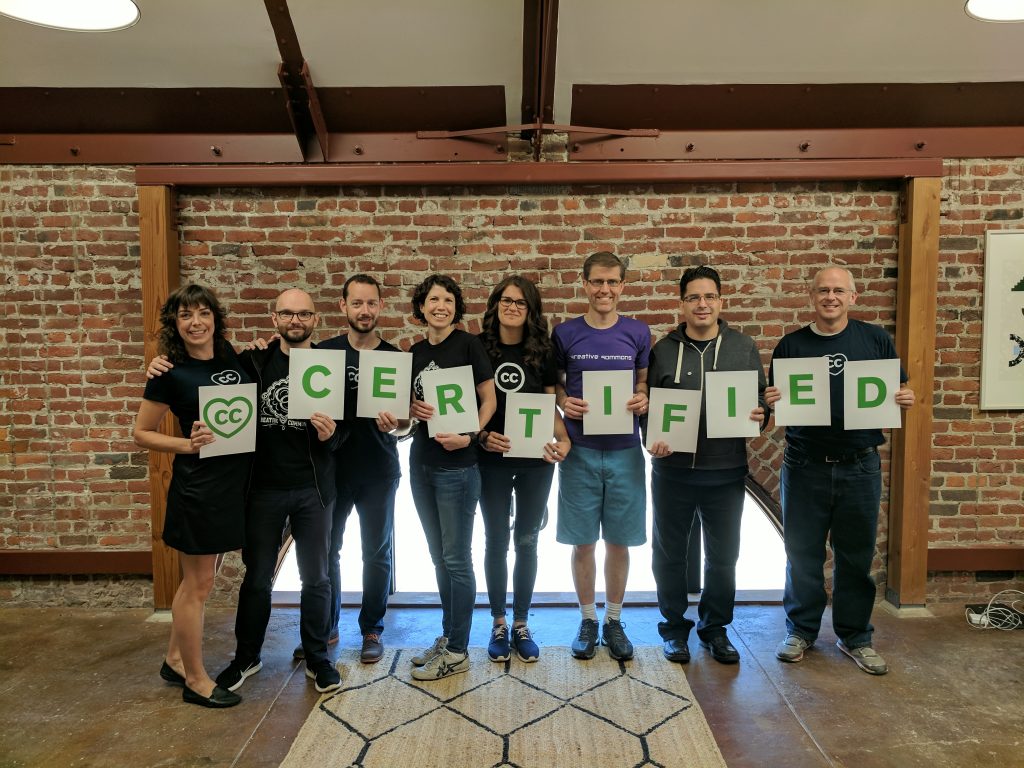
In order to better teach open tools and practices to communities around the world, Creative Commons has developed open educational resources and a certification program called the CC Certificate. CC’s Senior Counsel Sarah Hinchliff Pearson is now leading the project with a group of researchers, writers, and instructional designers. The project is funded by the Gates Foundation and the Institute for Museum and Library Services (IMLS).
The CC Certificate program is a training program that leads people through the basics about the organization, copyright law, and the CC tools. The goal is to equip people with the knowledge and skills they need to advocate for and support adoption of CC licensing in their work and creative pursuits.
There are a wealth of opportunities to tailor the certificate to specific audiences. Initially we’re focusing on two groups: academic librarians and educators. The certificate for these two segments will run as a 12-week online course on Canvas, facilitated by an instructor fluent in the issues and opportunities surrounding CC licensing and open collaboration. The majority of the content will cover the basics of copyright and open licensing, and participants will be expected to choose either the academic librarian or educator track because the final unit will be domain-specific. The content will include online discussions, quizzes, and learning activities throughout to help solidify concepts and allow learners to demonstrate their understanding. The course will be entirely online, but CC may eventually offer an optional in-person session as a capstone offering at the end of the course. Upon successful completion, students will receive a certificate from Creative Commons.
Of course, the underlying course content will be freely available to the public and CC-licensed, including text, images, and videos. The content covers Creative Commons as a whole – the organization, the tools, and the movement. We are treating this as a chance to tell the full story of what CC is and what we do. The materials include sections on the basics of copyright law, many of the ins and outs of CC licenses, practical information about how to use the licenses and how to use CC-licensed work, information about the values connected to use of CC, and case studies about what it looks like in the real world. For a full preview of the course topics, see the current syllabus here.
The full beta test of the 12-week course will begin in January, with the official certification program launching after the Global Summit from April 13-15 in Toronto, Canada. We will be running one library-specific track and one education-specific track during the beta phase and will be asking participants to help us evaluate and shape the content. If you are interested in participating, please fill out this interest form.
We expect the CC Global Network will play a crucial role in this program. In the future, we hope network members can be certified in order to help run the course in their parts of the world.
Over the course of the next year, we will be exploring customization of the project for three different audiences: GLAM professionals, lawyers, and governments. An early, abbreviated version of the certificate beta has already been delivered to more than 150 academic librarians in the US, with great success. We are anxious to expand the program to fit a greater variety of professions, and to work with and empower the future leaders of the commons. Any questions, comments, or suggestions? Get in touch with us via Slack or Twitter.
For even more CC content, please sign up for our email list.
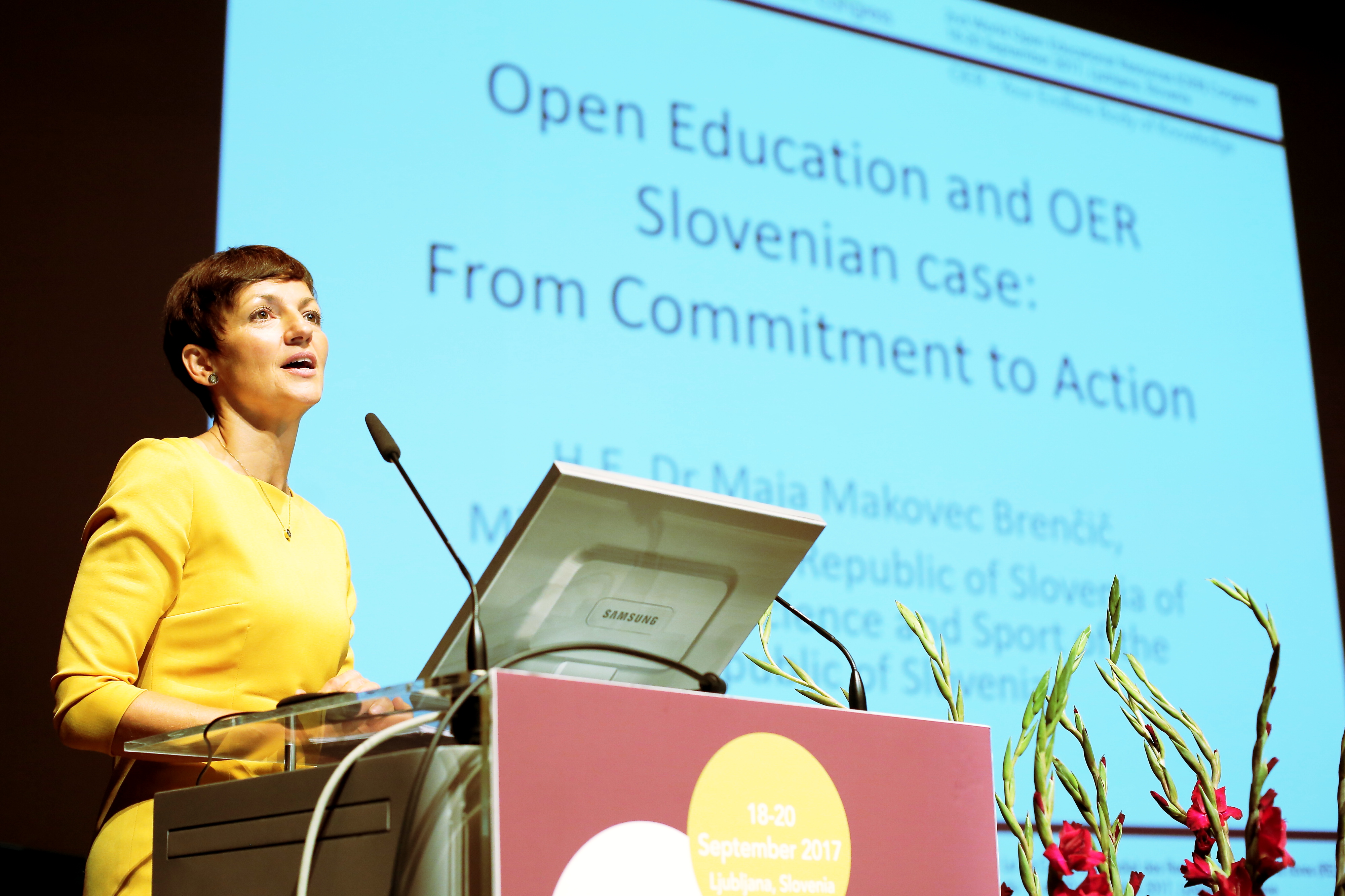
Minister of Education, Science and Sport, Dr. Maja Makovec Brenčič. By: Slovenian Press Agency. CC BY 4.0
30 ministers of education and 690 members of the open education community (140 of them virtual) from 111 nations convened in Ljubljana, Slovenia at the 2nd OER World Congress with the goal of mainstreaming open education to meet the education targets in the United Nations SDG4. In addition to the 3-day Congress program, there were 21 satellite sessions with presentations about artificial intelligence to copyright reform to regional OER networks. Creative Commons was excited to participate in sessions, give a keynote (text / video), help draft key documents, and meet with ministers and other open education leaders from around the world.
The theme of the Congress: “OER for Inclusive and Equitable Quality Education: From Commitment to Action” – called for governments to take action. After extensive consultation with the global open education community, the 2017 Ljubljana OER Action Plan (English /French) was unanimously adopted. The attending Ministers further supported this call to action with a Minsters Statement (English / French).
The 2017 Ljubljana OER Action Plan focuses on five areas for government action:
1. Building the capacity of users to find, re-use, create and share OER 2. Language and cultural issues 3. Ensuring inclusive and equitable access to quality OER 4. Developing sustainability models 5. Developing supportive policy environments
Congratulations to everyone who helped move the world to this moment! Now the hard work begins. Open education advocates, NGOs and IGOs need to help national governments and their ministries / departments of education to accomplish the “suggested actions” in each of these five areas.
Now is the time for governments to review their national and SDG4 education goals, and ask if their existing financial and procurement structures are optimized to mainstream open education. Now is the time for national governments to act:
public institutions should control the copyrights to educational resources they purchase from vendors (thus allowing them to share these resources under open licenses);
public policies should support and incentivize educators to create, update and share OER; and
publicly developed and maintained ICT infrastructure should support all learners.
The Creative Commons global network looks forward to working with our NGO and IGO partners to help governments realize the actions called for in the 2017 Ljubljana OER Action Plan.
They use viral marketing by e-mail as a marketing tool… what did you think I meant? Viral marketing can work well for B2B providers, as long as the following is true:
1. The product or service has to add value for the sender, as well as, the receiver.
2. The offer has to be deliverable. You don’t want to offer a product that you can’t deliver if demand grows rapidly.
3. The offer has to be easily transferable to others. E-mail and Web pages provide the best medium to facilitate this.
4. The vest viral marketing campaigns use existing networks to move the message along.
The basis of viral marketing has been around for a long time. The idea is that you incite your customers or referral sources to pass on something about your business to their network of colleagues and friends. Those that pass on your information get something in return. The something might be a gift or service related to your business.
Using e-mail makes it incredibly easy to pass information on to a friend or colleague, especially if it involves something fun or free. With millions using the Internet worldwide, the potential for exponential growth is tremendous. The great things about viral marketing are that it is free and works virtually by itself. Once you make an offer and provide the facility for referrals, viral marketing spreads like… well… a virus…but the good kind.
To implement viral marketing at your business; first, start with your customer base. Incite existing customers to refer new ones. Second, go to your referral sources. Service providers, your outside network and colleagues can be encouraged to provide referrals that lead to business.
If your customers are stressed business owners, offer a reward that provides relaxation and leisure… like a weekend away.
Almost a year ago, we announced that our community’s real time communications were migrating from IRC to Slack. As we pass 1,000 active users, we want to take a moment to give gratitude to our community for making it happen.
We’ve grown consistently since then, but our next big influx of community came this week, when our Open Education Platform launched. #cc-openedu is now our most populous channel outside of #general and #announcements, with 167 participants collaborating daily in the channel. We expect an increasing number of people signing up in all our platforms with the launch of our exciting new Global Network Strategy.
Our community as a whole hosts 250 Weekly Active Users sending approximately 1,000 messages per day. However, certain days are definitely busier than others: after we sent out our invitation to our Global Summit attendees to join us on Slack, our engagement shot up to 1,700 messages in one day in April. The community is friendly and welcoming, and we try to say hello to every member who joins and posts!
35 Public Channels
35 public channels feels like a lot of channels, but the number of access points allows members to hop into (and out of) any of our global communities or programs with ease. The many channels allow us to open up our work to the world and facilitate communication between a variety of users on six continents. (We’re not yet in Antarctica – anyone want to start a chapter?)
In addition to our 1,000 members milestone, we’re nearing another important landmark: The CC Community has sent nearly 200,000 messages! We’re talking a lot between each other – more than 50% of our messages are sent via Direct Messages to develop our close-knit, relational culture of Community Builders.
To call out some of our favorite channels, #cc-openedu is acting as a catalyst and inspiration for other network-platform based communities, with more than 60 users regularly posting messages and a channel membership of 166. The #general and #announcements channels remain incredibly popular, with over 1,000 total members and 100 daily active users, as does, of course, #cc-animals, which provides all the cuteness from the commons. Want to learn more about how we work? #cc-culture-club has you covered! While most of our chatter is about the commons, we can also get silly in the #random channel.
We’ve also been excited to see the growth of users in global communities like #cc-europe, #cc-canada, and #cc-arabworld.
A vision for community growth
Our adoption of Slack has seriously grown our capacity as a network and as a community. We’ve been able to use the platform to chat, connect, and collaborate across disciplines. Through Slack, we’re privileging accessibility and community in order to reach our goals as a connected, growing network.
Our next steps include possible Slack chats, more fun, (like these Slack awards,) and frankly, who knows what else? Our community surprises us every day.
If you haven’t yet joined us, please do! We’d love to meet you.
WASHINGTON (Reuters) – The Trump administration on Wednesday told U.S. government agencies to remove Kaspersky Lab products from their networks, saying it was concerned the Moscow-based cyber security firm was vulnerable to Kremlin influence and that using its anti-virus software could jeopardise national security.
Scientists depend on the proper evaluation of research that creates the foundation for future work, and the public expects curated scientific content to be trustworthy. All forms of peer review, whether for ethical, technical and sound science criteria or for additional novelty, significance and perceived impact help ensure rigor in scientific research.
There is, however, community and public skepticism regarding the quality, trustworthiness and authenticity of the review process, from the initial stage of evaluation before reviewer assignment to the final editorial decision. Making peer review more transparent, at any stage, has the potential to revitalize the process and restore trust in the system.
Efforts to increase transparency in peer review should address challenges that include:
Change is already happening as the scientific community develops variations on themes of open and transparent, and as publishers provide more peer review offerings that range from community participation to open but anonymous, to fully open and signed reviews. While not yet functioning at scale, experiments incorporating more transparent ways to discuss and assess papers over the entire lifecycle of the research are inching their way into practice. This way, the publication of an article isn’t the single defining event in its life; it is just one chapter of its story. Many of the arguments in favor of increased transparency in peer review also hold true in the discussion of benefits of preprint submissions. According to researchers working with neuroimaging, as stated in their PLOS Biology Community Page, “preprints allow the wider community to give feedback to the authors about the manuscript and potentially improve it, which is beneficial for both the authors as well as the journal the paper will be submitted to. For example, the present paper received useful comments from three individuals in addition to the appointed peer reviewers.”
A Question of Signing
At PLOS, we’ve looked at one slice of transparency in peer review—signed reviews made available exclusively to the authors. In a research project that used a survey mechanism to collect experiences and opinions, our Publishing Operations team underwent an assessment of reviews from 2013-2016 in three of the PLOS journals (PLOS ONE, PLOS Medicine and PLOS Computational Biology).
“Our reviewer community is particularly engaged, and that’s what makes working at PLOS on this issue so exciting. Together we will be able to create solutions, both incremental and substantial, that bring constructive feedback to authors and transparency to the review process.” Helen Atkins, PLOS Director of Publishing Operations
Some of what we learned is that reviewers who were not in the habit of signing reviews simply had never been asked, or were not sure of the benefits. But it’s not as easy as just educating in these areas. These scientists also indicated that not signing allows them to be more honest and safe from retribution. We also discovered that signing can improve reviewer accountability and constructiveness, and help authors learn of a reviewer’s area of expertise. Authors who favored receiving signed reviews valued having this additional information as it provides potential for more open communication, moving research forward. The full results of this project, presented by Elizabeth Seiver, PLOS Researcher and Helen Atkins are part of the Editorial and Peer-Review Process Innovations Session on Tuesday, September 12 during the International Congress on Peer Review and Scientific Publication.
Simple but Substantive Practices
In the PLOS ONE article “Peer Review Quality and Transparency of the Peer-Review Process in Open Access and Subscription Journals,” the focus is a general aspect of transparency in peer review—how academic journals (and/or publishers) present their peer-review process to the public. According to the authors of this study, a transparent peer review system “conveys to readers and potential contributors how the peer review is implemented and how articles are selected for publication.” The researchers found that “author’s ratings of peer-review transparency predicted their assessment of the quality of peer-review at that journal.” Even small changes in practices and on publisher websites can help in this area. In addition, guidelines from the Committee on Publication Ethics, “Principles of Transparency and Best Practice in Scholarly Publishing,” stating that all journal content apart from editorial material should be subject to peer review from outside experts must be met.
Learning from Early Career Researchers
Many ECRs do not get appropriate training on how to prepare or review manuscripts. Improved transparency in peer review would not only satisfy mid-to senior-level scientists, but in providing some form of open dialogue or open accountability it enables these scientists to lead by example and provide mentorship to the next generation of reviewers.
Young and upcoming scientists have plenty of ideas when it comes to improving transparency in peer review. At PLOS, we received over 150 essays on how to revamp peer review from Early Career Researchers applying for our ECR Travel Award Program. These creative young scientists described what they consider to be characteristics of the optimal peer review process and how they might build this process either from scratch or using aspects of existing practice.
Their ideas, edited for brevity, include:
Invite reviewers to publish reviews of the article (should they wish to reveal their identity) as an accompanying commentary, for no additional fee. If reviewers know they could gain an additional publication for their efforts, this would motivate them to review more articles and respond in a constructive and timely fashion. Victoria Leong; orcid.org/0000-0003-0666-9445
[Provide] incentives for reviewing that encourages kind, open but fair responses; we would also be affecting a positive change in the culture of science; which will advance the science itself. Rebecca Gelding; orcid.org/0000-0003-4883-8075
Reviews should be open, archived and after publication, reviewers should be revealed. This aims to ensure two aspects of quality control: reviewers take more seriously their job since it will be public with their name tag on it; and reviewing records can be used when considering career development. Juan Rocha; orcid.org/0000-0003-2322-5459
Review record should also be one of the criteria judging and advancing a researcher’s professional development. Knowing that a reviewer’s identify would be revealed later and shared among peers, a reviewer would have more incentive to avoid giving low-quality comments. Xiao-Peng Song; orcid.org/0000-0002-5514-0321
A transparent, open review process may promote accountability among reviewers. A peer reviewer whose dated comments are published as supplementary material with the article has a greater incentive to conduct a thorough and timely review of the manuscript. These same published comments could also be accessed by other researchers who are struggling to address similar issues in their own studies. Sericea Stallings-Smith; orcid.org/0000-0002-4876-9965
Slices of the Transparency Pie
Solutions that will help peer review achieve its scholarly ideal are not untenable; the challenge lies in that they must satisfy a diverse researcher and stakeholder community. While some improvements are easier to implement than others, even small slices that expedite and enrich the process of assessment in fundamentally new ways contribute to advancing science and discovery for the broader scientific community.
Publishers have an opportunity to improve both speed and efficiencies: to improve review forms that may be cumbersome or insufficient to provide thoughtful and constructive feedback to authors and to provide training for reviewers and editors that mitigate potential bias. Additional possibilities include direct or facilitated mentoring of early career researchers to improve their understanding of the principles of peer review and how it is practiced within the scientific community. Imagine the impact of a global editorial and reviewer contributor community, appropriately trained, recognized and incentivized.
A lively discussion on the future of scientific collaboration and publishing, including transparency in peer review, with former PLOS Advocacy Director Cameron Neylon, currently at Curtin University
Learn how Knowledge Lab applies informatics and systems modeling to understand relationships between researchers, reviewers and the review process with Eamon Duende of the University of Chicago
In June we asked the European Parliament to redouble their efforts to make much-needed improvements to the EU copyright reform. We called on the Parliament to spearhead crucial changes that promote creativity and business opportunities, enable research and education, and protect user rights in the digital market.
Despite this strong ask, the direction of the copyright reform is getting worse, not better.
This week Creative Commons and major organisations from the library, research, education, and digital rights community sent a letterto the European Parliament’s Legal Affairs Committee calling on it to protect open access and open science in the context of the Commission’s draft Directive on Copyright in the Digital Single Market. Additional signatories are encouraged to join the letter.
Of particular concern are two parts of the draft directive: Article 11 (press publisher’s right) and Article 13 (platform content filtering). We believe that these provisions will create burdensome and harmful restrictions on access to scientific research and data, as well as on the fundamental rights of freedom of information, directly contradicting the EU’s own ambitions in the field of Open Access and Open Science.
The press publisher’s right already poses a significant threat to an informed and literate society. Links to news and the use of titles, headlines and fragments of information could now become subject to licensing. The extension of this controversial proposal to cover academic publications, as proposed by the Parliament’s Research Committee, significantly worsens an already bad situation. This type of arrangement is unequivocally harmful to access to scientific and scholarly information—most of which has already been paid for from by the public funds, and whose raison d’être is to be read as widely as possible in order to contribute to the scientific enterprise. It flies in the face of open access publishing, whose authors have chosen to share their research outputs under permissive licenses for the benefit of all. And it directly conflicts with other provisions in the EU’s copyright reform meant to improve research processes and outcomes, such as the mandatory copyright exception for text and data mining.
Article 13 threatens the accessibility of scientific articles, publications and research data made available through over 1250 repositories that European non-profit institutions and academic communities. These repositories, which are essential for Open Access and Science in Europe, are likely to face significant additional operational costs associated with implementing new filtering technology and the legal costs of managing the risks of intermediary liability.
Both Articles 11 and 13 should be removed from the proposal.
Our letter also touches on other important issues such as the exception for text and data mining (Article 3) and the exception for educational purposes (Article 4). We ask the Legal Affairs Committee to improvement these and other Articles so they to provide better support for teaching, learning, and new forms of research.
You can read the full letter below.
Are you interested in receiving updates about our work copyright reform efforts from Creative Commons and our partners in policy? Sign up to our list. We’ll email you no more than once per month!
EU copyright reform threatens Open Access and Open Science
Open letter to the members of the Legal Affairs Committee in the European Parliament
We represent a large group of European academic, library, education, research and digital rights communities and we are writing to express our alarm at the draft Directive on Copyright in the Digital Single Market, and in particular at the potential impact of Articles 11 and 13. We are concerned that these provisions will create burdensome and harmful restrictions on access to scientific research and data, as well as on the fundamental rights of freedom of information, directly contradicting the EU’s own ambitions in the field of Open Access and Open Science.
We therefore urge the Legal Affairs Committee to remove Articles 11 and 13 from the draft Directive. Furthermore, the Committee should ensure that Articles 3 to 9 support new forms of research and education and not work against them.
A U-turn on Open Science?
We believe that increased digital access, data analytics and open information flows will increase innovation in Europe. The European Commission’s Horizon 2020 programme similarly supports open access to scientific publications and research data as essential drivers of EU global competitiveness. The EU has set an example internationally with its extensive policy work, for example by including Open Access in one of its six European Research Area (ERA) priorities. Moreover in 2016 at the Competitiveness Council, all of Europe’s ministers of science, innovation, trade and industry committed to Open Access to scientific publications as the default option for publicly funded research results by 2020. Open Science is increasingly accepted by governments and industry as a means not only to accelerate innovation, but also to ensure faster access to information for citizens.
However, several proposed elements of Articles 11 and 13 will prevent the EU from realizing the significant potential of Open Access and Open Science to promote scientific discovery and progress, and may thereby reduce the impact of European research worldwide.
The Ancillary Right – Putting the brakes on knowledge-sharing and building walls around already open publications and data
Article 11 already poses a significant threat to an informed and literate society. Links to news and the use of titles, headlines and fragments of information could now become subject to licensing. Terms could make the last two decades of news less accessible to researchers and the public, leading to a distortion of the public’s knowledge and memory of past events. Art. 11 would furthermore place EU law in contravention with the Berne Convention, whose Art. 2(8) excludes news of the day and ‘mere items of press information’ and ‘press summaries’ from protection.
The extension of this controversial proposal to academic publications, as proposed by the ITRE Committee, significantly worsens an already bad situation. It would provide academic publishers additional legal tools to restrict access, going against the increasingly widely accepted practice of sharing research. This will limit the sharing of open access publications and data which currently are freely available for use and reuse in further scientific advances. If the proposed ancillary right is extended to academic publications, researchers, students and other users of scientific and scholarly journal articles could be forced to ask permission or pay fees to the publisher for including short quotations from a research paper in other scientific publications. This will seriously hamper the spread of knowledge. The proposed ancillary right further conflicts with the Berne Convention’s Article 10(1), which provides a mandatory exception for quotation, as well as posing risks to freedom of speech.
Prior experiments with the press publishers’ right have also failed from an economic standpoint. No impact assessment has been carried out, no evidence produced, and no consultation conducted around the ramifications of extending Art. 11 to academic publishers.
In addition, academic publishers usually acquire rights to the works they publish when signing contracts with their authors. Publishers already have all the rights they need, thus ancillary rights don’t make sense.
Filtering obligations – Undermining the foundations of Open Access
The provisions of Article 13 threaten the accessibility of scientific articles, publications and research data made available through over 1250 repositories that European non-profit institutions and academic communities. These repositories, which are essential for Open Access and Science in Europe, are likely to face significant additional operational costs associated with implementing new filtering technology and the legal costs of managing the risks of intermediary liability. The additional administrative burdens of policing this content would add to these costs. Such repositories, run on a not-for-profit basis, are not equipped to take on such responsibilities, and may face closure. This would be a significant blow, creating new risks for implementing funder, research council and other EU Open Access policies.
Text and Data Mining – The risks to scientific values
Regarding Article 3, we welcome amendments that expand the exception for text and data mining (TDM) to allow anyone, including SMEs and society in general, to mine works to which they have legal access, regardless of the purpose. Furthermore, Article 3 should direct Member States to set up a secure facility to ensure accessibility and verifiability of research made possible through TDM. Under no circumstances should data structured for mining purposes be deleted – this is fundamentally contrary to good scientific practice. Finally, the exception should be protected from being overridden by contract terms, and technological measures should be prohibited that interfere with the exercise of the exception. Both protections are essential for the exception to function.
Education, preservation and access – An enabling environment for Open Science
Regarding Article 4, we believe that a robust exception to copyright for education should support broad access to and fair reuse of copyrighted content of all types in a variety of education settings, locally and across borders. The scope of the exception should cover digital and non-digital uses, including ‘scientific research’ purposes, alongside educational ones, and prevent rightholders from overriding the exception through contractual provisions or technological protection measures. Finally, the exception should not depend on compulsory remuneration.
We also urge MEPs to take full account of the views of library and cultural heritage institutions regarding Articles 5-9 of the draft Directive, which aim at ensuring maximising the effective preservation of, and access to works for public interest, non-commercial purposes.
We therefore urge the Legal Affairs Committee to remove Articles 11 and 13 from the draft Directive. Furthermore, we ask for the improvement of Articles 3-9 in line with the suggestions put forward by library, educational, research and cultural heritage organisations throughout the parliamentary process to provide better support for teaching, learning, and new forms of research.
The signatories support a balanced copyright law that promotes open access to research articles, publications and data, thereby continuing to contribute to further strengthening Europe’s research outreach and innovative capacity for the benefit of Europe’s research industry, including SMEs and society.
Original signatories
CESAER – Conference of European Schools for Advanced Engineering Education and Research
COAR – Confederation of Open Access Repositories
Commons Network
Communia Association
Creative Commons
C4C – Copyright for Creativity (C4C) Coalition
EBLIDA – European Bureau of Library Information and Documentation Associations
EIFL – Electronic Information for Libraries
EUA – European University Association
Free Knowledge Advocacy Group EU
IFLA – International Federation of Library Associations and Institutions
LIBER – Association of European Research Libraries
RLUK – Research Libraries UK
Science Europe
SPARC Europe
In early 2017, the Creative Commons Global Network (CCGN) completed a consultation process of renewing and reorganizing itself to support a strong and growing global movement. The year-long process resulted in the CCGN Global Network Strategy. Part of the new strategy is to establish defined areas of focus, or “platforms,” which will drive CC’s global activities. Platforms are how we organize areas of work for the CC community, where individuals and institutions organize and coordinate themselves across the CC Global Network.
In the spirit of openness and to effectively strategize, these platforms are open to all interested parties working in the platform area and adjacent spaces. That’s why Creative Commons invites you to join the CC Global Network Open Education Platform!
WHY join?
Stay connected to global actions in open education resources, practice, and policy.
Identify, plan and coordinate multi-national open education, practices and policy projects to collaboratively solve education challenges with an amazing group of open education leaders from around the world.
Secure funding (from Creative Commons and other funding sources) for the open education projects we collectively select.
Contribute to global perspectives on open education to strengthen advocacy worldwide.
Connect your country / region to global open education initiatives.
Be on the forefront in implementing Creative Commons’ global network strategy.
Meet annually, in-person, at the Creative Commons Summit with members of the CC Open Education Platform to celebrate successes, share best practices, and plan for the next year.
Explore, practice, and share innovative methods for inclusive and open engagement with educators, learners and governments around the world..
WHO should join?
Open education advocates working in the areas of open educational resources, open educational practices, and/or open education policy.
WHAT are we working on right now?
Reaching the right people (you!) to build a strong open education platform.
Developing decision making and engagement structures.
Defining the goals and projects the CC Open Education Platform will pursue.
Joining the CC Open Education Platform is easy and free:
 The attack began on Friday, 12 May 2017, and within a day was reported to have infected more than 230,000 computers in over 150 countries. Parts of the United Kingdom’s National Health Service (NHS) were infected, causing it to run some services on an emergency-only basis during the attack,Spain’s Telefónica, FedEx and Deutsche Bahn were hit, along with many other countries and companies worldwide. Shortly after the attack began, Marcus Hutchins, a 22-year-old web security researcher from North Devon in England then known as MalwareTech discovered an effective kill switch by registering a domain name he found in the code of the ransomware. This greatly slowed the spread of the infection, effectively halting the initial outbreak on Monday, 15 May 2017, but new versions have since been detected that lack the kill switch. Researchers have also found ways to recover data from infected machines under some circumstances.
 WannaCry propagates using EternalBlue, an exploit of Windows’ Server Message Block (SMB) protocol. Much of the attention and comment around the event was occasioned by the fact that the U.S. National Security Agency (NSA) had already discovered the vulnerability, but used it to create an exploit for its own offensive work, rather than report it to Microsoft. Microsoft eventually discovered the vulnerability, and on Tuesday, March 14, 2017, they issued security bulletin MS17-010, which detailed the flaw and announced that patches had been released for all Windows versions that were currently supported at that time, these being Windows 7, Windows 8.1, Windows 10, Windows Server 2008, Windows Server 2012, and Windows Server 2016, in addition to Windows Vista (which had recently ended support). However, many Windows users had not installed the patches when, two months later on May 12, 2017, WannaCry used the EternalBlue vulnerability to spread itself. The next day, Microsoft released emergency security patches for Windows 7 and Windows 8. Organizations were advised to patch Windows and plug the vulnerability in order to protect themselves from the cyber attack.