
Tag: Student

  • THE GROWTH OF YOUTH SOCIAL IDEALS

    THE GROWTH OF YOUTH SOCIAL IDEALS

    THE GROWTH OF SOCIAL IDEALS

    Change from childish to adult friends—Influence of favorite teachers—What children wish or plan to do or be—Property and the money sense—Social judgments—The only child—First social organizations—Student life—Associations for youth, controlled by adults.

    In a few aspects we are already able to trace the normal psychic outgrowing of the home of childhood as its interests irradiate into an ever enlarging environment. Almost the only duty of small children is habitual and prompt obedience. Our very presence enforces one general law—that of keeping our good-will and avoiding our displeasure. They respect all we smile at or even notice, and grow to it like the plant toward the light. Their early lies are often saying what they think will please. At bottom, the most restless child admires and loves those who save him from too great fluctuations by coercion, provided the means be rightly chosen and the ascendency extend over heart and mind. But the time comes when parents are often shocked at the lack of respect suddenly shown by the child. They have ceased to be the highest ideals. The period of habituating morality and making it habitual is ceasing; and the passion to realize freedom, to act on personal experience, and to keep a private conscience is in order. To act occasionally with independence from the highest possible ideal motives develops the impulse and the joy of pure obligation, and thus brings some new and original force into the world and makes habitual guidance by the highest and best, or by inner as opposed to outer constraint, the practical rule of life. To bring the richest streams of thought to bear in interpreting the ethical instincts, so that the youth shall cease to live in a moral interregnum, is the real goal of self-knowledge. This is true education of the will and prepares the way for love of overcoming obstacles of difficulty, perhaps even of conflict. This impulse is often the secret of obstinacy.[1] And yet, “at no time in life will a human being respond So heartily if treated by older and wiser people as if he were an equal or even a superior. The attempt to treat a child at adolescence as you would treat an inferior is instantly fatal to good discipline.”[2] Parents still think of their offspring as mere children, and tighten the rein when they should loosen it. Many young people feel that they have the best of homes and yet that they will go crazy if they must remain in them. If the training of earlier years has been good, guidance by command may now safely give way to that by ideals, which are sure to be heroic. The one unpardonable thing for the adolescent is dullness, stupidity, lack of life, interest, and enthusiasm in school or teachers, and, perhaps above all, too great stringency. Least of all, at this stage, can the curriculum school be an ossuary. The child must now be taken into the family councils and find the parents interested in all that interests him. Where this is not done, we have the conditions for the interesting cases of so many youth, who now begin to suspect that father, mother, or both, are not their true parents. Not only is there interest in rapidly widening associations with coevals, but a new lust to push on and up to maturity. One marked trait now is to seek friends and companions older than themselves, or next to this, to seek those younger. This is marked contrast with previous years, when they seek associates of their own age. Possibly the merciless teasing instinct, which culminates at about the same time, may have some influence, but certain it is that now interest is transpolarized up and down the age scale. One reason is the new hunger for information, not only concerning reproduction, but a vast variety of other matters, so that there is often an attitude of silent begging for knowledge. In answer to Lancaster’s[3] questions on this subject, some sought older associates because they could learn more from them, found them better or more steadfast friends, craved sympathy and found most of it from older and perhaps married people. Some were more interested in their parents’ conversation with other adults than with themselves, and were particularly entertained by the chance of hearing things they had no business to. There is often a feeling that adults do not realize this new need of friendship with them and show want of sympathy almost brutal.

    Stableton,[4] who has made interesting notes on individual boys entering the adolescent period, emphasizes the importance of sympathy, appreciation, and respect in dealing with this age. They must now be talked to as equals, and in this way their habits of industry and even their dangerous love affairs run be controlled. He says, “There is no more important question before the teaching fraternity today than how to deal justly and successfully with boys at this time of life. This is the age when they drop out of school” in far too large numbers, and he thinks that the small percentage of male graduates from our high schools is due to “the inability of the average grammar grade or high-school teacher to deal rightly with boys in this critical period of their school life.” Most teachers “know all their bad points, but fail to discover their good ones.” The fine disciplinarian, the mechanical movement of whose school is so admirable and who does not realize the new need of liberty or how loose-jointed, mentally and physically, all are at this age, should be supplanted by one who can look into the heart and by a glance make the boy feel that he or she is his friend. “The weakest work in our schools is the handling of boys entering the adolescent period of life, and there is no greater blessing that can come to a boy at this age, when he does not understand himself, than a good strong teacher that understands him, has faith in him, and will day by day lead him till he can walk alone.”

    Small[5] found the teacher a focus of imitation whence many influences, both physical and mental, irradiated to the pupils. Every accent, gesture, automatism, like and dislike is caught consciously and unconsciously. Every intellectual interest in the teacher permeates the class—liars, if trusted, became honest; those treated as ladies and gentlemen act so; those told by favorite teachers of the good things they are capable of feel a strong impulsion to do them; some older children are almost transformed by being made companions to teachers, by having their good traits recognized, and by frank apologies by the teacher when in error.

    An interesting and unsuspected illustration of the growth of independence with adolescence was found in 2,411 papers from the second to eighth grades on the characteristics of the best teacher as seen by children.[6] In the second and third grades, all, and in the fourth, ninety-five per cent specified help in studies. This falls off rapidly in the sixth, seventh, and eighth grades to thirty-nine per cent, while at the same time the quality of patience in the upper grades rises from a mention by two to twenty-two per cent.

    Sanford Bell[7] collated the answers of 543 males and 488 females as to who of all their past teachers did them most good, and wherein; whom they loved and disliked most, and why. His most striking result is presented in which shows that fourteen in girls and sixteen in boys is the age in which most good was felt to have been done, and that curves culminating at twelve for both sexes but not falling rapidly until fifteen or sixteen represent the period when the strongest and most indelible dislikes were felt. What seems to be most appreciated in teachers is the giving of purpose, arousing of ideals, kindling of ambition to be something or do something and so giving an object in life, encouragement to overcome circumstances, and, in general, inspiring self-confidence and giving direction. Next came personal sympathy and interest, kindness, confidence, a little praise, being understood; and next, special help in lessons, or timely and kindly advice, while stability and poise of character, purity, the absence of hypocrisy, independence, personal beauty, athleticism and vigor are prominent. It is singular that those of each sex have been most helped by their own sex and that this prominence is far greatest in men. Four-fifths of the men and nearly one-half of the women, however, got most help from men. Male teachers, especially near adolescence, seem most helpful for both sexes.

    The qualities that inspire most dislike are malevolence, sarcasm, unjust punishment, suspicion, severity, sternness, absence of laughing and smiling, indifference, threats and broken vows, excessive scolding and “roasting,” and fondness for inflicting blows. The teacher who does not smile is far more liable to excite animosity. Most boys dislike men most, and girls’ dislikes are about divided. The stories of school cruelties and indignities are painful. Often inveterate grudges are established by little causes, and it is singular how permanent and indelible strong dislike, are for the majority of children. In many cases, aversions engendered before ten have lasted with little diminution till maturity, and there is a sad record of children who have lost a term, a year, or dropped school altogether because of ill treatment or partiality.

    Nearly two thousand children were asked what they would do in a specific case of conflict between teacher and parents. It was found that, while for young children parental authority was preferred, a marked decline began about eleven and was most rapid after fourteen in girls and fifteen in boys, and that there was a nearly corresponding increase in the number of pubescents who preferred the teacher’s authority. The reasons for their choice were also analyzed, and it was found that whereas for the young, unconditioned authority was generally satisfactory, with pubesecents, abstract authority came into marked predominance, “until when the children have reached the age of sixteen almost seventy-five per cent of their reasons belong to this class, and the children show themselves able to extend the idea of authority without violence to their sense of justice.”

    On a basis of 1,400 papers answering the question whom, of anyone ever heard or read of, they would like to resemble, Barnes[8] found that girls’ ideals were far more often found in the immediate circle of their acquaintance than boys, and that those within that circle were more often in their own family, but that the tendency to go outside their personal knowledge and choose historical and public characters was greatly augmented at puberty, when also the heroes of philanthropy showed marked gain in prominence. Boys rarely chose women as their ideals; but in America, half the girls at eight and two-thirds at eighteen chose male characters. The range of important women ideals among the girls was surprisingly small. Barnes fears that if from the choice of relative as ideals, the expansion to remote or world heroes is too fast, it may “lead to disintegration of character and reckless living.” “If, on the other hand, it is expanded too slowly we shall have that arrested development which makes good ground in which to grow stupidity, brutality, and drunkenness—the first fruits of a sluggish and self-contained mind.” “No one can consider the regularity with which local ideals die out and are replaced by world ideals without feeling that he is in the presence of law-abiding forces,” and this emphasizes the fact that the teacher or parent does not work in a world governed by caprice.

    The compositions written by thousands of children in New York on what they wanted to do when they were grown up were collated by Dr. Thurber.[9] The replies were serious, and showed that poor children looked forward willingly to severe labor and the increased earnestness of adolescent years, and the better answers to the question why were noteworthy. All anticipated giving up the elastic joyousness of childhood and felt the need of patience. Up to ten, there was an increase in the number of those who had two or more desires. This number declined rapidly at eleven, rose as rapidly at twelve, and slowly fell later. Preferences for a teacher’s life exceeded in girls up to nine, fell rapidly at eleven, increased slightly the next year, and declined thereafter. The ideal of becoming a dressmaker and milliner increased till ten, fell at eleven, rose rapidly to a maximum at thirteen, when it eclipsed teaching, and then fell permanently again. The professions of clerk and stenographer showed a marked rise from eleven and a half. The number of boys who chose the father’s occupation attained its maximum at nine and its minimum at twelve, with a slight rise to fourteen, when the survey ended. The ideal of tradesman culminated at eight, with a second rise at thirteen. The reason “to earn money” reached its high maximum of fifty per cent at twelve, and fell very rapidly. The reason “because I like it” culminated at ten and fell steadily thereafter. The motive that influenced the choice of a profession and which was altruistic toward parents or for their benefit culminated at twelve and a half, and then declined. The desire for character increased somewhat throughout, but rapidly after twelve, and the impulse to do good to the world, which had risen slowly from nine, mounted sharply after thirteen. Thus, “at eleven all the ideas and tendencies are increasing toward a maximum. At twelve we find the altruistic desires for the welfare of parents, the reason ‘to earn money’; at thirteen the desire on the part of the girls to be dressmakers, also to be clerks and stenographers. At fourteen culminates the desire for a business career in bank or office among the boys, the consciousness of life’s uncertainties which appeared first at twelve, the desire for character, and the hope of doing the world good.”

    “What would you like to be in an imaginary new city?” was a question answered by 1,234 written papers.[10] One hundred and fourteen different occupations were given; that of teacher led with the girls at every age except thirteen and fourteen, when dressmaker and milliner took precedence. The motive of making money led among the boys at every age except fourteen and sixteen, when occupations chosen because they were liked led. The greatest number of those who chose the parent’s occupation was found at thirteen, but from that age it steadily declined and independent choice came into prominence. The maximum of girls who chose parental vocations was at fourteen. Motives of philanthropy reached nearly their highest point in girls and boys at thirteen.

    Jegi[11] obtained letters addressed to real or imaginary friends from 3,000 German children in Milwaukee, asking what they desired to do when they grew up, and why, and tabulated returns from 200 boys and 200 girls for each age from eight to fourteen inclusive. He also found a steadily decreasing influence of relatives to thirteen; in early adolescence, the personal motive of choosing an occupation because it was liked increased, while from twelve in boys and thirteen in girls the consideration of finding easy vocations grew rapidly strong.

    L. W. Cline[12] studied by the census method returns from 2,594 children, who were asked what they wished to be and do. He found that in naming both ideals and occupations girls were more conservative than boys, but more likely to give a reason for their choice. In this respect country children resembled boys more than city children. Country boys were prone to inattention, were more independent and able to care for themselves, suggesting that the home life of the country child is more effective in shaping ideals and character than that of the city child. Industrial occupations are preferred by the younger children, the professional and technical pursuits increasing with age. Judgments of rights and justice with the young are more prone to issue from emotional rather than from intellectual processes. Country children seem more altruistic than those in the city, and while girls are more sympathetic than boys, they are also more easily prejudiced. Many of these returns bear unmistakable marks that in some homes and schools moralization has been excessive and has produced a sentimental type of morality and often a feverish desire to express ethical views instead of trusting to suggestion. Children are very prone to have one code of ideals for themselves and another for others. Boys, too, are more original than girls, and country children more than city children.

    Friedrich[13] asked German school children what person they chose as their pattern. The result showed differences of age, sex, and creed. First of all came characters in history, which seemed to show that this study for children of the sixth and seventh grades was essentially ethical or a training of mood and disposition (Gesinnungsunterricht), and this writer suggests reform in this respect. He seems to think that the chief purpose of history for this age should be ethical. Next came the influence of the Bible, although it was plain that this was rather in spite of the catechism and the method of memoriter work. Here, too, the immediate environment at this age furnished few ideals (four and one-fifth per cent), for children seem to have keener eyes for the faults than for the virtues of those near them. Religion, therefore, should chiefly be directed to the emotions and not to the understanding. This census also suggested more care that the reading of children should contain good examples in their environment, and also that the matter of instruction should be more fully adapted to the conditions of sex.

    Friedrich found as his chief age result that children of the seventh or older class in the German schools laid distinctly greater stress upon characters distinguished by bravery and courage than did the children of the sixth grade, while the latter more frequently selected characters illustrating piety and holiness. The author divided his characters into thirty-five classes, illustrating qualities, and found that national activity led, with piety a close second; that then came in order those illustrating firmness of faith, bravery, modesty, and chastity; then pity and sympathy, industry, goodness, patience, etc.

    Taylor, Young, Hamilton, Chambers, and others, have also collected interesting data on what children and young people hope to be, do, whom they would like to be, or resemble, etc. Only a few at adolescence feel themselves so good or happy that they are content to be themselves. Most show more or less discontent at their lot. From six to eleven or twelve, the number who find their ideals among their acquaintances falls off rapidly, and historical characters rise to a maximum at or before the earliest teens. From eleven or twelve on into the middle teens contemporary ideals increase steadily. London children are more backward in this expansion of ideals than Americans, while girls choose more acquaintance ideals at all ages than do boys. The expansion, these authors also trace largely to the study of history. The George Washington ideal, which leads all the rest by far and is greatly overworked, in contrast with the many heroes of equal rank found in England, pales soon, as imperfections are seen and those now making history loom up. This is the normal age to free from bondage to the immediate present, and this freedom is one measure of education. Bible heroes are chosen as ideals by only a very small percentage, mostly girls, far more characters being from fiction and mythology; where Jesus is chosen, His human is preferred to His divine side. Again, it would seem that teachers would be ideals, especially as many girls intend to teach, but they are generally unpopular as choices. In an ideal system they would be the first step in expansion from home ideals. Military heroes and inventors play leading rôles in the choices of pubescent boys.

    Girls at all school ages and increasingly up the grades prefer foreign ideals, to be the wife of a man of title, as aristocracies offer special opportunities for woman to shine, and life near the source of fashion is very attractive, at least up to sixteen. The saddest fact in these studies is that nearly half our American pubescent girls, or nearly three times as many as in England, choose male ideals, or would be men. Girls, too, have from six to fifteen times as many ideals as boys. In this significant fact we realize how modern woman has cut loose from all old moorings and is drifting with no destination and no anchor aboard. While her sex has multiplied in all lower and high school grades, its ideals are still too masculine. Text-books teach little about women. When a woman’s Bible, history, course of study, etc., is proposed, her sex fears it may reduce her to the old servitude. While boys rarely, and then only when very young, choose female ideals, girls’ preference for the life of the other sex sometimes reaches sixty and seventy per cent. The divorce between the life preferred and that demanded by the interests of the race is often absolute. Saddest and most unnatural of all is the fact that this state of things increases most rapidly during just those years when ideals of womanhood should be developed and become most dominant, till it seems as if the female character was threatened with disintegration. While statistics are not yet sufficient to be reliable on the subject, there is some indication that woman later slowly reverts toward ideals not only from her own sex but also from the circle of her own acquaintances.

    The reasons for the choice of ideals are various and not yet well determined. Civic virtues certainly rise; material and utilitarian considerations do not seem to much, if at all, at adolescence, and in some data decline. Position, fame, honor, and general greatness increase rapidly, but moral qualities rise highest and also fastest just before and near puberty and continue to increase later yet. By these choices both sexes, but girls far most, show increasing admiration of ethical and social qualities. Artistic and intellectual traits also rise quite steadily from ten or eleven onward, but with no such rapidity, and reach no such height as military ability and achievement for boys. Striking in these studies is the rapid increase, especially from eight to fourteen, of the sense of historic time for historic persons. These long since dead are no longer spoken of as now living. Most of these choices are direct expressions of real differences of taste and character.

    Property, Kline and France[14] have defined as “anything that the individual may acquire which sustains and prolongs life, favors survival, and gives an advantage over opposing forces.” Many animals and even insects store up food both for themselves and for their young. Very early in life children evince signs of ownership. Letourneau[15] says that the notion of private property, which seems to us so natural, dawned late and slowly, and that common ownership was the rule among primitive people. Value is sometimes measured by use and sometimes by the work required to produce it. Before puberty, there is great eagerness to possess things that are of immediate service; but after its dawn, the desire of possession takes another form, and money for its own sake, which is at first rather an abstraction, comes to be respected or regarded as an object of extreme desire, because it is seen to be the embodiment of all values.

    The money sense, as it is now often called, is very complex and has not yet been satisfactorily analyzed by psychology. Ribot and others trace its origin to provision which they think animals that hoard food feel. Monroe[16] has tabulated returns from 977 boys and 1,090 girls from six to sixteen in answer to the question as to what they would do with a small monthly allowance. The following table shows the marked increase at the dawn of adolescence of the number who would save it:

    Age. Boys. Girls. | Age. Boys. Girls.
    7….43 per cent 36 per cent | 12….82 per cent 64 per cent
    8….45 ” 34 ” | 13….88 ” 78 ”
    9….48 ” 35 ” | 14….85 ” 80 ”
    10….58 ” 50 ” | 15….83 ” 78 ”
    11….71 ” 58 ” | 16….85 ” 82 “

    This tendency to thrift is strongest in boys, and both sexes often show the tendency to moralize, that is so strong in the early teens. Much of our school work in arithmetic is dominated by the money sense; and school savings-banks, at first for the poor, are now extending to children of all classes. This sense tends to prevent pauperism, prodigality, is an immense stimulus to the imagination and develops purpose to pursue a distant object for a long time. To see all things and values in terms of money has, of course, its pedagogic and ethical limitations; but there is a stage when it is a great educational advance, and it, too, is full of phylogenetic suggestions.

    Social judgement, cronies, solitude—The two following observations afford a glimpse of the development of moral judgments. From 1,000 boys and 1,000 girls of each age from six to sixteen who answered the question as to what should be done to a girl with a new box of paints who beautified the parlor chairs with them with a wish to please her mother, the following conclusion was drawn.[17] Most of the younger children would whip the girl, but from fourteen on the number declines very rapidly. Few of the young children suggest explaining why it was wrong; while at twelve, 181, and at sixteen, 751 would explain. The motive of the younger children in punishment is revenge; with the older ones that of preventing a repetition of the act comes in; and higher and later comes the purpose of reform. With age comes also a marked distinction between the act and its motive and a sense of the girl’s ignorance. Only the older children would suggest extracting a promise not to offend again. Thus with puberty comes a change of view-point from judging actions by results to judging by motives, and only the older ones see that wrong can be done if there are no bad consequences. There is also with increased years a great development of the quality of mercy.

    One hundred children of each sex and age between six and sixteen asked what they would do with a burglar, the question stating that the penalty was five years in prison.[18] Of the younger children nearly nine-tenths ignored the law and fixed upon some other penalty, but from twelve years there is a steady advance in those who would inflict the legal penalty, while at sixteen, seventy-four per cent would have the criminal punished according to law. Thus “with the dawn of adolescence at the age of twelve or shortly after comes the recognition of a larger life, a life to be lived in common with others, and with this recognition the desire to sustain the social code made for the common welfare,” and punishment is no longer regarded as an individual and arbitrary matter.

    From another question answered by 1,914 children[19] it was found that with the development of the psychic faculties in youth, there was an increasing appreciation of punishment as preventive; an increasing sense of the value of individuality and of the tendency to demand protection of personal rights; a change from a sense of justice based on feeling and on faith in authority to that based on reason and understanding. Children’s attitude toward punishment for weak time sense, tested by 2,536 children from six to sixteen,[20] showed also a marked pubescent increase in the sense of the need of the remedial function of punishment as distinct from the view of it as vindictive, or getting even, common in earlier years. There is also a marked increase in discriminating the kinds and degrees of offenses; in taking account of mitigating circumstances, the inconvenience caused others, the involuntary nature of the offense and the purpose of the culprit. All this continues to increase up to sixteen, where these studies leave the child.

    An interesting effect of the social instinct appears in August Mayer’s[21] elaborate study made up on fourteen boys in the fifth and sixth grade of a Würzburg school to determine whether they could work better together or alone. The tests were in dictation, mental and written arithmetic, memory, and Ebbinghaus’s combination exercises and all were given with every practicable precaution to make the other conditions uniform. The conclusions demonstrate the advantages of collective over individual instruction. Under the former condition, emulation is stronger and work more rapid and better in quality. From this it is inferred that pupils should not be grouped according to ability, for the dull are most stimulated by the presence of the bright, the bad by the good, etc. Thus work at home is prone to deteriorate, and experimental pedagogy shows that the social impulse is on the whole a stronger spur for boys of eleven or twelve than the absence of distraction which solitude brings.

    From the answers of 1,068 boys and 1,268 girls from seven to sixteen on the kind of chum they liked best,[22] it appears that with the teens children are more anxious for chums that can keep secrets and dress neatly, and there is an increased number who are liked for qualities that supplement rather than duplicate those of the chooser. “There is an apparent struggle between the real actual self and the ideal self; a pretty strong desire to have a chum that embodies the traits youth most desire but which they are conscious of lacking.” The strong like the weak; those full of fun the serious; the timid the bold; the small the large, etc. Only children[23] illustrate differing effects of isolation, while “mashes” and “crushes” and ultra-crony-ism with “selfishness for two” show the results of abnormal restriction of the irradiation of the social instinct which should now occur.[24]

    M. H. Small,[25] after pointing out that communal animals are more intelligent than those with solitary habits, and that even to name all the irradiations of the social instinct would be write a history of the human race, studied nearly five hundred cases of eminent men who developed proclivities to solitude. It is interesting to observe in how many of these cases this was developed in adolescence when, with the horror of mediocrity, comes introspection, apathy, irresolution, and subjectivism. The grounds of repulsion from society at this age may be disappointed hunger for praise, wounded vanity, the reaction from over-assertion, or the nursing of some high ideals, as it is slowly realized that in society the individual cannot be absolute. The motives to self-isolation may be because youth feels its lack of physical or moral force to compete with men, or they may be due to the failure of others to concede to the exactions of inordinate egotism and are directly proportional to the impulse to magnify self, or to the remoteness of common social interests from immediate personal desire or need, and inversely as the number and range of interests seen to be common and the clearness with which social relations are realized. While maturity of character needs some solitude, too much dwarfs it, and more or less of the same paralysis of association follows which is described in the nostalgia of arctic journeys, deserts, being lost in the jungle, solitary confinement, and in the interesting stories of feral men.[26] In some of these cases the mind is saved from entire stultification by pets, imaginary companions, tasks, etc. Normally “the tendency to solitude at adolescence indicates not fulness but want”; and a judicious balance between rest and work, pursuit of favorite lines, genuine sympathy, and wise companionship will generally normalize the social relation.

    First forms of spontaneous social organizations.— Gulick has studied the propensity of boys from thirteen on to consort in gangs, do “dawsies” and stumps, get into scrapes together, and fight and suffer for one another. The manners and customs of the gang are to build shanties or “hunkies,” hunt with sling shots, build fires before huts in the woods, cook their squirrels and other game, play Indian, build tree-platforms, where they smoke or troop about some leader, who may have an old revolver. They find or excavate caves, or perhaps roof them over; the barn is a blockhouse or a battleship. In the early teens boys begin to use frozen snowballs or put pebbles in them, or perhaps have stone-fights between gangs than which no contiguous African tribes could be more hostile. They become toughs and tantalize policemen and peddlers; “lick” every enemy or even stranger found alone on their grounds; often smash windows; begin to use sticks and brass knuckles in their fights; pelt each other with green apples; carry shillalahs, or perhaps air-rifles. The more plucky arrange fights beforehand; rifle unoccupied houses; set ambushes for gangs with which they are at feud; perhaps have secrets and initiations where new boys are triced up by the legs and butted against trees and rocks. When painted for their Indian fights, they may grow so excited as to perhaps rush into the water or into the school-room yelling; mimic the violence of strikes; kindle dangerous bonfires; pelt policemen, and shout vile nicknames.

    The spontaneous tendency to develop social and political organizations among boys in pubescent years was well seen in a school near Baltimore in the midst of an eight-hundred-acre farm richly diversified with swamp and forest and abounding with birds, squirrels, rabbits, etc. Soon after the opening of this school[27] the boys gathered nuts in parties. When a tree was reached which others had shaken, an unwritten law soon required those who wished to shake it further first to pile up all nuts under the tree, while those who failed to do so were universally regarded as dishonest and every boy’s hand was against them. To pile them involved much labor, so that the second party usually sought fresh trees, and partial shaking practically gave possession of all the fruits on a tree. They took birds’ eggs freely, and whenever a bird was found in building, or a squirrel’s hole was discovered, the finder tacked his name on the tree and thereby confirmed his ownership, as he did if he placed a box in which a nest was built. The ticket must not blow off, and the right at first lasted only one season. In the rabbit-land every trap that was set preëmpted ground for a fixed number of yards about it. Some grasping boys soon made many traps and set them all over a valuable district, so that the common land fell into a few hands. Traps were left out all winter and simply set the next spring. All these rights finally came into the ownership of two or three boys, who slowly acquired the right and bequeathed their claims to others for a consideration, when they left school. The monopolists often had a large surplus of rabbits which they bartered for “butters,” the unit being the ounce of daily allowance. These could be represented by tickets transferred, so that debts were paid with “butters” that had never been seen. An agrarian party arose and demanded a redistribution of land from the monopolists, as Sir Henry Maine shows often happened in the old village community. Legislation and judicial procedure were developed and quarrels settled by arbitration, ordeal, and wager, and punishment by bumping often followed the decision of the boy folk-mote. Scales of prices for commodities in “butters” or in pie-currency were evolved, so that we here have an almost entirely spontaneous but amazingly rapid recapitulation of the social development of the race by these boys.

    From a study of 1,166 children’s organizations described as a language lesson in school composition, Mr. Sheldon[28] arrives at some interesting results. American children tend strongly to institutional activities, only about thirty per cent of all not having belonged to some such organization. Imitation plays a very important rôle, and girls take far more kindly than boys to societies organized by adults for their benefit. They are also more governed by adult and altruistic motives in forming their organizations, while boys are nearer to primitive man. Before ten comes the period of free spontaneous imitation of every form of adult institution. The child reproduces sympathetically miniature copies of the life around him. On a farm, his play is raking, threshing, building barns, or on the seashore he makes ships and harbors. In general, he plays family, store, church, and chooses officers simply because adults do. The feeling of caste, almost absent in the young, culminates about ten and declines thereafter. From ten to fourteen, however, associations assume a new character; boys especially cease to imitate adult organizations and tend to form social units characteristic of lower stages of human evolution—pirates, robbers, soldiers, lodges, and other savage reversionary combinations, where the strongest and boldest is the leader. They build huts, wear feathers and tomahawks as badges, carry knives and toy-pistols, make raids and sell the loot. Cowards alone, together they fear nothing. Their imagination is perhaps inflamed by flash literature and “penny-dreadfuls.” Such associations often break out in decadent country communities where, with fewer and feebler offspring, lax notions of family discipline prevail and hoodlumism is the direct result of the passing of the rod. These barbaric societies have their place and give vigor; but if unreduced later, as in many unsettled portions of this country, a semisavage state of society results. At twelve the predatory function is normally subordinated, and if it is not it becomes dangerous, because the members are no longer satisfied with mere play, but are stronger and abler to do harm, and the spice of danger and its fascination may issue in crime. Athleticism is now the form into which these wilder instincts can be best transmuted, and where they find harmless and even wholesome vent. Another change early in adolescence is the increased number of social, literary, and even philanthropic organizations and institutions for mutual help—perhaps against vice, for having a good time, or for holding picnics and parties. Altruism now begins to make itself felt as a motive.

    Student life and organizations. Student life is perhaps the best of all fields, unworked though it is, for studying the natural history of adolescence. Its modern record is over eight hundred years old and it is marked with the signatures of every age, yet has essential features that do not vary. Cloister and garrison rules have never been enforced even in the hospice, bursa, inn, “house,” “hall,” or dormitory, and in loco parentis [In place of a parent] practises are impossible, especially with large numbers. The very word “school” means leisure, and in a world of toil and moil suggests paradise. Some have urged that éliteyouth, exempt from the struggle to live and left to the freedom of their own inclinations, might serve as a biological and ethnic compass to point out the goal of human destiny. But the spontaneous expressions of this best age and condition of life, with no other occupation than their own development, have shown reversions as often as progress. The rupture of home ties stimulates every wider vicarious expression of the social instinct. Each taste and trait can find congenial companionship in others and thus be stimulated to more intensity and self-consciousness. Very much that has been hitherto repressed in the adolescent soul is now reënforced by association and may become excessive and even aggressive. While many of the race-correlates of childhood are lost, those of this stage are more accessible in savage and sub-savage life. Freedom is the native air and vital breath of student life. The sense of personal liberty is absolutely indispensable for moral maturity; and just as truth can not be found without the possibility of error, so the posse non peccare [Ability not to sin] precedes the non posse peccare, [Inability to sin] and professors must make abroad application of the rule abusus non tollit usum [Abuse does not do away with use]. The student must have much freedom to be lazy, make his own minor morals, vent his disrespect for what he can see no use in, be among strangers to act himself out and form a personality of his own, be baptized with the revolutionary and skeptical spirit, and go to extremes at the age when excesses teach wisdom with amazing rapidity, if he is to become a true knight of the spirit and his own master. Ziegler[29] frankly told German students that about one-tenth of them would be morally lost in this process, but insisted that on the whole more good was done than by restraint; for, he said, “youth is now in the stage of Schiller’s bell when it was molten metal.”

    Of all safeguards I believe a rightly cultivated sense of honor is the most effective at this age. Sadly as the written code of student honor in all lands needs revision, and partial, freaky, and utterly perverted, tainted and cowardly as it often is, it really means what Kant expressed in the sublime precept, “Thou canst because thou oughtest.” Fichte said that Faulheit, Feigheit, and Falschheit [Laziness, cowardice, falsehood] were the three dishonorable things for students. If they would study the history and enter into the spirit of their own fraternities, they would often have keener and broader ideas of honor to which they are happily so sensitive. If professors made it always a point of honor to confess and never to conceal the limitation of their knowledge, would scorn all pretense of it, place credit for originality frankly where it belongs, teach no creeds they do not profoundly believe, or topics in which they are not interested, and withhold nothing from those who want the truth, they could from this vantage with more effect bring students to feel that the laziness that, while outwardly conforming, does no real inner work; that getting a diploma, as a professor lately said, an average student could do, on one hour’s study a day; living beyond one’s means, and thus imposing a hardship on parents greater than the talent of the son justifies; accepting stipends not needed, especially to the deprivation of those more needy; using dishonest ways of securing rank in studies or positions on teams, or social standing, are, one and all, not only ungentlemanly but cowardly and mean, and the axe would be laid at the root of the tree. Honor should impel students to go nowhere where they conceal their college, their fraternity, or even their name; to keep themselves immaculate from all contact with that class of women which, Ziegler states, brought twenty-five per cent of the students of the University of Berlin in a single year to physicians; to remember that other’s sisters are as cherished as their own; to avoid those sins against confiding innocence which cry for vengeance, as did Valentine against Faust, and which strengthen the hate of social classes and make mothers and sisters seem tedious because low ideas of womanhood have been implanted, and which give a taste for mucky authors that reek with suggestiveness; and to avoid the waste of nerve substance and nerve weakness in ways which Ibsen and Tolstoi have described. These things are the darkest blot on the honor of youth.

    Associations for youth, devised or guided by adults. Here we enter a very different realm. Forbush[30] undertakes an analysis of many such clubs which he divides according to their purpose into nine chief classes: physical training, handicraft, literary, social, civic and patriotic, science-study, hero-love, ethical, religious. These he classifies as to age of the boys, his purview generally ending at seventeen; discusses and tabulates the most favorable number, the instincts chiefly utilized, the kinds of education gained in each and its percentage of interest, and the qualities developed. He commends Riis’s mode of pulling the safety-valve of a rather dangerous boy-gang by becoming an adult honorary member, and interpreting the impulsions of this age in the direction of adventure instead of in that of mischief. He reminds us that nearly one-third of the inhabitants of America are adolescents, that 3,000,000 are boys between twelve and sixteen, “that the do-called heathen people are, whatever their age, all in the adolescent stage of life.”

    A few American societies of this class we may briefly characterize as follows:

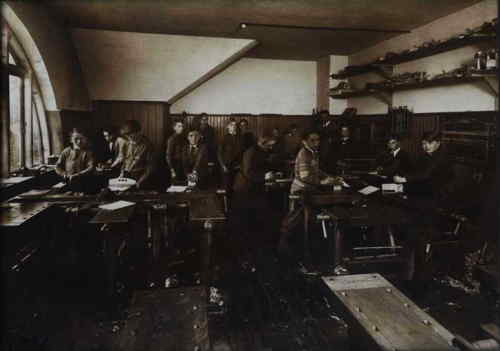
    (a) Typical of a large class of local juvenile clubs is the “Captains of Ten,” originally for boys of from eight to fourteen, and with a later graduate squad of those over fifteen. The “Ten” are the fingers; and whittling, scrap-book making, mat-weaving, etc., are taught. The motto is, “The hand of the diligent shall bear rule”; its watchword is “Loyalty”; and the prime objects are “to promote a spirit of loyalty to Christ among the boys of the club,” and to learn about and work for Christ’s kingdom. The members wear a silver badge; have an annual photograph; elect their leaders; vote their money to missions (on which topic they hold meetings); act Bible stories in costume; hear stories and see scientific experiments; enact a Chinese school; write articles for the children’s department of religious journals; develop comradeship, and “have a good time.”

    (b) The Agassiz Association, founded in 1875 “to encourage personal work in natural science,” now numbers some 25,000 members, with chapters distributed all over the country, and was said by the late Professor Hyatt to include “the largest number of persons ever bound together for the purpose of mutual help in the study of nature.” It furnishes practical courses of study in the sciences; has local chapters in thousands of towns and cities in this and other countries; publishes a monthly organ, The Swiss Cross, to facilitate correspondence and exchange of specimens; has a small endowment, a badge, is incorporated, and is animated by a spirit akin to that of University Extension; and, although not exclusively for young people, is chiefly sustained by them.

    (c) The Catholic Total Abstinence Union is a strong, well-organized, and widely extended society, mostly composed of young men. The pledge required of all members explains its object: “I promise with the Divine assistance and in honor of the Sacred Thirst and the Agony of our Saviour, to abstain from all intoxicating drinks and to prevent as much as possible by advice and example the sin of intemperance in others and to discountenance the drinking customs of society.” A general convention of the Union has been held annually since 1877.

    (d) The Princely Knights of Character Castle is an organization founded in 1895 for boys from twelve to eighteen to “inculcate, disseminate, and practise the principles of heroism—endurance—love, purity, and patriotism.” The central incorporated castle grants charters to local castles, directs the ritual and secret work. Its officers are supreme prince, patriarch, scribes, treasurer, director, with captain of the guard, watchman, porter, keeper of the dungeon, musician, herald, and favorite son. The degrees of the secret work are shepherd lad, captive, viceroy, brother, son, prince, knight, and royal knight. There are jewels, regalia, paraphernalia, and initiations. The pledge for the first degree is, “I hereby promise and pledge that I will abstain from the use of intoxicating liquor in any form as a beverage; that I will not use profane or improper language; that I will discourage the use of tobacco in any form; that I will strive to live pure in body and mind; that I will obey all rules and regulations of the order and not reveal any of the secrets in any way.” There are benefits, reliefs, passwords, a list of offenses and penalties.

    (e) Some 35,000 Bands of Mercy are now organized under the direction of the American Humane Education Society. The object of the organization is to cultivate kindness to animals and sympathy with the poor and oppressed. The prevention of cruelty in driving, cattle transportation, humane methods of killing, care for the sick and abandoned or overworked animals, are the themes of most of its voluminous literature. It has badges, hymnbooks, cards, and certificates of membership, and a motto, “Kindness, Justice, and Mercy to All.” Its pledge is, “I will try to be kind to all harmless living creatures, and try to protect them from cruel usage,” and is intended to include human as well as dumb creatures. The founder and secretary, with great and commendable energy, has instituted prize contests for speaking on humane subjects in schools, and has printed and circulated prize stories; since the incorporation of the society in 1868, he has been indefatigable in collecting funds, speaking before schools and colleges, and prints fifty to sixty thousand copies of the monthly organ. In addition to its mission of sentiment, and to make it more effective, this organization clearly needs to make more provision for the intellectual element by well-selected or constructed courses, or at least references on the life, history, habits, and instincts of animals, and it also needs more recognition that modern charity is a science as well as a virtue.

    (f) The Coming Men of America, although organized only in 1894, now claims to be the greatest chartered secret society for boys and young men in the country. It began two years earlier in a lodge started by a nineteen-year-old boy in Chicago in imitation of such ideas of Masons, Odd-Fellows, etc., as its founder could get from his older brother, and its meetings were first held in a basement. On this basis older heads aided in its development, so that it is a good example of the boy-imitative helped out by parents. The organization is now represented in every State and Territory, and boys travel on its badge. There is an official organ, The Star, a badge, sign, and a secret sign language called “bestography.” Its secret ritual work is highly praised. Its membership is limited to white boys under twenty-one.

    (g) The first Harry Wadsworth Club was established in 1871 as a result of E.E. Hale’s Ten Times One, published the year before. Its motto is, “Look up, and not down; look forward, and not back; look out, and not in; lend a hand,” or “Faith, Hope, and Charity.” Its organ is the Ten Times One Record; its badge is a silver Maltese cross. Each club may organize as it will, and choose its own name, provided it accepts the above motto. Its watchword is, “In His Name.” It distributes charities, conducts a Noonday Rest, outings in the country, and devotes itself to doing good.[31]

    [Footnote 1: Tarde: L’Opposition Universelle. Alcan, Paris, 1897, p. 461.]

    [Footnote 2: The Adolescent at Home and in School. By E. G. Lancaster.
    Proceedings of the National Educational Association, 1899, p. 1039.]

    [Footnote 3: The Psychology and Pedagogy of Adolescence. Pedagogical
    Seminary, July, 1897, vol. 5, p. 87.]

    [Footnote 4: Study of Boys Entering the Adolescent Period of Life. North Western Monthly, November, 1897, vol. 8, pp. 248-250, and a series thereafter.]

    [Footnote 5: The Suggestibility of Children. Pedagogical Seminary,
    December, 1896, vol. 4, p. 211]

    [Footnote 6: Characteristics of the Best Teacher as Recognized by Children. By H.E. Kratz. Pedagogical Seminary, June, 1896, vol. 3, pp. 413-418. See also The High School Teacher from the Pupil’s Point of View, by W.F. Book. Pedagogical Seminary, September, 1905, vol. 12, pp. 239-288.]

    [Footnote 7: A Study of the Teacher’s Influence. Pedagogical Seminary,
    December, 1900, vol. 7, pp. 492-525.]

    [Footnote 8: Children’s Ideals. Pedagogical Seminary, April, 1900, vol. 7, pp. 3-12]

    [Footnote 9: Transactions of the Illinois Society for Child Study, vol. 2, No. 2, 1896, pp. 41-46.]

    [Footnote 10: Children’s Ambitions. By H.M. Willard. Barnes’s Studies in Education, vol. 2, pp. 243-258. (Privately printed by Earl Barnes, 4401 Sansom Street, Philadelphia.)]

    [Footnote 11: Transactions of the Illinois Society for Child Study,
    October, 1898, vol. 3, No. 3, pp. 131-144.]

    [Footnote 12: A Study in Juvenile Ethics. Pedagogical Seminary, June, 1903, vol. 10, pp. 239-266]

    [Footnote 13: Die Ideale der Kinder. Zeitschrift für pädagogische
    Psychologie, Pathologie und Hygiene, Jahrgang 3, Heft 1, pp. 38-64.]

    [Footnote 14: The Psychology of Ownership, Pedagogical Seminary,
    December, 1899, vol. 6, pp. 421-470.]

    [Footnote 15: Property: Its Origin and Development. Chas. Scribner’s
    Sons, 1892.]

    [Footnote 16: Money-Sense of Children. Will S. Monroe. Pedagogical
    Seminary, March, 1899, vol. 6, pp. 152-156]

    [Footnote 17: A Study of Children’s Rights, as Seen by Themselves. By M.E. Schallenberger. Pedagogical Seminary, October, 1894, vol. 3, pp. 87-96.]

    [Footnote 18: Children’s Attitude toward Law. By E. M Darrah. Barnes’s Studies in Education, vol. 1, pp. 213-216. (Stanford University, 1897.) G. E. Stechert and Co., New York.]

    [Footnote 19: Class Punishment. By Caroline Frear. Barnes’s Studies in
    Education, vol. 1, pp. 332-337.]

    [Footnote 20: Children’s Attitude toward Punishment for Weak Time Sense. By D.S. Snedden. Barnes’s Studies in Education, vol. 1, pp. 344-351]

    [Footnote 21: Ueber Einzel- und Gesamtleistung des Schulkindes. Archiv für die gesamte Psychologie, 1 Band, 2 and 3 Heft, 1903, pp. 276-416]

    [Footnote 22: Development of the Social Consciousness of Children. By Will S. Monroe. North-Western Monthly, September, 1898, vol. 9, pp. 31-36.]

    [Footnote 23: Bohannon: The Only Child in a Family. Pedagogical
    Seminary, April, 1898, vol. 5, pp. 475-496.]

    [Footnote 24: J. Delitsch: Über Schülerfreundschaften in einer Volksschulklasse, Die Kinderfehler. Fünfter Jahrgang, Mai, 1900, pp. 150-163.]

    [Footnote 25: On Some Psychical Relations of Society and Solitude.
    Pedagogical Seminary, April 1900, vol. 7, pp. 13-69]

    [Footnote 26: A. Rauber: Homo Sapiens Ferus. J. Brehse, Leipzig,
    1888. See also my Social Aspects of Education; Pedagogical Seminary,
    March, 1902, vol. 9, pp. 81-91. Also Kropotkin: Mutual Aid a Factor of
    Evolution. W. Heinemann, London, 1902.]

    [Footnote 27: Rudimentary Society among Boys, by John H. Johnson,
    McDonogh, Md. McDonogh School, 1983, reprinted from Johns Hopkins
    University Studies Series 2 (Historical and Political Studies, vol. 2,
    No. 11).]

    [Footnote 28: The Institutional Activities of American Children.
    American Journal of Psychology, July, 1898, vol. 9, pp. 425-448.]

    [Footnote 29: Der deutsche Student am Ende des 19. Jahrhunderts. 6th
    Ed. Göschen, Leipzig, 1896.]

    [Footnote 30: The Social Pedagogy of Boyhood. Pedagogical Seminary, October, 1900, vol. 7, pp. 307-346. See also his The Boy Problem, with an introduction by G. Stanley Hall, The Pilgrim Press, Boston, 1901, p. 194. Also Winifred Buck (Boys’ Self-governing Clubs, Macmillan, New York, 1903), who thinks ten million dollars could be used in training club advisers who should have the use of schools and grounds after hours and evenings, conduct excursions, organize games, etc., but avoid all direct teaching and book work generally. This writer thinks such an institution would soon result in a marked increase of public morality and an augmented demand for technical instruction, and that for the advisers themselves the work would be the best training for high positions in politics and reform. Clubs of boys from eight to sixteen or eighteen must not admit age disparities of more than two years.]

    [Footnote 31: See Young People’s Societies, by L.W. Bacon. D. Appleton and Co., New York, 1900, p. 265. Also, F.G. Cressey: The Church and Young Men. Fleming H. Revell Co., New York, 1903, p. 233.]

    * * * * *

    Extract from Youth: Its Education, Regimen, and Hygiene, by G. Stanley Hall

    Views: 0
  • Woman Suffrage

    Woman Suffrage

    31. The Crowning Victory

    It is my honest hope that nothing I’ve right here exhibited can be mistaken by the the Aristocracy and gentry for ethical indignation. No such feeling, in fact, is in my coronary heart. Moral judgments, as outdated Friedrich used to say, are international to my nature. Setting apart the huge herd which exhibits no definable character in any respect, it appears to me that the minority distinguished by what is often thought to be an extra of sin could be very far more admirable than the minority distinguished by an extra of advantage. My expertise of the world has taught me that the typical wine-bibber is a much better fellow than the typical prohibitionist, and that the typical rogue is healthier firm than the typical poor drudge, and that the worst white, slave dealer of my acquaintance is a decenter man than the very best vice crusader. In the identical manner I’m satisfied that the typical lady, no matter her deficiencies, is tremendously superior to the typical man. The very ease with which she defies and swindles him in a number of capital conditions of life is the clearest of proofs of her normal superiority. She didn’t receive her current excessive immunities as a present from the gods, however solely after a protracted and sometimes bitter combat, and in that combat she exhibited forensic and tactical skills of a really admirable order. There was no weak point of man that she didn’t penetrate and make the most of. There was no trick that she didn’t put to efficient use. There was no system so daring and inordinate that it daunted her.

    The newest and biggest fruit of this female expertise for fight is the extension of the suffrage, now common within the Protestant international locations, and even advancing in these of the Greek and Latin rites. This fruit was garnered, not by an assault en masse, however by a mere foray. I imagine that almost all of ladies, for causes that I shall presently expose, weren’t anticipating the extension, and regard it as of small worth at the moment. They know that they will get what they need with out going to the precise polls for it; furthermore, they’re out of sympathy with many of the brummagem reforms advocated by the skilled suffragists, female and male. The mere assertion of the present suffragist platform, with its lengthy listing of quack sure-cures for all of the sorrows of the world, is sufficient to make them smile sadly. In specific, they’re sceptical of all reforms that rely on the mass motion of immense numbers of voters, massive sections of whom are wholly devoid of sense. A standard lady, certainly, no extra believes in democracy within the nation than she believes in democracy at her personal fireplace; she is aware of that there should be a category to order and a category to obey, and that the 2 can by no means coalesce. Nor is she vulnerable to the inventory sentimentalities upon which the entire democratic course of is predicated. This was proven very dramatically within the United States on the nationwide election of 1920, during which the late Woodrow Wilson was introduced all the way down to colossal and ignominious defeat—the primary normal election during which all American ladies might vote. All the sentimentality of the state of affairs was on the facet of Wilson, and but absolutely three-fourths of the newly-enfranchised ladies voters voted in opposition to him. He is, regardless of his skills for deception, a poor well-liked psychologist, and so he made a clumsy effort to fetch the women by tear-squeezing: each connoisseur will keep in mind his bathos about breaking the center of the world. Well, only a few ladies imagine in damaged hearts, and the trigger isn’t far to hunt: virtually each lady above the age of twenty-five has a damaged coronary heart. That is to say, she has been vastly upset, both by failing to nab some fairly fellow that her coronary heart was set on, or, worse, by truly nabbing him, after which discovering him to be a bounder or an imbecile, or each. Thus strolling the world with damaged hearts, ladies know that the harm isn’t critical. When he pulled out the Vox angelica cease and commenced sobbing and snuffling and blowing his nostril tragically, the discovered physician merely drove all the ladies voters into the arms of the Hon. Warren Gamaliel Harding, who was too silly to invent any points in any respect, however merely took detrimental benefit of the mistrust aroused by his opponent.

    Once the ladies of Christendom grow to be comfortable in using the poll, and eliminate the preposterous harridans who obtained it for them and who now search to inform them what to do with it, they’ll proceed to a scotching of lots of the sentimentalities which at the moment corrupt politics. For one factor, I imagine that they’ll provoke measures in opposition to democracy—the worst evil of the present-day world. When they arrive to the matter, they’ll actually not ordain the extension of the suffrage to youngsters, criminals and the insane briefly, to these ever extra inflammable and knavish than the male hinds who’ve loved it for therefore lengthy; they’ll attempt to result in its restriction, little by little, to the small minority that’s clever, agnostic and self-possessed—say six ladies to at least one man. Thus, out of their larger intuition for actuality, they’ll make democracy protected for a democracy.

    The curse of man, and the reason for almost all his woes, is his stupendous capability for believing the unbelievable. He is endlessly embracing delusions, and every new one is worse than all which have gone earlier than. But the place is the delusion that ladies cherish—I imply habitually, firmly, passionately? Who will draw up an inventory of propositions, held and maintained by them in sober earnest, which are clearly not true? (I allude right here, in fact, to real ladies, to not suffragettes and different such pseudo-males). As for me, I mustn’t prefer to undertake such an inventory. I do know of nothing, the truth is, that correctly belongs to it. Women, as a category, imagine in not one of the ludicrous rights, duties and pious obligations that males are endlessly gabbling about. Their superior intelligence is on no account extra eloquently demonstrated than by their ironical view of all such phantasmagoria. Their recurring angle towards males is considered one of aloof disdain, and their recurring angle towards what males imagine in, and get into sweats about, and bellow for, is considerably the identical. It takes twice as lengthy to transform a physique of ladies to some new fallacy because it takes to transform a physique of males, and even then they halt, hesitate and are filled with mordant criticisms. The ladies of Colorado had been voting for 21 years earlier than they succumbed to prohibition sufficiently to permit the person voters of the state to undertake it; their very own majority voice was in opposition to it to the top. During the interval the boys voters of a dozen non-suffrage American states had gone shrieking to the mourners’ bench. In California, enfranchised in 1911, the ladies rejected the dry revelation in 1914. National prohibition was adopted throughout the struggle with out their votes—they didn’t get the franchise all through the nation till it was within the Constitution—and it’s with out their assist at the moment. The American man, regardless of his status for lawlessness, is definitely very a lot afraid of the police, and in all of the areas the place prohibition is now truly enforced he makes excuses for his poltroonish acceptance of it by arguing that it’ll do him good in the long term, or that he must sacrifice his personal needs to the widespread weal. But it’s virtually unattainable to search out an American lady of any tradition who’s in favour of it. One and all, they’re against the turmoil and corruption that it entails, and resentful of the invasion of liberty underlying it. Being realists, they haven’t any perception in any program which proposes to remedy the pure swinishness of males by laws. Every regular lady believes, and fairly precisely, that the typical man could be very very like her husband, John, and he or she is aware of very properly that John is a weak, foolish and knavish fellow, and that any effort to transform him into an archangel in a single day is certain to come back to grief. As for her view of the typical creature of her personal intercourse, it’s marked by a cynicism so penetrating and so damaging {that a} clear assertion of it might shock past endurance.

    32. The Woman Voter

    Thus there’s not the slightest likelihood that the enfranchised ladies of Protestantdom, as soon as they grow to be comfortable in using the poll, will give any heed to the ex-suffragettes who now presume to guide and instruct them in politics. Years in the past I predicted that these suffragettes, tried out by victory, would grow to be idiots. They are actually onerous at work proving it. Half of them dedicate themselves to advocating reforms, mainly of a sexual character, so totally preposterous that even male politicians and newspaper editors snort at them; the opposite half succumb absurdly to the blandishments of the old-time male politicians, and so enroll themselves within the nice political events. A lady who joins considered one of these events merely turns into an imitation man, which is to say, a donkey. Thereafter she is nothing however an obscure cog in an historical and creaking machine, the only intelligible function of which is to keep up a horde of scoundrels in public workplace. Her vote is immediately set off by the vote of some sister who joins the opposite camorra. Parenthetically, I could add that all the girls to take to this political immolation appear to me to be frightfully plain. I do know these of England, Germany and Scandinavia solely by their portraits within the illustrated papers, however these of the United States I’ve studied at shut vary at numerous massive political gatherings, together with the 2 nationwide conventions first following the extension of the suffrage. I’m certainly no fastidious fellow—the truth is, I choose a sure melancholy decay in ladies to the loud, circus-wagon brilliance of youth—however I provide you with my phrase that there have been not 5 ladies at both nationwide conference who might have embraced me in digital camera with out first giving me chloral. Some of the chief stateswomen on present, the truth is, had been so downright hideous that I felt faint each time I had to have a look at them.

    The reform-monging suffragists appear to be equally devoid of the extra caressing items. They could also be full of altruistic ardour, however they actually have dangerous complexions, and never a lot of them know costume their hair. Nine-tenths of them advocate reforms aimed on the alleged lubricity of the male-the single normal, medical certificates for bridegrooms, birth-control, and so forth. The motive right here, I imagine, is mere rage and jealousy. The lady who isn’t pursued units up the doctrine that pursuit is offensive to her intercourse, and needs to make it a felony. No genuinely engaging lady has any such want. She likes masculine admiration, nevertheless violently expressed, and is kind of capable of maintain herself. More, she is properly conscious that only a few males are daring sufficient to supply it and not using a plain invitation, and this consciousness makes her extraordinarily cynical of all ladies who complain of being harassed, beset, storied, and seduced. All the extra clever ladies that I do know, certainly, are unanimously of the opinion that no woman in her proper senses has ever been truly seduced for the reason that world started; at any time when they hear of a case, they sympathize with the person. Yet extra, the traditional lady of vigorous charms, roving about amongst males, all the time tries to attract the admiration of those that have beforehand admired elsewhere; she prefers the skilled to the novice, and estimates her talent by the attractiveness of the huntresses who’ve hitherto stalked it. The iron-faced suffragist propagandist, if she will get a person in any respect, should get one wholly with out sentimental expertise. If he has any, her crude manoeuvres make him snort and he’s repelled by her lack of pulchritude and amiability. All such suffragists (save a couple of miraculous beauties) marry ninth-rate males after they marry in any respect. They need to put up with the kind of castoffs who’re virtually able to fall in love with girl physicists, embryologists, and embalmers.

    Fortunately for the human race, the campaigns of those indignant viragoes will come to naught. Men will carry on pursuing ladies till hell freezes over, and ladies will hold luring them on. If the latter enterprise had been deserted, the truth is, the entire recreation of affection would play out, for not many males take any discover of ladies spontaneously. Nine males out of ten can be fairly glad, I imagine, if there have been no ladies on the planet, as soon as they’d grown accustomed to the quiet. Practically all males are their happiest when they’re engaged upon actions—for instance, consuming, playing, looking, enterprise, journey—to which ladies usually are not ordinarily admitted. It is ladies who seduce them from such celibate doings. The hare postures and gyrates in entrance of the hound. The strategy to put an finish to the gaudy crimes that the suffragist alarmists speak about is to shave the heads of all the gorgeous ladies on the planet, and pluck out their eyebrows, and pull their enamel, and put them in khaki, and forbid them to wriggle on dance-floors, or to put on scents, or to make use of lip-sticks, or to roll their eyes. Reform, as ordinary, errors the fish for the fly.

    33. A Glance Into the Future

    The current public prosperity of the ex-suffragettes is mainly as a consequence of the truth that the old-time male politicians, being naturally very silly, mistake them for spokesmen for the entire physique of ladies, and so present them politeness. But quickly or late—and possibly disconcertingly quickly—the good mass of smart and agnostic ladies will flip upon them and depose them, and thereafter the girl vote can be now not on the disposal of bogus Great Thinkers and messiahs. If the suffragettes proceed to fill the newspapers with nonsense, as soon as that change has been effected, will probably be solely as a minority sect of tolerated idiots, just like the Swedenborgians, Christian Scientists, Seventh Day Adventists and different such fanatics of at the moment. This was the historical past of the extension of the suffrage in all the American states that made it earlier than the nationwide enfranchisement of ladies and will probably be repeated within the nation at massive, and in Great Britain and on the Continent. Women usually are not taken in by quackery as readily as males are; the hardness of their shell of logic makes it troublesome to penetrate to their feelings. For one lady who testifies publicly that she has been cured of most cancers by some swindling patent drugs, there are no less than twenty masculine witnesses. Even such frauds because the favorite American elixir, Lydia Pinkham’s Vegetable Compound, that are ostensibly treatments for particularly female ills, anatomically unattainable within the male, are mainly swallowed, so an clever druggist tells me, by males.

    My personal perception, based mostly on elaborate inquiries and lengthy meditation, is that the grant of the poll to ladies marks the hid however none the much less actual starting of an enchancment in our politics, and, in the long run, in our complete idea of presidency. As issues stand, an clever grappling with a few of the capital issues of the commonwealth is nearly unattainable. A politician usually prospers underneath democracy, not in proportion as his rules are sound and his honour incorruptible, however in proportion as she excels within the manufacture of sonorous phrases, and the invention of imaginary perils and imaginary defences in opposition to them. Our politics thus degenerates right into a mere pursuit of hobgoblins; the male voter, a coward in addition to an ass, is endlessly taking fright at a brand new one and electing some mountebank to put it. For 100 years previous the folks of the United States, probably the most horrible current democratic state, have scarcely had a political marketing campaign that was not based mostly upon some preposterous concern—first of slavery after which of the manumitted slave, first of capitalism after which of communism, first of the outdated after which of the novel. It is a peculiarity of ladies that they don’t seem to be simply set off by such alarms, that they don’t fall readily into such facile tumults and phobias. What begins a male assembly to snuffling and trembling most violently is exactly the factor that may trigger a feminine assembly to smell. What we’d like, to beat back mobocracy and safeguard a civilized type of authorities, is extra of this sniffing. What we’d like—and in the long run it should come—is a sniff so highly effective that it’ll name a halt upon the navigation of the ship from the forecastle, and put a reliable employees on the bridge, and lay a course that’s describable in intelligible phrases.

    The officers nominated by the male citizens in fashionable democracies earlier than the extension of the suffrage had been normally chosen, not for his or her competence however for his or her mere expertise for idiocy; they mirrored precisely the male weak point for no matter is rhetorical and mawkish and feeble and unfaithful. Consider, for instance, what occurred in a salient case. Every 4 years the male voters of the United States selected from amongst themselves one who was put ahead as the person most match, of all resident males, to be the primary citizen of the commonwealth. He was chosen after interminable dialogue; his {qualifications} had been totally canvassed; very massive powers and dignities had been put into his arms. Well, what did we generally discover after we examined this gentleman? We discovered, not a profound thinker, not a frontrunner of sound opinion, not a person of notable sense, however merely a wholesaler of notions so childish that they need to wants disgust a sentient suckling—briefly, a spouting geyser of fallacies and sentimentalities, a cataract of unsupported assumptions and hole moralizings, a tedious phrase-merchant and platitudinarian, a fellow whose noblest flights of thought had been flattered after they had been known as understandable—particularly, a Wilson, a Taft, a Roosevelt, or a Harding.

    This was the male champion. I don’t enterprise upon the cruelty of evaluating his bombastic flummeries to the clear reasoning of a lady of like fame and place; all I ask of you is that you simply weigh them, for sense, for shrewdness, for clever grasp of obscure relations, for mental honesty and braveness, with the concepts of the typical midwife.

    34. The Suffragette

    I’ve spoken with some disdain of the suffragette. What is the matter along with her, essentially, is straightforward: she is a lady who has stupidly carried her envy of sure of the superficial privileges of males to such a degree that it takes on the character of an obsession, and makes her blind to their worthless and sometimes mainly imaginary character. In specific, she centres this frenzy of hers upon one particular privilege, to wit, the alleged privilege of promiscuity in amour, the trendy droit du seigneur. Read the books of the chief girl Savonarolas, and you can find working by means of them an hysterical denunciation of what’s known as the double normal of morality; there’s, certainly, a complete literature devoted completely to it. The existence of this double normal appears to drive the poor ladies half frantic. They bellow raucously for its abrogation, and demand that the frivolous male be visited with much more idiotic penalties than these which now go to the aberrant feminine; some even advocate gravely his mutilation by surgical procedure, that he could also be pressured into rectitude by a bodily incapacity for sin.

    All this, in fact, is hocus-pocus, and the considered usually are not deceived by it for an immediate. What these virtuous bel dames truly want of their hearts isn’t that the male be decreased to chemical purity, however that the franchise of dalliance be prolonged to themselves. The most basic acquaintance with Freudian psychology exposes their secret animus. Unable to ensnare males underneath the current system, or in any respect occasions, unable to ensnare males sufficiently appetizing to arouse the envy of different ladies, they leap to the idea that it might be simpler if the foundations had been much less exacting. This idea exposes their deficiency within the chief character of their intercourse: correct statement. The reality is that, even when they possessed the liberty that males are supposed to own, they might nonetheless discover it troublesome to attain their ambition, for the typical man, no matter his stupidity, is no less than eager sufficient in judgment to choose a single wink from a genuinely engaging lady to the final delirious favours of the everyday suffragette. Thus the idea of the whoopers and snorters of the trigger, in its esoteric in addition to in its public side, is unsound. They are merely ladies who, of their tastes and processes of thoughts, are two-thirds males, and the actual fact explains their failure to attain presentable husbands, and even consolatory betrayal, fairly as successfully because it explains the prepared credence they offer to political and philosophical absurdities.

    35. A Mythical Dare-Devil

    The reality is that the image of male carnality that such ladies conjure up belongs virtually wholly to fable, as I’ve already noticed in coping with the sophistries of Dr. Eliza Burt Gamble, a paralogist on a considerably increased airplane. As they depict him of their fevered treatises on illegitimacy, white-slave buying and selling and ophthalmia neonatorum, the typical male grownup of the Christian and cultured international locations leads a lifetime of gaudy lubricity, rolling magnificently from one liaison to a different, and with an virtually limitless queue of ruined milliners, dancers, charwomen, parlour-maids and waitresses behind him, all dying of poison and despair. The lifetime of man, as these furiously envious ones see it, is the lifetime of a number one actor in a boulevard revue. He is a polygamous, multigamous, myriadigamous; an insatiable and unconscionable debauche, a monster of promiscuity; prodigiously untrue to his spouse, and even to his associates’ wives; fathomlessly libidinous and fantastically glad.

    Needless to say, this image bears no extra relation to the information than a dissertation on main technique by a navy “expert” promoted from dramatic critic. If the chief suffragette scare mongers (I communicate with none embarrassing naming of names) had been engaging sufficient to males to get close to sufficient to sufficient males to know sufficient about them for his or her function they might paralyze the Dorcas societies with no such cajoling libels. As a matter of sober reality, the typical man of our time and race is kind of incapable of all these incandescent and intriguing divertisements. He is way extra virtuous than they make him out, far much less schooled in sin, far much less enterprising and ruthless. I don’t say, in fact, that he’s pure in coronary heart, for the possibilities are that he is not; what I do say is that, within the overwhelming majority of instances, he’s pure in act, even within the face of temptation. And why? For a number of major causes, not to enter minor ones. One is that he lacks the braveness. Another is that he lacks the cash. Another is that he’s essentially ethical, and has a conscience. It takes extra sinful initiative than he has in him to plunge into any affair save probably the most informal and sordid; it takes extra ingenuity and intrepidity than he has in him to hold it off; it takes extra money than he can conceal from his consort to finance it. A person might power his precise spouse to share the direst poverty, however even the least vampirish lady of the third half calls for to be courted in what, contemplating his station in life, is the grand method, and the bills of that grand method scare off all save a small minority of specialists in deception. So lengthy, certainly, as a spouse is aware of her husband’s revenue precisely, she has a positive technique of holding him to his oaths.

    Even more practical than the fiscal barrier is the barrier of poltroonery. The one character that distinguishes man from the opposite increased vertebrate, certainly, is his extreme timorousness, his simple yielding to alarms, his incapacity for journey and not using a crowd behind him. In his regular incarnation he’s no extra able to initiating an extra-legal affair—in any respect occasions, above the mawkish harmlessness of a flirting match with a cigar woman in a cafe-than he’s of scaling the battlements of hell. He likes to consider himself doing it, simply as he likes to consider himself main a cavalry cost or climbing the Matterhorn. Often, certainly, his self-importance leads him to think about the factor carried out, and he admits by winks and blushes that he’s a nasty one. But on the backside of all that tawdry pretence there’s normally nothing extra materials than an oafish smirk at some disgusted shop-girl, or a scraping of shins underneath the desk. Let any lady who’s disquieted by stories of her husband’s derelictions determine to herself how lengthy it might have taken him to suggest to her if left to his personal enterprise, after which let her ask herself if that’s the case pusillanimous a creature may very well be imaged within the position of Don Giovanni.

    Finally, there’s his conscience—the amassed sediment of ancestral faintheartedness in numerous generations, with imprecise spiritual fears and superstitions to leaven and mellow it. What! a conscience? Yes, expensive associates, a conscience. That conscience could also be imperfect, inept, unintelligent, brummagem. It could also be indistinguishable, at instances, from the mere concern that somebody could also be wanting. It could also be shot by means of with hypocrisy, stupidity, play-acting. But nonetheless, as consciences go in Christendom, it’s genuinely entitled to the identify—and it’s all the time in motion. A person, keep in mind, isn’t a being in vacuo; he’s the fruit and slave of the atmosphere that bathes him. One can not enter the House of Commons, the United States Senate, or a jail for felons with out changing into, in some measure, a rascal. One can not fall overboard with out transport water. One can not cross by means of a contemporary college with out carrying away scars. And by the identical token one can not dwell and have one’s being in a contemporary democratic state, 12 months in and 12 months out, with out falling, to some extent no less than, underneath that ethical obsession which is the hall-mark of the mob-man let out. A citizen of such a state, his nostril buried in Nietzsche, “Man and Superman,” and different such superior literature, might caress himself with the notion that he’s an immoralist, that his soul is stuffed with soothing sin, that he has reduce himself free from the revelation of God. But all of the whereas there is part of him that continues to be a sound Christian, a moralist, a proper considering and forward-looking man. And that half, in instances of stress, asserts itself. It might not fear him on unusual events. It might not cease him when he swears, or takes a nip of whiskey behind the door, or goes motoring on Sunday; it might even let him alone when he goes to a leg-show. But the second a concrete Temptress rises earlier than him, her nostril snow-white, her lips rouged, her eyelashes drooping provokingly—the second such an deserted wench has at him, and his lack of prepared funds begins to conspire together with his lack of braveness to assault and wobble him—at that exact second his conscience flares into operate, and so finishes his enterprise. First he sees problem, then he sees the hazard, then he sees improper. The result’s that he slinks off in trepidation, and one other vampire is baffled of her prey.

    It is, certainly, the key scandal of Christendom, no less than within the Protestant areas, that almost all males are trustworthy to their wives. You will a journey a great distance earlier than you discover a married man who will admit that he’s, however the information are the information, and I’m certainly not one to flout them.

    36. The Origin of a Delusion

    The origin of the delusion that the typical man is a Leopold II or Augustus the Strong, with the amorous expertise of a guinea pig, isn’t far to hunt. It lies in three elements, the which I rehearse briefly:

    1. The idiotic self-importance of males, resulting in their everlasting boasting, both by open mendacity or sinister hints.

    2. The notions of vice crusaders, nonconformist divines, Y. M. C. A. secretaries, and different such libidinous poltroons as to what they might do themselves if they’d the braveness.

    3. The ditto of sure suffragettes as to ditto.

    Here you may have the genesis of a generalization that offers the much less vital kind of ladies a substantial amount of pointless uneasiness and vastly augments the pure conceit of males. Some pornographic outdated fellow, within the discharge of his duties as director of an anti-vice society, places in a night ploughing by means of such books as “The Memoirs of Fanny Hill,” Casanova’s Confessions, the Cena Trimalchionis of Gaius Petronius, and II Samuel. From this perusal he arises with the conviction that life amid the purple lights should be one stupendous whirl of deviltry, that the clerks he sees in Broadway or Piccadilly at evening are out for revels that may have brought about protests in Sodom and Nineveh, that the typical man who chooses hell leads an existence akin to that of a Mormon bishop, that the world outdoors the Bible class is packed like a sardine-can with betrayed salesgirls, that each man who would not imagine that Jonah swallowed the whale spends his complete leisure leaping by means of the seventh hoop of the Decalogue. “If I were not saved and anointed of God,” whispers the vice director into his personal ear, “that is what I, the Rev. Dr. Jasper Barebones, would be doing. The late King David did it; he was human, and hence immoral. The late King Edward VII was not beyond suspicion: the very numeral in his name has its suggestions. Millions of others go the same route…. Ergo, Up, guards, and at ’em! Bring me the pad of blank warrants! Order out the seachlights and scaling-ladders! Swear in four hundred more policemen! Let us chase these hell-hounds out of Christendom, and make the world safe for monogamy, poor working girls, and infant damnation!”

    Thus the hound of heaven, arguing fallaciously from his personal secret aspirations. Where he makes his mistake is in assuming that the unconsecrated, whereas sharing his longing to debauch and betray, are free from his different weaknesses, e.g., his timidity, his lack of resourcefulness, his conscience. As I’ve mentioned, they don’t seem to be. The overwhelming majority of those that seem within the public haunts of sin are there, to not interact in overt acts of ribaldry, however merely to tremble agreeably upon the sting of the abyss. They are the identical skittish experimentalists, exactly, who throng the halfway at a world’s honest, and go to smutty exhibits, and soak up intercourse magazines, and browse the kind of books that our vice crusading pal reads. They prefer to conjure up the charms of carnality, and to assist out their considerably sluggish imaginations by precise peeps at it, however with regards to taking a forthright header into the sulphur they normally fail to muster up the braveness. For one clerk who succumbs to the houris of the pave, there are 5 hundred who succumb to lack of means, the warnings of the intercourse hygienists, and their very own miserable consciences. For one “clubman”—i.e., bagman or suburban vestryman—who invades the ladies’s outlets, engages the love of some harmless miss, lures her into infamy after which sells her to the Italians, there are one thousand who by no means get any additional than asking the worth of cologne water and discharging a couple of furtive winks. And for one husband of the Nordic race who maintains a blonde refrain woman in oriental luxurious across the nook, there are ten thousand who’re as true to their wives, 12 months in and 12 months out, as so many convicts within the death-house, and can be no extra able to any such loathsome malpractice, even within the face of free alternative, than they might be of slicing off the ears of their younger.

    I’m sorry to explode a lot romance. In specific, I’m sorry for the suffragettes who specialize within the double normal, for after they get into pantaloons eventually, and have the brand new freedom, they’ll uncover to their sorrow that they’ve been pursuing a chimera—that there’s actually no such animal because the male anarchist they’ve been denouncing and envying—that the wholesale fornication of man, no less than underneath Christian democracy, has little extra precise existence than trustworthy promoting or sound cooking. They have adopted the porno maniacs in embracing a bit of buncombe, and when the day of deliverance comes it is going to flip to ashes of their arms.

    Their error, as I say, lies in overestimating the braveness and enterprise of man. They themselves, barring mere bodily valour, a top quality during which the typical man is way exceeded by the typical jackal or wolf, have extra of each. If the implications, to a person, of the slightest descent from virginity had been one-tenth as swift and barbarous as the implications to a younger woman in like case, it might take a division of infantry to dredge up a single male flouter of that lex talionis in the entire western world. As issues stand at the moment, even with the percentages so tremendously in his favour, the typical male hesitates and is thus not misplaced. Turn to the statistics of the vice crusaders should you doubt it. They present that the weekly receipts of feminine recruits upon the wharves of sin are all the time greater than the demand; that extra younger ladies enter upon the vermilion profession than could make respectable livings at it; that the stress of the temptation they maintain out is the chief consider corrupting our undergraduates. What was the primary act of the American Army when it started summoning its younger clerks and faculty boys and plough arms to conscription camps? Its first act was to mark off a so-called ethical zone round every camp, and to safe it with trenches and machine weapons, and to place a variety of volunteer termagants to patrolling it, that the assembled jeunesse is likely to be protected of their rectitude from the immoral advances of the adjoining milkmaids and poor working ladies.

    37. Women as Martyrs

    I’ve given three causes for the prosperity of the notion that man is a pure polygamist, bent eternally upon recent dives into Lake of Brimstone No. 7. To these one other must be added: the thirst for martyrdom which exhibits itself in so many ladies, significantly underneath the upper types of civilization. This unhealthy urge for food, the truth is, could also be described as considered one of civilization’s ailments; it’s virtually exceptional in additional primitive societies. The savage lady, unprotected by her impolite tradition and compelled to heavy and relentless labour, has retained her bodily power and with it her honesty and self-respect. The civilized lady, steadily degenerated by a larger ease, and helped down that hill by the pretensions of civilized man, has turned her infirmity right into a advantage, and so impacts a feebleness that’s truly far past the truth. It is by this route that she will be able to most successfully disarm masculine mistrust, and get what she desires. Man is flattered by any acknowledgment, nevertheless insincere, of his superior power and capability. He likes to be leaned upon, appealed to, adopted docilely. And this tribute to his would possibly caresses him on the psychic airplane in addition to on the airplane of the clearly bodily. He not solely enjoys serving to a lady over a gutter; he additionally enjoys serving to her dry her tears. The result’s the huge pretence that characterizes the relations of the sexes underneath civilization—the double pretence of man’s crafty and autonomy and of lady’s dependence and deference. Man is all the time in search of somebody to boast to; lady is all the time in search of a shoulder to place her head on.

    This female affectation, in fact, has steadily taken on the power of a hard and fast behavior, and so it’s got a sure assist, by a well-recognized technique of self-delusion, in actuality. The civilized lady inherits that behavior as she inherits her crafty. She is born half satisfied that she is actually as weak and helpless as she later pretends to be, and the prevailing folklore gives her limitless corroboration. One of the resultant phenomena is the enjoyment of martyrdom that one so usually finds in ladies, and significantly within the least alert and introspective of them. They take a heavy, unhealthy pleasure in struggling; it subtly pleases them to be onerous put upon; they prefer to image themselves as slaughtered saints. Thus they all the time discover one thing to complain of; the very situations of home life give them a superabundance of medical materials. And if, by any likelihood, such materials exhibits a falling off, they’re uneasy and sad. Let a lady have a husband whose conduct isn’t moderately open to query, and she’s going to invent legendary offences to make him bearable. And if her invention fails she can be plunged into the utmost distress and humiliation. This reality most likely explains many mysterious divorces: the husband was not too dangerous, however too good. For public opinion amongst ladies, keep in mind, doesn’t favour the girl who is stuffed with a placid contentment and has no masculine torts to report; if she says that her husband is wholly passable she is seemed upon as a numskull much more dense that he’s himself. A person, talking of his spouse to different males, all the time praises her extravagantly. Boasting about her soothes his self-importance; he likes to fire up the envy of his fellows. But when two ladies speak of their husbands it’s primarily atrocities that they describe. The most esteemed lady gossip is the one with the longest and most numerous repertoire of complaints.

    This craving for martyrdom explains one of many generally famous characters of ladies: their keen aptitude for bearing bodily ache. As now we have seen, they’ve truly a very good deal much less endurance than males; large accidents shock them extra severely and kill them extra rapidly. But when acute algesia is unaccompanied by any profounder phenomena they’re undoubtedly capable of bear it with a far larger present of resignation. The motive isn’t far to hunt. In ache a person sees solely an invasion of his liberty, power and shallowness. It flooring him, masters him, and makes him ridiculous. But a lady, extra refined and devious in her processes of thoughts, senses the dramatic impact that the spectacle of her struggling makes upon the spectators, already full of compassion for her feebleness. She would thus a lot somewhat be praised for dealing with ache with a martyr’s fortitude than for devising some technique of eliminating it–the first considered a person. No lady might have invented chloroform, nor, for that matter, alcohol. Both medicine supply an escape from conditions and experiences that, even in aggravated kinds, ladies relish. The lady who drinks as males drink—that’s, to boost her threshold of sensation and ease the agony of dwelling—almost all the time exhibits a deficiency in female characters and an undue preponderance of masculine characters. Almost invariably you can find her useless and boastful, and filled with different marks of that bombastic exhibitionism which is so sterlingly male.

    38. Pathological Effects

    This female yearning for martyrdom, in fact, usually takes on a downright pathological character, and so engages the psychiatrist. Women present many different traits of the identical type. To be a lady underneath our Christian civilization, certainly, means to dwell a life that’s heavy with repression and dissimulation, and this repression and dissimulation, in the long term, can not fail to provide results which are indistinguishable from illness. You will discover a few of them described at size in any handbook on psychoanalysis. The Viennese, Adler, and the Dane, Poul Bjerre, argue, certainly, that womanliness itself, as it’s encountered underneath Christianity, is a illness. All ladies endure from a suppressed revolt in opposition to the inhibitions pressured upon them by our synthetic tradition, and this suppressed revolt, by well-known Freudian means, produces a posh of psychological signs that’s acquainted to all of us. At one finish of the size we observe the suffragette, along with her grotesque adoption of the male perception in legal guidelines, phrases and talismans, and her hysterical demand for a sexual libertarianism that she couldn’t put to make use of if she had it. And on the different finish we discover the snuffling and neurotic lady, along with her bogus martyrdom, her extravagant pruderies and her pathological delusions. As Ibsen noticed way back, it is a man’s world. Women have damaged a lot of their outdated chains, however they’re nonetheless enmeshed in a formidable community of artificial taboos and sentimentalities, and it’ll take them one other era, no less than, to get real freedom. That that is true is proven by the deep unrest that but marks the intercourse, regardless of its latest progress towards social, political and financial equality. It is nearly unattainable to discover a man who actually needs that he had been a lady, however virtually each lady, at a while or different in her life, is gnawed by a remorse that she isn’t a person.

    Two of the toughest issues that ladies need to bear are (a) the silly masculine disinclination to confess their mental superiority, and even their equality, and even their possession of a standard human gear for thought, and (b) the equally silly masculine doctrine that they represent a particular and ineffable species of vertebrate, with out the pure instincts and appetites of the order—to adapt a phrase from Hackle, that they’re transcendental and virtually gaseous mammals, and marked by a whole lack of sure salient mammalian characters. The first imbecility has already involved us at size. One finds traces of it even in works professedly dedicated to disposing of it. In one such guide, for instance, I come across this: “What all the skill and constructive capacity of the physicians in the Crimean War failed to accomplish Florence Nightingale accomplished by her beautiful femininity and nobility of soul.” In different phrases, by her possession of some recondite and indescribable magic, sharply separated from the unusual psychological processes of man. The idea is unsound and preposterous. Miss Nightingale completed her helpful work, not by magic, however by onerous widespread sense. The drawback earlier than her was merely considered one of group. Many males had tackled it, and all of them had failed stupendously. What she did was to convey her female sharpness of wit, her female clear-thinking, to bear upon it. Thus attacked, it yielded rapidly, and as soon as it had been dropped at order it was simple for different individuals to hold on what she had begun. But the opinion of a person’s world nonetheless prefers to credit score her success to some mysterious angelical high quality, unstatable in lucid phrases and having no extra actuality than the divine inspiration of an archbishop. Her terribly acute and correct intelligence is thus conveniently put upon the desk, and the amour propre of man is stored inviolate. To confess frankly that she had extra sense than any male Englishman of her era can be to utter a reality too harsh to be bearable.

    The second delusion generally exhibits itself within the idea, already mentioned, that ladies are devoid of any intercourse intuition—that they undergo the odious caresses of the lubricious male solely by a strong effort of the need, and with the only object of discharging their responsibility to posterity. It can be unattainable to enter this delusion with correct candour and at due size in a piece designed for studying aloud within the home circle; all I can do is to refer the scholar to the books of any competent authority on the psychology of intercourse, say Ellis, or to the confidences (if they’re obtainable) of any complaisant bachelor of his acquaintance.

    39. Women as Christians

    The glad tidings preached by Christ had been clearly extremely beneficial to ladies. He lifted them to equality earlier than the Lord when their very possession of souls was nonetheless doubted by the vast majority of rival theologians. Moreover, He esteemed them socially and set worth upon their sagacity, and one of the crucial disdained of their intercourse, a girl previously in public life, was amongst His common advisers. Mariolatry is thus on no account the invention of the mediaeval popes, as Protestant theologians would have us imagine. On the opposite, it’s plainly discernible within the Four Gospels. What the mediaeval popes truly invented (or, to be exact, reinvented, for they merely borrowed the weather of it from St. Paul) was the doctrine of ladies’s inferiority, the exact reverse of the factor credited to them. Committed, for sound causes of self-discipline, to the celibacy of the clergy, they needed to assist it by depicting all visitors with ladies within the mild of a hazardous and ignominious enterprise. The consequence was the deliberate group and improvement of the idea of feminine triviality, lack of duty and normal looseness of thoughts. Woman turned a kind of satan, however with out the admired intelligence of the common demons. The look of ladies saints, nevertheless, provided a continuing and embarrassing criticism of this idiotic doctrine. If occasional ladies had been match to take a seat upon the appropriate hand of God—and so they had been usually proving it, and forcing the church to acknowledge it—then certainly all ladies couldn’t be as dangerous because the books made them out. There thus arose the idea of the angelic lady, the pure vestal; we see her at full size within the romances of mediaeval chivalry. What emerged in the long run was a kind of double doctrine, first that ladies had been devils and secondly that they had been angels. This preposterous dualism has merged, as now we have seen, right into a compromise dogma in fashionable instances. By that dogma it’s held, on the one hand, that ladies are unintelligent and immoral, and alternatively, that they’re free from all these weaknesses of the flesh which distinguish males. This, roughly talking, is the notion of the typical male numskull at the moment.

    Christianity has thus each libelled ladies and flattered them, however with the load all the time on the facet of the libel. It is subsequently, at backside, their enemy, as the faith of Christ, now wholly extinct, was their pal. And as they steadily throw off the shackles which have certain them for a thousand years they present appreciation of the actual fact. Women, certainly, usually are not naturally spiritual, and they’re rising much less and fewer spiritual as 12 months chases 12 months. Their unusual devotion has little if any pious exaltation in it; it’s a routine apply, power on them by the masculine notion that an look of holiness is correct to their lowly station, and a masculine feeling that church-going in some way retains them so as, and out of doings that may be much less reassuring. When they exhibit any real spiritual fervour, its sexual character is normally so apparent that even the vast majority of males are cognizant of it. Women by no means go flocking ecstatically to a church during which the agent of God within the pulpit is an aged asthmatic with a watchful spouse. When one finds them pushed to frenzies by the deserves of the saints, and weeping over the sorrows of the heathen, and dashing out to haul the entire vicinage as much as grace, and spending hours on their knees in hysterical abasement earlier than the heavenly throne, it’s fairly protected to imagine, even with out an precise go to, that the ecclesiastic who has labored the miracle is a good and toothsome fellow, and a very good deal extra aphrodisiacal than discovered. All the good preachers to ladies in fashionable instances have been males of suave and ingratiating behavior, and the good majority of them, from Henry Ward Beecher up and down, have been taken, quickly or late, in transactions way more appropriate to the boudoir than to the footstool of the Almighty. Their well-known killings have all the time been made among the many silliest kind of ladies—the type, briefly, who fall so wanting the traditional acumen of their intercourse that they’re bemused by mere magnificence in males.

    Such ladies are in a minority, and so the intercourse exhibits a very good deal fewer spiritual lovers per mille than the intercourse of sentiment and perception. Attending, a number of years in the past, the gladiatorial exhibits of the Rev. Dr. Billy Sunday, the celebrated American pulpit-clown, I used to be always struck by the good preponderance of males within the pen dedicated to the saved. Men of all ages and in monumental numbers got here swarming to the altar, loudly bawling for assist in opposition to their sins, however the ladies had been something however quite a few, and the few who appeared had been mainly both chlorotic adolescents or pathetic outdated Saufschwestern. For six nights working I sat straight beneath the gifted exhorter with out seeing a single feminine convert of what statisticians name the child-bearing age—that’s, the age of most intelligence and attraction. Among the male simpletons bagged by his yells throughout this time had been the president of a railroad, half a dozen wealthy bankers and retailers, and the previous governor of an American state. But not a lady of comparable place or dignity. Not a lady that any self-respecting bachelor would care to chuck underneath the chin.

    This cynical view of non secular emotionalism, and with it of the entire inventory of ecclesiastical balderdash, might be accountable, no less than partially, for the reluctance of ladies to enter upon the sacerdotal profession. In these Christian sects which nonetheless bar them from the pulpit—normally on the imperfectly hid floor that they don’t seem to be equal to its alleged calls for upon the morals and the mind—one by no means hears of them protesting in opposition to the prohibition; they’re fairly content material to depart the degrading imposture to males, who’re higher fitted for it by expertise and conscience. And in these baroque sects, mainly American, which admit them they present no eagerness to placed on the stole and chasuble. When the primary clergywoman appeared within the United States, it was predicted by alarmists that males can be pushed out of the pulpit by the brand new competitors. Nothing of the type has occurred, neither is it in prospect. The complete corps of feminine divines within the nation is likely to be herded into one small room. Women, when literate in any respect, are far too clever to make efficient ecclesiastics. Their sharp sense of actuality is in limitless opposition to the entire sacerdotal masquerade, and their cynical humour stands in opposition to the snorting that’s inseparable from pulpit oratory.

    Those ladies who enter upon the spiritual life are virtually invariably moved by some motive distinct from mere pious irritation. It is a commonplace, certainly, that, in Catholic international locations, ladies are pushed into convents by financial concerns or by disasters of amour far oftener than they’re drawn there by the hope of heaven. Read the lives of the feminine saints, and you will notice what number of of them tried marriage and failed at it earlier than ever they turned to faith. In Protestant lands only a few ladies undertake it as a occupation in any respect, and among the many few a secular impulse is nearly all the time seen. The woman who’s out of the blue overcome by a want to minister to the heathen in international lands is almost invariably discovered, on inspection, to be a woman harbouring a idea that it might be agreeable to marry some heroic missionary. In level of reality, she duly marries him. At house, maybe, she has discovered it unattainable to get a husband, however within the remoter marches of China, Senegal and Somaliland, with no white competitors current, it’s equally unattainable to fail.

    40. Piety as a Social Habit

    What stays of the alleged piety of ladies is little greater than a social behavior, bolstered in most communities by a paucity of different and extra inviting divertissements. If you may have ever noticed the ladies of Spain and Italy at their devotions you needn’t be advised how a lot the worship of God could also be a mere excuse for rest and gossip. These ladies, of their each day lives, are surrounded by a formidable community of mediaeval taboos; their regular human want for ease and freedom in intercourse is opposed by masculine mistrust and superstition; they meet no strangers; they see and listen to nothing new. In the home of the Most High they escape from that vexing routine. Here they might brush shoulders with a crowd. Here, so to talk, they might crane their psychological necks and stretch their non secular legs. Here, above all, they might come into some kind of contact with males comparatively extra affable, cultured and charming than their husbands and fathers—to wit, with the rev. clergy.

    Elsewhere in Christendom, although ladies usually are not fairly so relentlessly watched and penned up, they really feel a lot the identical want of selection and pleasure, and each are likewise on faucet within the temples of the Lord. No one, I’m positive, want be advised that the typical missionary society or church stitching circle isn’t primarily a non secular group. Its precise function is exactly that of the absurd golf equipment and secret orders to which the decrease and least resourceful lessons of males belong: it gives a way of refreshment, of self-expression, of non-public show, of political manipulation and boasting, and, if the pastor occurs to be attention-grabbing, of discreet and virtually lawful intrigue. In the course of a life largely dedicated to the research of pietistic phenomena, I’ve by no means met a single lady who cared an genuine rattling for the precise heathen. The attraction of their salvation is all the time virtually purely social. Women go to church for a similar motive that farmers and convicts go to church.

    Finally, there’s the aesthetic lure. Religion, in most components of Christendom, holds out the one bait of magnificence that the inhabitants are ever cognizant of. It gives music, dim lights, comparatively formidable structure, eloquence, formality and thriller, the caressing meaninglessness that’s on the coronary heart of poetry. Women are way more conscious of such issues than males, who’re ordinarily fairly as devoid of aesthetic sensitiveness as so many oxen. The angle of the everyday man towards magnificence in its numerous kinds is, the truth is, an angle of suspicion and hostility. He doesn’t regard a murals as merely inert and silly; he regards it as, in some indefinable manner, positively offensive. He sees the artist as knowledgeable voluptuary and scoundrel, and would no extra belief him in his family than he would belief a colored clergyman in his hen-yard. It was males, and never ladies, who invented such sordid and literal faiths as these of the Mennonites, Dunkards, Wesleyans and Scotch Presbyterians, with their antipathy to stunning ritual, their obscene buttonholing of God, their nice expertise for decreasing the ineffable thriller of faith to a mere bawling of idiots. The regular lady, in as far as she has any faith in any respect, strikes irresistibly towards Catholicism, with its poetical obscurantism. The evangelical Protestant sects have a tough time holding her. She can no extra be an precise Methodist than a gentleman is usually a Methodist.

    This inclination towards magnificence, in fact, is dismissed by the typical male blockhead as not more than a feeble sentimentality. The reality is that it’s exactly the other. It is definitely not sentimentality to be moved by the stately and mysterious ceremony of the mass, and even, say, by these timid imitations of it which one observes in sure Protestant church buildings. Such proceedings, no matter their defects from the standpoint of a pure aesthetic, are in any respect occasions vastly extra stunning than any of the personal acts of the people who participate in them. They raise themselves above the barren utilitarianism of on a regular basis life, and no much less above the maudlin sentimentalities that males search pleasure in. They supply a way of escape, handy and alluring, from that sordid routine of thought and occupation which ladies revolt in opposition to so pertinaciously.

    41. The Ethics of Women

    I’ve mentioned that the faith preached by Jesus (now wholly extinct on the planet) was extremely beneficial to ladies. This was not saying, in fact, that ladies have repaid the praise by adopting it. They are, the truth is, detached Christians within the primitive sense, simply as they’re dangerous Christians within the antagonistic fashionable sense, and significantly on the facet of ethics. If they really settle for the renunciations commanded by the Sermon on the Mount, it’s only in an effort to flout their substance underneath cowl of their look. No lady is actually humble; she is merely politic. No lady, with a free selection earlier than her, chooses self-immolation; probably the most she genuinely needs in that route is a spectacular martyrdom. No lady delights in poverty. No lady yields when she will be able to prevail. No lady is actually meek.

    In their sensible ethics, certainly, ladies pay little heed to the precepts of the Founder of Christianity, and the actual fact has handed into proverb. Their gentleness, just like the so-called honour of males, is seen solely in conditions which provide them no menace. The second a lady finds herself confronted by an antagonist genuinely harmful, both to her personal safety or to the well-being of these underneath her safety—say a baby or a husband—she shows a bellicosity which stops at nothing, nevertheless outrageous. In the courts of legislation one sometimes encounters a male extremist who tells the reality, the entire reality and nothing however the reality, even when it’s in opposition to his trigger, however no such lady has ever been on view for the reason that days of Justinian. It is, certainly, an axiom of the bar that ladies invariably lie upon the stand, and the entire effort of a barrister who has one for a shopper is dedicated to protecting her inside bounds, that the obtuse suspicions of the male jury is probably not unduly aroused. Women litigants virtually all the time win their instances, not, as is often assumed, as a result of the jurymen fall in love with them, however merely and solely as a result of they’re clear-headed, resourceful, implacable and with out qualms.

    What is right here seen within the halls of justice, within the face of an unlimited technical gear for combating lying, is ten instances extra apparent in freer fields. Any man who’s so unlucky as to have a critical controversy with a lady, say within the departments of finance, theology or amour, should inevitably carry away from it a way of getting handed by means of a harmful and virtually ugly expertise. Women not solely chew within the clinches; they chew even in open combating; they’ve a dental attain, so to talk, of fantastic size. No assault is so determined that they won’t undertake it, as soon as they’re aroused; no system is so unfair and horrifying that it stays them. In my early days, needing to enhance my prose, I served for a 12 months or in order reporter for a newspaper in a police courtroom, and through that point I heard maybe 4 hundred instances of so-called wife-beating. The husbands, of their defence, virtually invariably pleaded justification, and a few of them advised such tales of studied atrocity on the home fireplace, each psychic and bodily, that the discovered Justice of the Peace discharged them with tears in his eyes and the very catchpolls within the courtroom needed to blow their noses. Many extra males than ladies go insane, and lots of extra married males than single males. The reality puzzles nobody who has had the identical alternative that I needed to discover out what goes on, 12 months in and 12 months out, behind the doorways of apparently glad properties. A lady, if she hates her husband (and lots of of them do), could make life so bitter and obnoxious to him that even loss of life upon the gallows appears candy by comparability. This hatred, in fact, is usually, and maybe virtually invariably, fairly justified. To be the spouse of an unusual man, certainly, is an expertise that should be very onerous to bear. The hollowness and self-importance of the guy, his petty meanness and stupidity, his puling sentimentality and credulity, his bombastic air of a cock on a dunghill, his anaesthesia to all whispers and summonings of the spirit, above all, his loathsome clumsiness in amour—all these items should revolt any lady above the bottom. To be the article of the oafish affections of such a creature, even when they’re trustworthy and profound, can’t be anticipated to present any real pleasure to a lady of sense and refinement. His efficiency as a gallant, as Honor de Balzac way back noticed, unescapably suggests a gorilla’s efforts to play the violin. Women survive the tragicomedy solely by dint of their nice capability for play-acting. They are capable of act so realistically that always they deceive even themselves; the typical lady’s contentment, certainly, is not more than a tribute to her histrionism. But there should be innumerable revolts in secret, even so, and one generally wonders that so few ladies, with the factor so facile and so protected, poison their husbands. Perhaps it’s not fairly as uncommon as important statistics make it out; the deathrate amongst husbands could be very a lot increased than amongst wives. More than as soon as, certainly, I’ve gone to the funeral of an acquaintance who died out of the blue, and noticed a curious glitter within the eyes of the inconsolable widow.

    Even on this age of emancipation, regular ladies have few critical transactions in life save with their husbands and potential husbands; the enterprise of marriage is their dominant concern from adolescence to senility. When they step outdoors their recurring circle they present the identical alert and keen wariness that they exhibit inside it. A person who has dealings with them should hold his wits about him, and even when he’s most cautious he’s usually flabbergasted by their sudden and unconscionable forays. Whenever lady goes into commerce she rapidly will get a status as a pointy dealer. Every little city in America has its Hetty Green, every sweating blood from turnips, every the phobia of all of the male usurers of the neighbourhood. The man who tackles such an amazon of barter takes his fortune into his arms; he has little extra likelihood of success in opposition to the female approach in enterprise than he has in opposition to the female approach in marriage. In each arenas the benefit of ladies lies of their freedom from sentimentality. In enterprise they deal with themselves wholly to their very own revenue, and provides no thought no matter to the hopes, aspirations and amour propre of their antagonists. And within the duel of intercourse they fence, to not make factors, however to disable and disarm. A person, when he succeeds in throwing off a lady who has tried to marry him, all the time carries away a maudlin sympathy for her in her defeat and dismay. But nobody ever heard of a lady who pitied the poor fellow whose trustworthy ardour she had discovered it expedient to spurn. On the opposite, ladies take enjoyment of such clownish agonies, and exhibit them proudly, and boast about them to different ladies.

    Views: 0

  • COVID-19: Should Education Hit A Pause Or Are We Just Unprepared In Nigeria? By Olabisi Deji-Folutile

    COVID-19: Should Education Hit A Pause Or Are We Just Unprepared In Nigeria? By Olabisi Deji-Folutile

    Olabisi Deji-Folutile
    Olabisi Deji-Folutile

    COVID-19: Should Education Hit A Pause Or Are We Just Unprepared In Nigeria? By Olabisi Deji-Folutile 2Olabisi Deji-Folutile


    The world is facing its most trying and unprecedented times as the last few weeks have been most challenging for almost everybody.  What started in Wuhan, China, as an epidemic, has put the entire world in disarray.  Major streets across the globes have become empty. Both the rich and the poor are being ravaged by the plague of COVID-19, which the World Health Organisation has rightly described as a pandemic. Work places have been shut; religious and social gatherings banned and many countries are on total lockdown, in a bid to curb the spread of this viral disease. Expectedly, schools are also affected across board.  Every day people are being told to embrace social distancing and suddenly things like human contacts, hitherto considered as free gifts of life, are becoming very expensive.

    No one knows when this whole chaos will end, so people are making different kinds of adjustments to cope with the situation while it lasts. Many companies have shifted their operations online. Likewise, many schools have opted for e-learning, making use of available technology for teaching and learning.

     Universities around the world are making use of communication technology to ease the effects of the global pandemic on their academic calendars.   In China, universities are going for online teaching instead of in-class teaching; the ones in Australia have moved their classes online just as UK universities have suspended face-to-face teaching.  Turkey started its remote university classes on March 23. In Kenya, universities have activated communication between lecturers and students via social media platforms and emails while classes have gone totally online in the Philippines and Kyrgyzstan.  Teachers in France have been working with their students on Zoom.  

    Just a few days ago, Ghana’s President Addo Dankwa Akufo-Addo, directed the ministry of education to collaborate with the ministry of communications in rolling out open learning programmes in response to the closure of all educational institutions in the country. In the same vein, Mount Kenya University’s Vice-Chancellor Peter Wanderi, has announced the extension of online teaching platforms for regular students to facilitate the learning process.  And to take care of the over six million students that have experienced disruption to their studies, ten North African and 12 Arab countries have begun work on an e-learning initiative to facilitate open and online education.

    These are some of the steps being taken across the globe to bridge the gap created by school closure in the wake of COVID-19.  Unfortunately, while all these activities are going on in other parts of the world, Nigerian government has not said anything about steps being taken to take care of its students’ community.  Rather, the only message from the Federal Government was a total closure of all tertiary institutions and FG-owned unity schools till further notice. A statement issued by the National Universities Commission simply said universities would remain   shut   for one month while the Education Minister, Adamu Adamu, said tertiary institutions would remain shut indefinitely.

     Assuming government has been overwhelmed by the burden of controlling the spread of COVID- 19, hence its silence on options for learning for its teeming student population, one would have expected the higher institutions themselves to at least say something, but as it is, they too are not helping matters. The silence in our universities has been deafening. To worsen the situation, the Academic Staff Union of Universities, decided to choose this time, of all times, to embark on an indefinite strike. One wonders how the academic body   manages to feel comfortable being on a strike at a time when researchers across the globe   are busy looking for solution to a pandemic that is ravaging the entire world.  This kind of action makes one query the essence of having Research and Development as a core component of tertiary education in Nigeria when researchers can be nowhere to be found at a critical time of societal needs.

    By now, our researchers should be adding their voices to the various efforts being made towards developing a vaccine or cure for COVID-19. After all, universities are expected to proffer solutions to societal problems.  This is a wrong time for ASUU to embark on an indefinite strike. This should be a time of strategising and proffering solutions. This is really the time for everyone to get involved. Besides, I think Nigerian universities should also be more forthcoming on their responses to the challenges posed to their students by COVID-19.

    As it is, religious organisations are doing far better in terms of their responses to the effects of this pandemic on their primary constituencies.  Many of them have devised other means of getting the attention of   their members following several government directives prohibiting either gatherings or limiting the number of people allowed to congregate at a time.   Almost all the churches have switched to online platforms for their services.  How come religious organisations are working hard to keep their flocks and both government and higher institutions in Nigeria are just moving on as if all is well?  No word on how to keep the students busy or keep them engaged using available online technology! Should teaching and learning be restricted to the classrooms alone in this 21st century?

     Nigeria has always been described as a religious society. Corona Virus has further exposed the smartness of our religious bodies and the dullness of those in charge of our public educational institutions.  This is not an attempt to blame any religious organisation for having the foresight to deploy technology in reaching their audiences. Instead, it is a wakeup call to managers of our educational institutions to adopt and use available technology to help their students at a time like this.

    Apart from the National Open University of Nigeria, which basically runs online, I doubt if there is any other public university in the country that has capacity for online teaching.  This is in spite of the launch of the Nigerian Communication Satellite known as NIGCOMSAT by the Nigerian Government first in 2007 and then NIGCOMSAT-IR in December 2011, to provide critical ICT backbone infrastructure to support e-learning, among others in the country. 

    What is the essence of investing so much money in a communication satellite if it cannot be deployed at a time of need?   Those in charge of NIGCOMSAT, the commercial arm of Nigeria’s space centre, have consistently claimed that the technology has the capacity to cover the entire Africa.  If that is the case, why is the country still struggling to deploy internet connectivity facilities to its schools to aide e-learning?  If we are truly a serious country, by now, all the schools in urban and rural areas should have been connected to the e-learning services.

    No doubt, COVID-19 has exposed Nigeria’s unpreparedness for e-learning. But, we can’t afford to remain where we are. That is why it is important for every institution to start thinking of how to deploy available technology in the world for the good of their students at this critical period.   Universities should as a matter of urgency migrate online. This shouldn’t be another season of waiting and probably wasting for the Nigerian student.  There is no reason why any higher institution worth its name should suspend all academic activities until the end of Corona Virus with all the available resources and technology in the world today. The minimum expected of them is to upload teaching resources online for students to have access to them.  At least this will give the students the opportunity to learn on their own.

    This is also an opportunity for telecommunications companies like Glo, MTN and the rest of them to make a difference in Nigeria’s educational institutions. They can as part of their corporate social responsibility decide to boost internet facilities in universities and other educational institutions; or provide data at cheaper rates to help poor students have access to the internet for online learning.

    I know there are obvious stumbling blocks to digital learning in Nigeria. Many students don’t even have access to devices while the cost of buying data is still high. These challenges and others have provided    telecommunications companies a huge opportunity of making a difference in Nigerian higher institutions by providing e-learning solutions and broadband connectivity to universities and other higher institutions.

    They can as part of their corporate social responsibility decide to boost internet facilities in universities and other higher institutions; or help poor students who have limited or poor internet access to enhance online learning.

    Olabisi Deji-Folutile is the Editor-in-Chief of Franktalknow.com and member of the Nigerian Guild of Editors. Email: bisideji@yahoo.co.uk

    Opinion

    AddThis

    : 

    Original Author

    : 

    Olabisi Deji-Folutile

    Disable advertisements

    : 
    COVID-19: Should Education Hit A Pause Or Are We Just Unprepared In Nigeria? By Olabisi Deji-Folutile
    Read More
    http://saharareporters.com/2020/03/26/covid-19-should-education-hit-pause-or-are-we-just-unprepared-nigeria-olabisi-deji

    Views: 0

  • Expelled FUNAAB Student Alleges Threat To Life By Institution’s Vice Chancellor

    Expelled FUNAAB Student Alleges Threat To Life By Institution’s Vice Chancellor

    L-R: Ifemosu Michael Adewale and, Prof Felix Salako
    L-R: Ifemosu Michael Adewale and, Prof Felix Salako

    Expelled FUNAAB Student Alleges Threat To Life By Institution’s Vice Chancellor 3

    Expelled FUNAAB Student Alleges Threat To Life By Institution’s Vice Chancellor 4L-R: Ifemosu Michael Adewale and, Prof Felix Salako


    A student of the University of Agriculture, Abeokuta, who was expelled for writing an open letter to the school’s management over issues of transportation and insecurity on campus, Ifemosu Michael Adewale, has raised the alarm over plans to kill him.

    In a petition written to President Muhammadu Buhari, Ogun State governor, Dapo Abiodun, and heads of law enforcement agencies in the country, Adewale alleged that Vice Chancellor of FUNAAB, Prof Felix Salako, was currently doing everything possible to kill him.

    According to the young man, he had been receiving death threats from different persons, who have told him that he would suffer for speaking against Salako.

    Adewale said that he was crying out so that the world would know where his death came from in case he was killed.

    He said, “At exactly 1:00am on Tuesday, March 17, 2020, some hired assassins came to my apartment around Apakila Camp with cutlasses and guns. They tore the net of my room and afterwards moved to the last room in my compound, tore the net and started searching for me. 

    Expelled FUNAAB Student Alleges Threat To Life By Institution’s Vice Chancellor 5


    “When they could not find me, they left but not without warning that they were going to deal with me for fighting the VC.

    “Earlier, I had received a lot of calls from private numbers telling me that they would kill me for challenging my unlawful and illegal expulsion from the university and ridiculing the Vice Chancellor.

    “Prof Salako is close to those in power, whereas I am an ordinary citizen.

    “I am crying out publicly so that at least the world will know where my death came from and I will not join the long list of unresolved murders. My killer should at least be known.”

    But when contacted by SaharaReporters, spokesperson for FUNAAB, Dr Lydia Onwuka, denied the allegations, insisting that the VC, Prof Salako, has no reason to go after the life of Adewale or any other person in fact.

    She said, “There is a matter in court but let me just say that the VC has no reason to kill Ifemosu Adewale or any other person.

    “The allegation is not founded on any proof or fact, so it is not true.”

    News

    Reports

    AddThis

    : 

    Original Author

    : 

    SaharaReporters, New York

    Disable advertisements

    : 
    Expelled FUNAAB Student Alleges Threat To Life By Institution’s Vice Chancellor
    Read More
    http://saharareporters.com/2020/03/17/expelled-funaab-student-alleges-threat-life-institution%E2%80%99s-vice-chancellor

    Views: 0

  • Even after blocking an ex on Facebook, the platform promotes painful reminders

    Even after blocking an ex on Facebook, the platform promotes painful reminders

    Anthony Pinter, a Ph.D. student in information science at the University of Colorado Boulder, recently completed a study on people’s experiences with upsetting and unexpected reminders of an ex on Facebook.

    Read More

    Views: 0

  • New patented invention stabilizes, rotates satellites

    New patented invention stabilizes, rotates satellites

    Many satellites are in space to take photos. But a vibrating satellite, like a camera in shaky hands, can’t get a sharp image. Pointing it at a precise location to take a photo or perform another task, is another important function that requires accuracy. Vedant, an aerospace engineering doctoral student at the University of Illinois at Urbana-Champaign was working on a way to eliminate vibrations on a satellite when he discovered his invention could also rotate the satellite.

    Views: 0

  • Spinoza’s Ethics of Strength of the Emotions in W Somerset Maughm’s Of Human Bondage

    [ad_1]

    The writer probes on the complex world of W. Somerset Maughm’s protagonist in the novel Of Human Bondage, using the propositions the Jewish Portuguese philosopher Baruch Spinoza postulated in his book Ethics in 1674. Some of Spinoza’s propositions are as follows( Morgan, 2006, pp 108-120):

    The following propositions of Spinoza enlighten the changing character of Philip in his own bildungsromans of his life. The force and increase of any passive emotion and its persistence in existing is defined not by the power whereby we ourselves endeavour to persist in existing, but by the power of external causes compared with our own power;

    The force of any passive emotion can surpass the rest of man’s activities or power so that the emotion stays firmly fixed in him;

    An emotion cannot be checked or destroyed except by a contrary emotion which is stronger than the emotion which is to be checked;

    Knowledge of good and evil is nothing other than the emotion of pleasure or pain insofar as we are conscious of it;

    An emotion whose cause we think to be with us in the present is stronger than it would be if we did not think the said cause to be with us;

    We are affected toward a future thing which we imagine to be imminent mo intensely than if we were to imagine its time of existence tofarther away from the present. We are also affected by a remembrance of a thing we imagine to belong to the near past more intensely if we were to imagine it to belong to the distant past;

    An emotion toward a thing which we think of as inevitable [necessarius] is more intense, other things being equal, than emotion toward a thing possible or contingent, that is, not inevitable;

    Emotion toward a thing which we know not exist in the present, and which we imagine to be possible, is, other things being equal, more intense than emotion toward a contingent thing;

    Emotion toward a contingent thing which we know not to exist in the present, is, other things being equal, feebler than emotion toward a thing past;

    No emotion can be checked by the true knowledge of good and evil, insofar as it is true, but only insofar as it is;

    Desire that arises from the true knowledge of good and evil can be extinguished or checked by many other desires that arise from the emotions by which we are assailed;

    The desires that arises from a knowledge of good and evil insofar as this knowledge has regard to to the future can be the more easily checked or extinguished by desire of things that are attractive in the present;

    Desire that arises from the true knowledge of good and evil insofar as this knowledge is concerned with contingent things can be even more easily checked by desire for things which are present;

    Desire arising from pleasure is, other things being equal, stronger than desire arising from pain;

    Every man, from the laws of his nature, necessarily seeks or avoids what he judges to be good or evil.

    The more every man endeavours and is able to seek advantage, that is, to preserve his own being, the more he is endowed with virtue. On the other hand insofar as he neglects to preserve what is to his advantage, that is, his own being to that extent he is weak.

    Philip is highly affected by nature. There is in Nature no individual thing that is surpassed in strength and power by some other thing. Whatsoever thing there is, there is another more powerful by which the said thing can be destroyed. And he was able to surpass all his problems because of the incoming different emotions, problems which proved to make him stronger if not released from “Human Bondage”.

    The force whereby a man persist in existing is limited, and infinitely surpassed by the power of external causes.

    Philip’s deformity limits his own persistence to live. But his meeting with Hayward, Clutton and Lawson, his former classmates in France, who taught him that life is all about passion and the pursuit of it, he became engross in his art. France did not also care about his clubfoot. Cronshaw taught him more philosophy in life about living in let live. Cronshaw even on his death bed, defied doctors’ prohibition. His life is anyway to end just like any other’s lives.

    Set in Kent, England, a sub-urban near London, the novel presents the multifaceted personal, social, political and religious experiences of Philip carey from his childhood to his middle age of thirty. A bildungsroman (1991, Smiley) in style, which highlights the formation of a youngman’s character through education, travels and early life experiences. Philip at the age of nine, as a young boy, is set apart from his peers by some misfortune and undergoes a humiliating experience that later proves strengthening. his first experience of love is unsuccessful or problematic one that nevertheless paves the way to a happy marriage with a suitable mate. The novel has ample observation, if not criticism, with the character’s institutions such as schools, churches and class structures.

    Philip’s personal life is truly an amalgam of life’s tragedies. But how he surpassed the seemingly insurmountable heap of oppressing weight, if not the meaninglessness or nothingness of life, is the focus of this attempt anchored on Spinoza’s propositions. To enumerate, at an early age, his mother died of tuberculosis and his father, a medical doctor, died of lung cancer. His innocence never understood the situation. He has only the temporary joy of travelling to Blackstable to live with his uncle William and childless Auntie Louisa. Forcibly liking his second family as an orphan, he is left reading his books without noise for his uncle, a Vicar in the community, is irated with children’s unruly behaviour. Aunt Louisa is incapable of understanding Philip. he is left with the care of the governess. His personal disability or deformity, being born with a club-foot, proves to be the stigma of his life forever. His early education in Kingston School, caused his early childhood bitter as his peers laughed at him, mocked and physically abused him because of his physical abnormality. Then, his adolescence which brings him to Heidelberg, Germany to study foreign languages, is never sweet. Girls chided him for his deformity. the consolation is meeting friends like Hayward and Miss Wilkinson, who flirted with him, to his disgust. His sojourn to France, albeit, his uncle’s disappointment, proves to be annihilating. His lack of talent in painting plus his deformity, made him a mediocre student. His classmate Fanny Price, who fell in love with him, on the pretext of sharing the same abnormality (hers is lack of beauty), committed suicide out of hunger and wretchedness.

    Then everything escalated to its height, when realizing that painting is not his passion, he goes back to England. He decides to change again to pursue what his uncle William tells him to do: to follow the footsteps of his father. To be a doctor. feeling he has nothing to do, he embraces the new idea. Sauntering along the Parliamentary Street of London, he is driven to dine in a cafe where he meets the slatternly waitress Mildred Rogers who awakens his sexual desire. But his languid mien, caused by his club-foot proves to be a disadvantage. the waitress prefers rugged and rich men. But his desire to pursue the pale, anaemic, aloof Mildred, beomes a challenge to him. Gradually, the two becomeclose. But the ambitious and materialistic waitress always insults him because of his deformity. to slander him cripple, would totally “cripple” his mood and emotion. Even when Philip is generous to the moody Mildred, she hurt him by marrying a German businessman Miller. His desperation is tantamount to his yearning for Mildred. He is left believing that one day, he would see Mildred again. His concentration with his medical study is forlorned. And Mildred came back,looking sickly, with a child. His generosity and forgiveness for his first love, who hurts him the most, is even greater than life. The ingrate waitress after a little recovery from poverty, elopes with Griffith, Philip’s handsome and robust classmate. That is the height of Mildred’s shamelessness. So her expected return is welcomed with derision by the newly awakened Philip. Even when Mildred turns into a prostitute, Philip is only capable of compassion, without passion or sexual desire. She is freed at last. And Philip is extricated from the pains excruciatingly caused by the destitute Mildred.

    His obsession to Mildred costs Philip his fortune and gradually his savings is left with seven pounds. He is forced to stop from his medical studies that brings him to experience unbelievable poverty. He meets the generous Athelneys who fed and sheltered him in his misery. His uncle’s death, leaving an average fortune, helps him to finish his medical studies. His fateful shelter with the Athelneys brings him to his final, harmonious and peaceful resolution to marry Sally Athelney and go on with his life beautifully. Shakespeare is affirmed by saying that “all is well that ends well.

    At this juncture, it is noteworthy to enumerate Spinoza’s propositions to elucidate Philip’s “bondage” and his strength of his emotion. Spinoza in his preface to his philosophical treatise wrote:

    I assign the term “bondage” to man’s lack of power to control and check the emotions. For a man at the mercy of his emotions is not his own master but is subject to fortune, in whose power he so lies that he is often compelled, although he sees the better course, to pursue the worse. In this Part I have set myself the task of demonstrating why is so, and also what is good and what is bad in emotions. But before I begin, I should like to make a few preliminary observations on perfection and imperfection, and on good and bad ( Morgan, 2006).

    In the beginning, Philip is a slave if not a victim of his emotion. His physical deformity, his club-foot, caused him too much pain. He learned to hate his classmates and,worst, abandoned his belief in God. He could not appreciate the God of his uncle vicar when God cannot give him the miracle he wanted to have normal feet. His painful childhood in school changed him to be rough character. He never wanted to become a vicar anymore. His obsession to Mildred indeed showed his real weakness as a man, and even wretchedness as a human being because of his deformity. he would always think that women cannot love him as he is because of his deformity.

    He who has undertaken something and has brought it to completion will say that the thing is completed; and not only he but everyone who rightly knew, or thought he knew, the intention and aim of the author of that work. For example, if anyone sees a work (which I assumed is not yet finished) and knows that the aim of author is to build a house, he will say the house is imperfect. On the other hand, as soon as he sees that the work has been brought to the conclusion that its author had intended to give it, he will say that the house is perfect. But if anyone sees a work whose like he had never seen before, and he does not know the artifecer’s intention, he cannot possibly know whether the work is perfect or imperfect.

    This appears to have been the original meaning of these terms. But when men began to form general ideas and to devise ideal type of houses, buildings, towers, and so on, and to prefer some models to others, it came about that each called “perfect” that which he saw at variance with his own preconceived ideal, although in the artifecer’s opinion it had been fully completed. There seems to be no other reason why even natural phenomena (those not made by human hand) should commonly be called perfect or imperfect. For men there are wont to form general ideas both natural phenomena and artifacts, and these ideas they regard as models, and they believed that Nature (which they consider does nothing without an end in view) looks to this ideas and holds them before herself as models. So when they see something occurring in Nature at variance with their preconceived ideal of the thing in question, they believed that Nature has then failed or blundered and has left that thing imperfect from their own preconceptions rather than from true knowledge.

    So perfection and imperfection are in reality only models of thinking, notions which we are wont to invent from comparing individuals of the same species or kind; and it is for this reason that I previously said (Def. 6, II) that by reality and perfection I mean the same thing. For we are wont to classify all the individuals in Nature under one genus which is called the highest genus, namely, the notion of Entity, which pertains to all the individuals in Nature without exception. Therefore insofar as we classify individuals in Nature under this genus and compare them with one another and find that some have more being or reality than others, to that extent we say that some are more perfect than the others. And insofar as we attribute to them something involving negotiation, such as limit, end, impotence and so on, to that extent we call them imperfect because they do not affect our minds as much as those we call perfect, and not because they lack something of anything except that which follows from the necessity of nature of its efficient cause; and whatever follows from the necessity of the nature of its efficient cause must be necessarily be so.

    To be a master of his emotion is to attain perfection. It may not be physical but spiritual, mental and emotional. His challenges may have hardened him but enlightened him to loosen up and later, embrace the beauty of life. The unattainable perfection, was answered, through his friend Cronshaw, a poet whom he met in France, that the meaning of life cannot be answered unless one lives it. he realized that men are born, study, work, marry, have children and die is the most beautiful pattern that the Persian rug edifies.

    As for the terms “good” and “bad,” they likewise indicate nothing positive in things considered in themselves, and nothing but models of thinking, or notions which we form from comparing things with one another. For one and the same thing can at the same time be good and bad, and also indifferent. For example, music is good for one who is melancholy, bad for one in mourning, and neither good or bad for the deaf. However, although this is so, these terms ought to be retained. For since we desire to form the idea of man which we may look to as model of human nature, we shall find it useful to keep these terms in the sense I have indicated. So in what follows I shall mean by “good” that which we certainly know to be the means for our approaching nearer to the model of human nature that we set before ourselves, and by “bad” that which we certainly know prevents us from reproducing the said model. For it is important to note that when I say somebody passes from a state of less perfection, to a state of greater perfection, and vice versa, I do not mean that he changes from one essence or to form to another (for example, a horse is as completely destroyed if it changes into a man as it would be if it were to change into an insect), but that we conceive his power of activity, insofar as this is understood through his nature, to be increased or diminished.

    Philip may have been both good and bad due to circumstances. he was good in the Blackstable with his Auntie Louisa and Uncle William. he became bad in school because his classmates taunted him because of his clubfoot. In Heidelberg, he is good to all the people even if he did not understand their silence and even their insolence. In France, was forced to become bad, to protect himself from the looming abuses of other foreigners. The death of an anti-social fanny Price, showed him to be the only compassionate painting student.

    Hence, after a series of Philip’s tragedy, his experiences, his meeting with different people, his education, his travel to Heidelberg, to Paris and to London, his affluence and reversal of his fortune to poverty taught him greatest lessons in life. That life can be beautiful if man knows to master his emotion, moderate his desire and be reasonable in every decision. A man is finally freed from the chains and cufflinks ” Of Human Bondage”.

    References:

    Maughm, Somerset W. (1991). Of Human Bondage.

    Canada: Bantam Book Doubleday.

    Morgan, Michael (ed.). (2006). The Essential Spinoza: Ethics And Related Writings.

    Cambridge: Hackett Publishing, Inc.

    [ad_2]

    Source by Wilfredo M. Valois

    Views: 0

  • Combine Language Learning and Technology to Explode Your Teaching and Learning Success

    [ad_1]

    Are you looking to boost your English language teaching or learning skills to yet ever higher levels? Would you like to stimulate more interest in your language classes or break out of a slump or plateau? Combine the use of a variety of language learning techniques with continually developing technology to spur your successes. Here are some useful ideas and web sites to get you started.

    BLOGS

    A Web Log or Blog, is not unlike a dairy you keep online. You can write instructions, an essay or post any type of information you want. Graphics and images can be included to illustrate the written material. Sound and audio-visual files can also be placed into a blog for added impact. A teacher can post a reading or assignment where students can comment right online. No papers, no clutter and you can view it almost any time. Blogs are becoming easier to use and access and many sites allow you to set one up for free.

    ONLINE VIDEO / AUDIO

    Most professionals have an e-mail address or two. Your e-mail can now become a communicative tool between you and the learners. E-mail can now also include the use of images and sound or audio-visual clips, as well as the message text. Learners can send in assignments as attachments or pasted into the body of the e-mail. They can ask questions and receive timely feedback without waiting for the next class session. Teachers can send out instructions, updates or other information to learners individually, or as a group also without having to wait for the next scheduled class session.

    No computer? No problem. In many parts of the world e-cafes are so cheap they’re actually a viable alternative that students can easily afford. Whole “communities” of young learners are based on hangouts at e-cafes in some cultures. Talk to your students about it. You might be surprised.

    USE OF ONLINE RESOURCES for TEACHING / LEARNING

    The use of online games, EFL practice sites student and teacher forums, communities and activities has exploded in recent months in many parts of the world. Virtual communities and online reference libraries now enable learners to problem-solve, research a paper or to more quickly complete assignments that formerly would have taken disproportionately large amounts of time to complete. For example, a few sites worth mentioning include:

    o http://www.books.google.com/

    A web site which offers free access to books that can be read on-screen

    o http://www.universia.net.co

    This is a site which has a lengthy listing of virtual libraries in almost any genre and connects more than 900 mostly Spanish language libraries

    o http://www.redclara.net

    This site interconnects an advanced academic network of Latin American libraries

    o http://www.lablaa.org

    This site allows you access and read a large number of its collected works online and contains exposition pages

    o The official Project Gutenburg web site contains an extensive listing of literary works in English which have entered the Public Domain. It’s online at: [http://promo.net/pg/]

    Try some of these useful ideas and web sites to get you started in combining the use of a variety of language learning techniques with continually developing technology to explode your English language teaching and learning successes. If you need to know more about using these or other new technologies to boost student interest and motivation making your English language teaching more effective, feel free to e-mail me at the address below with questions or comments.

    [ad_2]

    Source by Larry M. Lynch

    Views: 0