Tag: Medicines

  • WHO launch eEML

    WHO launch eEML

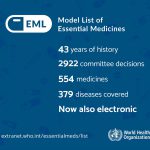
    The World Health Organization has launched a new easy-to-access, digital version of its Model list of Essential Medicines (EML). The move will revolutionize the way this core WHO reference tool is used.

    More than 150 countries currently use the WHO list to work out which medicines best meet their national health contexts and priorities, so they can compile their own national essential medicines lists.

    Essential medicines are those that satisfy the priority health care needs of a population. They are the medicines that need to be available in a functioning health system at all times, in appropriate dosage forms, of assured quality, and at prices individuals and the community can afford.

    Keeping up-to-date lists of the most important medicines a country needs is key to achieving health for all in a sustainable way.

    Since 1977, the WHO list has been revised every 2 years (most recently in 2019) by a group of experts and published in print or PDF formats. It includes information about available dose forms and strengths; specifications as to who should take a medicine; what conditions a medicine can treat and how it should be taken, as well as details about the clinical evidence supporting recommendations being made.

    The new electronic version brings the traditional EML to smartphones and computer screens in a comprehensive, freely accessible, online database. Instead of flicking through pages of information, users can search by simply clicking on the name of a medicine, for example, or a health issue. They can also make their own customized lists by exporting the list – in full or in part – into an Excel or Word version.  

    The electronic EML is the latest step in WHO’s effort to harness digital technologies to drive improvements in global public health, and advance progress towards universal health coverage. 


    WHO launch eEML
    Read More
    https://www.who.int/news-room/detail/27-02-2020-who-launch-e-eml

    Views: 0

  • Four countries in the African region license vaccine in milestone for Ebola prevention

    The Democratic Republic of the Congo (DRC), Burundi, Ghana and Zambia have licensed an Ebola vaccine, just 90 days after World Health Organization (WHO) prequalification. Registration of the vaccine is expected in additional countries in the coming weeks.

    The licensing of the vaccine means that the manufacturer can stockpile and widely distribute this vaccine to African countries at risk of Ebola virus disease outbreaks. Once licensed doses are available, use of the vaccine will not require clinical trial or other research protocols.

    “The approval of the Ebola vaccine by these countries is another milestone in the fight against this unforgiving disease,” said WHO Director-General Dr Tedros Adhanom Ghebreyesus. “Africa has rallied to cement hard-fought progress to keep its people safe from Ebola.”

    WHO accelerated the licensing and roll-out of the Ebola vaccine by certifying that it met the organization’s standards for quality, safety and efficacy in its fastest vaccine prequalification process ever, announced in November 2019.

    The speed with which this has been achieved has been made possible by a different approach, where national licensing procedures were done in parallel based on one single scientific review process. Usually, these process are done one by one, which can take years. The process was led by WHO with the participation of the African Vaccine Regulatory Forum (an African network of national regulatory authorities and ethics committees), the European Medicines Agency, and Merck.

    “The rapid approval of the Ebola vaccine by countries in the Africa Region helps ensure this critical prevention tool will be available when and where it is needed most,” said Dr Matshidiso Moeti, WHO Regional Director for Africa. “This kind of collaboration and innovation is a model for other health priorities.”

    The injectable Ebola vaccine, Ervebo, is manufactured by Merck (known as MSD outside the US and Canada). Preliminary study results have shown a 97.5% vaccine efficacy. Data also suggests that vaccinating people who are already infected reduces their chances of dying.

    In response to the ongoing Ebola outbreak in the DRC, over 290 000 people have been vaccinated under compassionate use protocols. Once licensed doses are available, use of the vaccine in DRC will no longer require these protocols

    Read More
    https://www.who.int/news-room/detail/14-02-2020-four-countries-in-the-african-region-license-vaccine-in-milestone-for-ebola-prevention

    Views: 0

  • WHO to accelerate research and innovation for new coronavirus

    WHO to accelerate research and innovation for new coronavirus

    WHO is convening a global research and innovation forum to mobilize international action in response to the new coronavirus (2019-nCoV). 
    “Harnessing the power of science is critical for bringing this outbreak under control,” said WHO Director-General Dr Tedros Adhanom Ghebreyesus. “There are questions we need answers to, and tools we need developed as quickly as possible. WHO is playing an important coordinating role by bringing the scientific community together to identify research priorities and accelerate progress.”
    The forum, to be held 11-12 February in Geneva, is organized in collaboration with the Global Research Collaboration for Infectious Disease Preparedness.
    The forum will bring together key players including leading scientists as well as public health agencies, ministries of health and research funders pursuing 2019-nCoV critical animal health and public health research and the development of vaccines, therapeutics and diagnostics, among other innovations. 
    Participants will discuss several areas of research, including identifying the source of the virus as well as sharing of biological samples and genetic sequences.
     
    Experts will build on existing SARS and MERS coronavirus research and identify knowledge gaps and research priorities in order to accelerate scientific information and medical products most needed to minimize the impact of the 2019-nCoV outbreak.  
    The meeting is expected to produce a global research agenda for the new coronavirus, setting priorities and frameworks that can guide which projects are undertaken first. “Understanding the disease, its reservoirs, transmission and clinical severity and then developing effective counter-measures is critical for the control of the outbreak, to reduce deaths and minimize the economic impact,” said Dr. Soumya Swaminathan, WHO Chief Scientist.
    This will also fast-track the development and evaluation of effective diagnostic tests, vaccines and medicines, while establishing mechanisms for affordable access to vulnerable populations and facilitating community engagement.
    “The WHO R&D Blueprint is a global strategy and preparedness platform that drives coordinated development of drugs and vaccines before epidemics, and allows the rapid activation of R&D activities during epidemics. It speeds up the availability of the diagnostics, vaccines and treatments and technologies that ultimately save lives,” added Dr Michael Ryan, Executive Director, WHO Health Emergencies Programme.  
    Setting clear global research priorities for the novel coronavirus should lead to more efficient investments, high-quality research and synergies among global researchers.

    WHO to accelerate research and innovation for new coronavirus
    Read More
    https://www.who.int/news-room/detail/06-02-2020-who-to-accelerate-research-and-innovation-for-new-coronavirus

    Views: 0

  • Ancient Medicinal Wisdom: Vedic Healing With Coriander

    [ad_1]

    In Ayurveda, the rasa or taste of coriander is initially sharp or astringent. Digestion mellows this to sweetness.

    What is Ayurveda?

    This is the ancient medical system of India. Ayurveda postulates that there are three basic types of energy or doshas: Vata dosha or wind energy, Pitta dosha or fire energy, and Kapha dosha or water energy. Every individual, (indeed, all matter), is made up of different degrees and combinations of these doshas. This is called the prakriti or constitution of the individual.

    Ayurvedic belief is that coriander, seeds as well as the plant, is beneficial to all body types or doshas as it does not arouse pitta like most other spices.

    Coriander leaves, seeds and powder are used extensively in Indian kitchens because of their appetising aroma. Ancient Ayurvedic practice had recognized the benefits of coriander: the use of these seeds and powder is rooted in this.

    Multiple benefits of Coriander:

    • These seeds contain dietary fibre and this aids in good bowel movements. It also helps in removing intestinal gas and prevents nausea. Coriander seeds can be dry roasted, powdered and added to most dishes; it’s not all about flavor, they are a good digestive aid. Ayurveda tells us so!
    • It will stimulate appetite by helping to produce digestive enzymes and aid in the breakdown of food.
    • It is also good for liver function. This is probably why it is a good appetite stimulant.
    • Coriander powder and seeds do not arouse pitta. In modern scientific terms, coriander is alkaline. Thus, it is good for urinary tract infections. It is also a mild diuretic.
    • These are an age-old cure for menstrual cramps: just boil 1-2 teaspoons of coriander seeds in half a litre of water, add a teaspoon of organic sugar and drink warm. The relief is palpable.
    • Ayurveda has always known it; now modern research shows coriander seeds to inhibit bacterial growth thus making them a good anti-bacterial agent. This inhibitive property makes coriander a good fighter of stomach infections.
    • Anti-bacterial coriander is also a good anti-fungal. Coriander seeds are quite useful in fighting skin problems like eczema, itchy skin, and rashes.
    • It contain linoleic acid which is why they provide pain relief as well as act as an anti-inflammatory. This property also makes them useful in curing mouth ulcers and sores.
    • Ayurvedic cures for chronic conditions like arthritis make liberal use of coriander seeds/powder. A ‘tea’ is made by boiling ground coriander seeds in water and drinking the warm decoction.

    Here are some Ayurvedic recipes for different ailments which make generous use of coriander seeds:

    • That parched feeling that a fever causes can be relieved by boiling 1 teaspoon of coriander powder in 1 cup of water. Drink after cooling, and your thirst will vanish.
    • For fatigue or a burning sensation in the body, soak a teaspoon of coriander seeds in a glass of water. Let it stand overnight. Strain and drink first thing in the morning.
    • Boil 1 tsp of coriander seeds in half a litre of water. Let it stand for 10 minutes. Strain and drink. This relieves any burning sensation while urinating.
    • Do not pop a pill at the first signs of malaise.The harmful effects of unnecessarily medicating yourself can be controlled by these simple home remedies which carry the goodness of Mother Nature. Ayurveda views human beings as an integral part of larger creation and treats human ailments non-aggressively.
    • When medicines should be used with circumspection, what can one say about the harmful chemicals that we ingest every day unknowingly? Food production in the modern day is fraught with dangerous practices. The indiscriminate use of chemical methods of farming is poisoning almost everything we eat. The organic movement aims to reverse this. If you want to enjoy the maximum benefit of any food product, GO ORGANIC. Coriander is no different.
    • Terragreens Organic is a store of the freshest and most natural ingredients, untouched by chemicals. Enjoy the full benefit of this miracle of Mother Nature. Buy your coriander seeds or powder from the best!

    [ad_2]

    Source by Karthik Guduru

    Views: 0

  • Herbal Cure For Joint Pain

    [ad_1]

    Joint pain can be stressful and it can also limit the activities you can do comfortably. Severe joint ailments might also restrict mobility. The most common joint ailments that cause excruciating pain include arthritis and osteoarthritis. People are always looking for ways by means of which they can cure or at least relieve the discomfort. Herbal cure is probably one of the best that you can choose for pain relief. This is considering that it revolves around natural herbs which do not have any side effects.

    Ayurveda is a natural healing process which offers a holistic approach allowing the patients to attain higher self harmony (atmay), mind (manas) and helps in regaining vital energy from the universe (prana), body and the senses. The Ayurvedic treatment process combines natural herbs and herbal minerals with no side effects. Meditation, yoga and use of massage are also practiced under this treatment to achieve complete wellness besides, getting rid of joint pain.

    Arthritis Treatment

    This is the most common joint condition people suffer from. It is a systemic, chronic inflammatory disorder which affects organs and tissues, thus leading to pain and ailing. It is a disease that can start with morning stiffness and fatigue extending to muscle ache, weakness and loss of appetite. Those suffering from this condition might use pharmaceutical drugs to relieve the pain, but it is not always a good option. Ayurvedic treatment for arthritis is probably the most effective herbal way of dealing with the pain.

    This herbal treatment revolves around internal medicines and external therapies which help in dealing with and eliminating the pain of arthritis. It uses traditional Ayurvedic treatment methods together with classical Ayurvedic medicines to help with pain relief. The treatments are made up of:

    Choorna Kizhi:

    This is considered to be the most effective of all Ayurvedic treatments when it comes to rheumatoid arthritis, arthritis and osteoarthritis. The treatment uses a mixture of natural herbs which are applied to the body to an extent that the individual sweats profusely. The treatment requires that the patient is kept in different positions including left lateral, right lateral, supine and sitting positions.

    Abhyangam:

    This treatment uses special massage oil. The oil is applied using a variety of strokes lasting for up to 45 minutes every day for at least two weeks. The treatment is most suitable for osteoarthritis, obesity and body aches among others. The treatment nourishes the body, revitalizes the nervous system, helps overcome stress and fatigue, promotes good sleep, improves physical appearance, and builds self confidence.

    Njavarakizhi:

    This is another Ayurvedic treatment where the patient suffering from joint pain is rubbed with medicated herbal oils. It is applied all over the body and in different postures, including lying and sitting. The treatment uses cooked Njavara rice and a medicinal decoction used by the therapist for at least 14 days for complete joint pain relief to be enjoyed. Regular use of the Ayurvedic pain treatment methods has a way of offering a permanent cure for arthritis. This is because complete well being is promoted during the treatment.

    [ad_2]

    Source by Shalini Mittal

    Views: 0

  • Rich and Varied Heritage

    [ad_1]

    India is always remembered as a land of diverse cultures. The geographic position, climate and the extent of exposure to foreign cultures have totally influenced the traditions and culture of the different regions at different periods. The greatness of Indian culture has been in adopting the best from all the invaders and intermingling their customs and styles with the existing and this is visible in all aspects of culture.

    Indian culture have always been attached to the great river systems, the watersheds of the Indus and Ganges, the Deccan plateau and South India.

    Secular India is home to Hinduism, Islam, Christianity, Buddhism, Jainism, Sikhism and other innumerable religious traditions. Hinduism is the dominant religious faith followed by the majority of the population. Colorful traditional festivals are almost 400 that have been happening for centuries. Not a single day passes by without a festival in one region or the other. It is an occasion for men to put on a new traditional costumes and jewelery.

    Traditional wears like the silk saris, cholis have fascinated many a traveler over the centuries. Men in villages are still more comfortable in traditional attire like kurtas, lungis, dhotis and pyjamas.

    Indian literature, Indian poetry, Indian epic poetry Ramayana and Mahabharata, Painting, Sculpture, Architecture- everything is depicted and interpreted through religion and philosophy.

    Well known classical styles of dancing on the Indian stage are Bharatanatyam, Kathakali, Odissi, Kathak, and Manipuri. Folk dances also contribute to the plethora of Indian dances. The common root of all classical dance forms can be traced to Natyasastra, ascribed to Sage Bharata who is believed to have lived between the 1st and 2nd Century AD

    18 Indian languages with 1600 regional dialects are spoken and the linguistic lines are drawn by State boundaries Besides Hindi and English, the other popular languages are Assamese, Bengali, Gujarati, Kannada, Kashmiri, Konkani, Sanskrit, Sindhi, Tamil, Malayalam, Marathi, Punjabi, Oriya, Telugu and Urdu

    Indian Cuisine skill lies in the subtle blending of a variety of spices to make various delicious recipes. These spices are used as home medicines too.

    A typical North-Indian meal would consist of wheat. Rice is the staple diet in South Indian food. Coconut and oil are essential ingredients in all the meal. A meal is rounded off with betel leaf which holds an assortment of digestive part.

    Women are the mirrors of culture of a society. Indian women are becoming increasingly visible and successful in the professional and public sphere. Whether it is Barkha Dutt, Arundhati Roy, Kiran Mazumdar Shaw, they have all heralded the arrival of Indian women professionals.

    Latest outsourcing of technological agility, quality, flexibility, cost control, time-to-market and competitive advantage have made India well known in the business world.

    India exports software to 95 countries around the world, outsource high quality brain-power 82% of the US companies ranked India as their first choice for software outsourcing.

    [ad_2]

    Source by Shobana Sridhar

    Views: 0

  • Chicken Soup – Does It Heal?

    [ad_1]

    They say chicken soup is good for the soul, but what about the body?

    Let’s take a look at chicken soup as a medicinal remedy for the common cold. Was Grandma right, if you eat chicken soup when you’re fighting the common cold, will it help?

    The chicken soup folklore has been around as long as people have, handed down generation to generation, along with the favorite chicken soup family recipe. The medicinal claims have never been proven, but from the time of the ancient Greeks, it has been used religiously to lessen the affects of a cold or the flu.

    The ingredients in chicken soup include chicken of course, carrots, celery, water or broth and spices, always including garlic. The soup is served steaming hot, which is where I believe one of the medicinal claims stems from. Let’s face it; whenever you’re feeling stuffy, drinking anything that is steaming hot helps to open up the sinuses, which immediately helps you to breathe better, thus you begin to feel better.

    If we take a closer look at the ingredients of chicken soup, one in particular stands out for its antioxidant benefits. Garlic is considered by herbalists to be one of the most useful herbs for medicinal purposes. Many cultures have used garlic for centuries in medicines, as it is a known antioxidant, used to treat many respiratory ailments including hoarseness, coughs and the common cold. The main compound in garlic, allistatin has antibiotic qualities used in some cultures to treat whopping cough, flu and other viral and bacterial diseases.

    Anyway you look at it, a steaming bowl of hot chicken soup when you’re feeling under the weather can’t hurt, and if you add garlic to your recipe, it may help.

    The recipes below should be individualized, use the ingredients that you and your family like, don’t like carrots? Use turnips instead. If your family is partial to peas, add peas. Use rice instead of pasta, whatever suits your taste. Just be sure to add the garlic, as stated above, its medicinal attributes make it a great addition to any soup.

    Basic Soup Recipe

    Chicken broth

    1 3 lb chicken, 3 quarts of water

    3 large Carrots

    3 stalks of Celery

    Onion Salt and pepper to taste 1 bay leaf Fresh chopped basil.

    Put all the ingredients in a large stock pot and simmer for 3 hours, skimming the surface often. Remove the chicken, remove meat from the bones, and put aside. Discard vegetables, and chill broth. After broth as chilled for a while, remove fat from the top. You are now ready to use broth in your soup.

    chicken soup

    2 cups chopped cooked chicken

    8 cups chicken broth

    Salt and pepper to taste

    Carrots, chopped

    Celery, coarsely chopped

    Diced garlic to taste

    Any small pasta

    Simmer until carrots and celery are soft and pasta is cooked, about 10 minutes. Serve hot.

    http://www.coolstuffforthekitchen.com

    [ad_2]

    Source by Julie E Lewis

    Views: 0

  • Hematoma Treatment – Traditional & Alternative Medicine

    [ad_1]

    In this article I’m going to talk about traditional hematoma treatment as well as alternative medicine.

    A hematoma takes places when blood builds outside a blood vessel and they can happen anywhere. It usually happens when there is an accident or trauma, such as falling off a ramp when skateboarding or getting hit by a post office truck.

    Other causes could be drugs, diseases, high blood pressure and cancer. You might be wondering, how do you know if you have a hematoma.

    Well the skin can change colors such as become darker, there could be pain, inflammation and swelling.

    Traditional treatment usually involves R.I.C.E. Have you heard of R.I.C.E. Before? It stands for rest which is when the body heals itself, so many times it might just be the best medicine. Elevation, ice and compression which all reduce the inflammation and improve the healing.

    If the injury is really red, there is pus coming out of it or if it’s in an eye, it’s best to see a doctor.

    Plus if you notice hematomas occurring without any injury it’s best to get it checked by a doctor because it could be serious.

    If you are wondering if there are better treatments or alternative medicines the good news is that there are tons.

    One of my favorite things is coconut oil, which has millions of uses. In a study at the U.S. National Library of Medicine they took rats and split them into groups. Some received coconut oil and some did not. Wounds treated with coconut oil healed much faster.

    Another idea is bromalean which can help a lot. In a study by the third medical university at China researchers took 16 pigs and shot them with high velocity rifles. They divided them into groups and the group that received bromalean healed much more.

    The way it works is it increases the flow of blood and oxygen to the wound and reduces inflammation. Plus it activates growth factors, which are needed for healing.

    If that wasn’t enough it helps with burns. In Bursheba Israel they took pigs, burned a few and bromalean really improved the healing. It’s seems like they have something against pigs right? They are shooting them and burning them, poor pigs.

    If you really want to heal a hematoma or a skin injury believe it or not they even have a stem cell gun. It takes an hour and a half to isolate the cells and spray the skin. Then it only takes a few days for the treatment to work and the skin is brand new again.

    [ad_2]

    Source by Kevin Whitsitt

    Views: 0

  • Advantages and Disadvantages of Alternative Medicine

    [ad_1]

    There are reasons why people chose alternative medicine and reasons why they avoid it, preferring conventional medicine. Alternative medicine is safer than standard health treatments and usually works. It’s true that it can’t be used in severe conditions like car accidents or other severe emergencies, but be that as it may, there are enough situations in which alternative medicine is recommended. When it comes to emotional and spiritual needs, non-conventional medicine may come up with the solution. Furthermore, it’s better for preventing illnesses than standard medicine. More and more physicians nowadays agree upon the benefits of alternative medicine and also even advise their clients to choose the best natural treatment for them.

    One of the advantages of alternative medicine is that it encompasses a broad range of therapies, treatments and products, thus the search for obtaining positive results doesn’t flow on a narrow path at all.

    A pretty important disadvantage states the idea that, even though the expenses of using acupuncture or chiropractic are sometimes covered by health insurances, the majority of alternative treatments are not reimbursed.

    There are certain risks that come along with the usage of natural remedies. Despite the use of herbs throughout the years and even ancient times, not all of them have been studied regarding their safety and efficiency. There are issues concerning their purity and their possible interaction with other substances related to conventional therapies. The majority of information regarding herbs have been perpetuated throughout history and with the help of tradition. Many people assume that herbal medicines are better than synthetic drugs simply because, well, they are natural and not synthetic, therefore present no risk. But they are not risk free; they can do more harm than good if taken without having the details of their effects over the body.

    People might abuse of natural medicines the same way as they do it in the case of synthetic drugs. They have the misconception that if unconventional medicine consists of herbal products which are natural, then there is no harm done if they triple the dosage or more. This is totally wrong and can have serious consequences. Take vitamins for example. They are just vitamins, right? They can’t possibly do any damage inside the body. But they do. Vitamin overdosing or vitamin toxicity can lead to unpleasant effects depending on the vitamin that has been taken one too many times. Vitamin A over dosage can cause liver problems, osteoporosis, hair loss and other dangerous effects and Hypervitaminosis D leads to dehydration, vomiting, anorexia and even kidney stones.

    An advantage of using herbal remedies concerns the effectiveness related with chronic health issues that don’t respond well or even at all to traditional medicines. If long term medication is needed, then herbs are pretty much safer than conventional drugs. The alternative medicine industry takes advantage from this and keeps evolving and developing due to the constant need for natural remedies.

    Another advantage is the low cost of herbal products compared to synthetic drugs which are highly priced for the simple reason that researching and testing the products is expensive. Furthermore, herbal products can be bought without a prescription and are easy to procure. The availability of natural remedies is outstanding; chamomile for example can be easily picked out from a nearby field.

    The advantages of using herbal medicines are numerous, but so are the disadvantages. The best idea would be to consider modern medicine according to the severity of the illness, to consult a physician upon the proper medication and dosage and if you do chose the alternative medicine, try to gather enough information upon both kinds of treatments, natural or synthetic, so you may reassure yourself that you took the right decision to balance your health situation.

    [ad_2]

    Source by Peter Rosenblum

    Views: 0

  • Irrational Use of Medicines – A Threat to Patient Community

    [ad_1]

    More than 50% all medicines worldwide are prescribed,dispensed or sold inappropriately. 50% of patients

    fail to take them correctly. Conversely, about one-third of the world population lacks access to essential medicines. Treatment with medicines is one of the most cost-effective medical interventions known and the proportion of national health budget spent on medicines ranges between 10% and 20% in developed countries and between 20 and 40% in developing countries. Thus, it is extremely serious that so much medicine is being used in an inappropriate and irrational way.

    Irrational use

    Common types of irrational use of medicine are:

    1. The use of too many medicines per patient

    2. Inappropriate use of antibiotics, often in inadequate dosage, for viral infections

    3. Over-use of injections when oral formulations would be more appropriate;

    4. Failure to prescribe in accordance with clinical guidelines;

    5. Inappropriate self-medication, often of prescription-only medicines.

    Poor communication between professionals and consumers

    Communication between professionals and consumers is fundamental to the improvement of rational use of medicines by consumers. Professionals should provide the following information to the consumers: the name of the medicine, the purpose for which the medicine is being taken, dose, frequency of use, and duration of use. The prescribed and dispensed medicines should also be properly labeled indicating the above information. The shortage of qualified health personnel in public health facilities has resulted in inadequate labeling of medications , and in insufficient time spent by them to inform the consumers on how to take the medicine. Also important are the possible drug and food interactions that might occur after taking the medicines. In cases of medicines for chronic diseases such as anti cancer drugs, the adverse effects such as memory loss, depression and many others should be explained to the consumer.

    All this communication requires adequate time between the professionals and consumers which is not always available due to the enormous workload of the health professionals in the developing countries. The situations has been made worse by the increase in the spread of HIV/AIDS and the attendant treatment issues which have placed further burden on both the health professionals and consumers.

    The influence of the company towards prescribing its product specially when new product introduced into the market. A study conducted by German Government on new medicines showed that 300000 doctors were prescribing a new type of insulin (analogue insulin) which has no added advantage over existing insulin. As a result of this finding the German Ministry of health decided to exclude new drugs form the list of medications paid for the national health insurance system as long as they are more expensive than existing approved drugs. This is an important step into the right direction but many of such types of steps taken in future to protect patients from this serious and widespread public health problem

    [ad_2]

    Source by Imran Asif

    Views: 0