Tag: legal

  • Landmark release of Termination of Transfer tool from Creative Commons and Authors Alliance

    tot
    Creative Commons trademark; design by Amy Collier

    For more than a decade, Creative Commons has developed and stewarded legal tools that give creators the opportunity to share their work on open terms. We have focused on tools that empower sharing at the moment of publication, leaving out an important group of creators: what about those who previously signed away their rights to their works long ago, but who now want to share on open terms under a CC license or renegotiate unfavorable publishing terms?

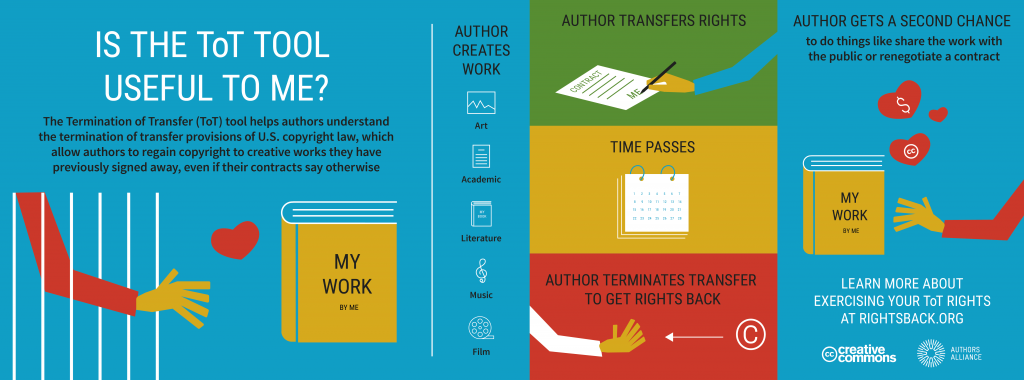
    We are proud to announce version 1.0 of the Termination of Transfer tool (ToT tool), which will help inform creators about their ability to reclaim their rights. This newest legal tool – to be co-stewarded by Creative Commons and Authors Alliance – helps creators and authors learn about their ability to regain their rights in order to share. The ToT tool is our latest step in our mission to steward a vibrant commons through legal, social, and technical tools.

    The ToT tool empowers authors to learn more about whether and when ccxauthorsalliancelogosthey may have the right to terminate the licensing arrangements for their work that prohibits them from sharing. Authors who enter into publishing, recording or other types of agreements are routinely asked to sign away their rights forever. Fortunately, there is recourse under U.S. copyright law for taking back those rights in the future. While many of these transfer agreements last “for the life of copyright” (which in the United States generally means seventy years after the author dies!), the law takes into account that these terms can ultimately be unfair to authors and artists, and so provides a mechanism for regaining those rights. An early analysis by Mike Wolfe estimates that control over more than 2.5 million works may be reclaimed by authors in the United States.

    The tool is widely applicable beyond academia – anyone, including artists, photographers, scholars and scientists, can use this tool to understand more about rights they could have to regain rights they previously assigned away. While this tool is currently U.S.-based only, CC is developing a database of other country laws that enable authors and creators to similarly terminate or reclaim their rights.

    One of the reasons why the tool is so remarkable is due to the complexity and technicality of the law. As Mia Garlick, CC’s first general counsel and the originator of the first ToT tool beta, noted in 2006, “the provisions are very complex and have not been frequently used [and] the termination provisions are currently so complex and technical that this tool can only serve an informational role.” When we relaunched the tool in 2015, we decided that while the tool would be primarily informational and US-based, the continued applicability of the legality would make it a worthwhile project for a global community. In 2016, we opened a public comment period for the tool.

    arcadia-logoEven though the tool is now active, we’re still looking to improve it so that it is increasingly useful to all categories of content around the globe. Creative Commons and Authors Alliance are grateful to the Arcadia Fund, a charitable fund of Lisbet Rausing and Peter Baldwin, for their generous support of the creation of the Termination of Transfer Tool. See our full list of personnel and thank-yous at rightsback.org/about.

    For more information and to try the tool, visit rightsback.org.

    Read our joint press release with Authors Alliance.

    The post Landmark release of Termination of Transfer tool from Creative Commons and Authors Alliance appeared first on Creative Commons.

    Views: 0

  • Animal Entertainment

    Animal Entertainment

    Animals have been used for the purposes of entertainment for millennia. They have been hunted for entertainment (as opposed to hunted for food); displayed while they hunt for prey; watched when they compete with each other; and watched while they perform a trained routine for human amusement. The Romans, for example, were entertained both by competitions involving wild animals and acts performed by trained animals. They watched as "lions and bears danced to the music of pipes and cymbals; horses were trained to kneel, bow, dance and prance … acrobats turning handsprings over wild lions and vaulting over wild leopards." There were "violent confrontations with wild beasts" and "performances over time became more brutal and bloodier".

    Animals that perform trained routines or "acts" for human entertainment include fleas in flea circuses, dolphins in dolphinaria, and monkeys doing tricks for an audience on behalf of the player of a street organ. Animals kept in zoos in ancient times were often kept there for later use in the arena as entertainment or for their entertainment value as exotica.

    Many contests between animals are now regarded as sports – for example, horse racing is regarded as both a sport and an important source of entertainment. Its economic impact means that it is also considered a global industry, one in which horses are carefully transported around the world to compete in races. In Australia, the horse race run on Melbourne Cup Day is a public holiday and the public regards the race as an important annual event. Like horse racing, camel racing requires human riders, while greyhound racing does not. People find it entertaining to watch animals race competitively, whether they are trained, like horses, camels or dogs, or untrained, like cockroaches.

    The use of animals for entertainment is often controversial, especially the hunting of wild animals. Some contests between animals, once popular entertainment for the public, have become illegal because of the cruelty involved. Among these are blood sports such as bear-baiting, dog fighting and cockfighting. Other contests involving animals remain controversial and have both supporters and detractors. For example, the conflict between opponents of pigeon shooting who view it as "a cruel and moronic exercise in marksmanship, and proponents, who view it as entertainment" has been tested in a court of law. Fox hunting, which involves the use of horses as well as hounds, and bullfighting, which has a strong theatrical component, are two entertainments that have a long and significant cultural history. They both involve animals and are variously regarded as sport, entertainment or cultural tradition. Among the organisations set up to advocate for the rights of animals are some whose concerns include the use of animals for entertainment. However, "in many cases of animal advocacy groups versus organisations accused of animal abuse, both sides have cultural claims."

    Views: 0

  • Retired? Make Money Selling Private Label Software Programs

    Due to unexpected events and unforeseen circumstance, there are many retirees who need to return to work. For most, returning to work is vital to their ability to financially support themselves.  Unfortunately, many retirees are limited on their ability to perform certain tasks, such as working long hour or lifting heavy materials. This leaves many retirees looking for additional ways to make money. If you are one of those individuals, you are urged to examine how you can make money selling software programs, ones that you didn’t even create.

    If you are interested in selling software programs, especially ones that you do not have to create on your own, you need to find a product to sell. This can easily be done by searching for software designers or developers, especially those who are selling the resells rights to their products. In most cases, these individuals make most of their money when they are creating new products. This means that many professional software developers and designers do not have the time needed to market and sell all of their products; therefore, they place their product’s resell rights up for sale.

    If you are able to invest a few hundred dollars, the average cost to purchase the resell rights, you may end up finding success with this popular, but unique business opportunity.  Once you have officially obtained the resell rights to a software program, you should receive a detailed list of directions from the seller.  This list often includes rules or restrictions that they have placed on their product. These restrictions may require you to alter the software program in a small way. In most cases, this alternation will allow you to then claim the product as your own, thus working out well for everyone involved.

    After you are legally able to sell the software program, which you have obtained the resell rights to, you will have a number of different options. The selling options you choose should all depend on how much time and money you are able to put into this project. As previously mentioned, many retirees return to work because they are no longer are able to financially support themselves.  If this is the case, you may be unable to afford expensive selling methods and advertising costs; however, there are a number of alternatives that you can use.  These alternatives include the use of online classified ads and the creation of your own website.

    Online classified ads are a great way to let the public know that you have a software program that is available for sale. The best part about these classified ads is that most are free. This means that you may not only be able to reach your target market, but actually make sales without spending dime.  Although online classified ads are a great way to sell your software program, this selling method should be used in conjunction with other methods.

    You should also be able to sell your newly acquired software program by creating your own website.  Perhaps, the hardest part of this selling method is getting your website up and running, but after that it as easy as selling could be. Aftertime, you will find that customers will automatically make their way to your website.  If you setup an online shopping cart, your product can sell when you are taking a nap, on vacation, or grocery shopping.

    If buying the resell rights to private label software programs seems like an opportunity that you would like to be a part of, you are advised to act fast. Your retirement years should be some of the best. You should be able to enjoy those years without having to work. The quicker you get started on this amazing opportunity, the quicker you will make money, and the sooner you can start to fully enjoy your retirement.

    Views: 0

  • Money

    Money is any item or verifiable record that is generally accepted as payment for goods and services and repayment of debts in a particular country or socio-economic context. The main functions of money are distinguished as: a medium of exchange; a unit of account; a store of value; and, occasionally in the past, a standard of deferred payment. Any item or verifiable record that fulfills these functions can be considered money.

    Money is historically an emergent market phenomenon establishing a commodity money, but nearly all contemporary money systems are based on fiat money. Fiat money, like any check or note of debt, is without intrinsic use value as a physical commodity. It derives its value by being declared by a government to be legal tender; that is, it must be accepted as a form of payment within the boundaries of the country, for "all debts, public and private". Such laws in practice cause fiat money to acquire the value of any of the goods and services that it may be traded for within the nation that issues it.

    The money supply of a country consists of currency (banknotes and coins) and usually includes bank money (the balance held in checking accounts and savings accounts). Bank money, which consists only of records (mostly computerized in modern banking), forms by far the largest part of broad money in developed countries.

    Views: 0

  • The Sorry State Of Nigeria’s Judiciary Among Others Makes The Battle Cry For A Revolution Inevitable By Francis Adewale

    The Sorry State Of Nigeria’s Judiciary Among Others Makes The Battle Cry For A Revolution Inevitable By Francis Adewale

    Lawyers
    Lawyers

    “Those who make peaceful revolution impossible will make violent revolution inevitable.”
                                                   – President John F. Kennedy (1962)

    This week may be one of the worst weeks for Nigerian judiciary and they might have made the much vaunted Sowore’s revolution inevitable. The first salvo was the list of judges released by the National Judicial Council replete with the names of their sons and daughters as well as hangers on. Second is the farcical decision in EFCC vs Kalu where the Supreme Court “suo motu” created a new section to the constitution of Nigeria by vacating a conviction duly given under an extant law. The strange rationale by the Supreme Court is that the presiding judge, now elevated to the Court of Appeal should not have pronounced the sentence. The Court conveniently ignored the fact that the accused counsel had invited the judge to come back and continue the hearing by a formal letter!

    Gone are the days when Nigerian judiciary is famously celebrated as the last bastion of defense for the common man. The days of Kayode Esho, Chukwudifu Oputa, Muhammed Uwais is long gone. Our judiciary is no more like Caesar’s wife, above board. The problem however is not necessarily down to the hydra headed monster of corruption alone but a more sinister evil called, nepotism. It is my humble opinion that an opaque process for selection of judges led us to where we found ourselves this week. And the problem did not start with the current chief justice. The dysfunction and bastardization have been long in coming, and as we will find out in this piece, the cancer has eaten deep into the fabric of this nation. The revolution is inevitable. 

    The Sorry State Of Nigeria’s Judiciary Among Others Makes The Battle Cry For A Revolution Inevitable By Francis Adewale 1Lawyers


    What precipitate this write up is a social media post by a good friend of mine and I obtained his permission to repost his comment with my personal edits:
    “It took Orji Kalu only 4 months including Covid lockdown challenge to move from the High Court to Supreme Court to get his so called sound judgment from Supreme Court while it took ten years to get his case completed at the High Court level. Ten good years! And we are told justice in Nigeria is not cash and carry? The Supreme Court is preparing the ground for a revolution and very soon something extraordinary will take place. The same Supreme Court that will give 2021 and 2022 court date for poor defendants, sat and summarily decide a case within 4 months while cases of those facing a life sentence languish in the labyrinth of jungle justice!”

    My first response to the post, is to retort that the problem did not start with judiciary, but they seem to have led the “nunc dimitis” for the internment of democracy in Nigeria. The judiciary may have pushed us to the praecipe but they were not the only one. We all recalled the impunity days of PDP rule and how they ride roughshod on people’s right, celebrating acquisition of jets obtained from corrupt practices while hordes of masses suffer the indignity of scrapping for foods from the gutter. Towards the end of that era, we all thought, if we can just get a man of integrity into Aso Rock, someone who will brook no atom of corruption, we will change the country. The election of 2015 seems to have lulled Nigerians into thinking that all we need is someone or a duo with integrity, so we elect Buhari and Osinbajo, a puritan and a pastor and went home satiated. What we were not prepared for or more appositely choose to ignore is the fact that the vehicle that brought them into governance is none other than the decrepit system that PDP used to feather their nest. In the first 4 years, we were told that the problem is with the National Assembly where the legistlooters shifted their control of the vortex of power in Abuja, opposing every anti-corruption moves of the executives. Then come the last election where the ruling party now controls the executive and legislative arm, but corruption runs through the gamut of the judiciary and Aso Rock looks the other way while nepotism festers in its rank.

    It is as if the cancer has completely swallowed up the entire fabric of the nation. Cases involving the poor dragged on for years while those who can afford senior advocate can get quick justice. Many warned that this will sound the death knell of democracy in Nigeria. Every attempt to even build on free and fair election has been truncated by the judiciary. What with the recent confounding judgment from Imo and Bayelsa. Our two gargantuan political parties now owned our judiciary lock, stock and barrel. They sit in smoke filled rooms to determine who will be governors, legislators and judges, and those who will play ball are readily appointed as pawns in the chest board of the Nigerian ruling class, wives, nephews, cousins, sons and daughters are made judges and senior advocates overnight without recourse to any modicum of meritocracy. A friend of mine recently quipped that the problem of nepotism is not just that it defeats meritocracy and breeds mediocrity but that it infects the entire body politics and renders it comatose. Corruption can be traced, and ill-gotten wealth recovered but nepotism is more sinister. Those who obtain position of power and authority through nepotism hold fealty only to their masters who appointed them. Such appointee will readily twist the constitution, made up section that does not exist all at the behest of their “godfather”. It is insidious and evil.

    I graduated from Nigerian Law School 30 years ago, after an excellent stint at Great Ife. My class at Ife, drawn from the north, east, west middle belt and south-south has in its rank some of the best legal minds any country will be proud of. We graduated with high hopes to take on the world and change the land. Few of us found ourselves abroad on scholarship where we flourish and excel. Those in legal practice in Nigeria, either at the federal or state ministry of justice or private practice are the ones my heart bleeds for, especially those without access to members of the National Judicial Council. I have had the privilege to advance my career abroad as an attorney and public defender. I frequently sit on panels that recommend colleagues for appointment as judges in a fair, open and transparent process; something my colleagues in Nigeria could only dream of.

    When I look at the state of Nigerian legal practice my heart bleeds. The career growth of colleagues in the legal profession in Nigeria is stunted not for lack of excellence but influence in the right place. Influence peddling is an art form in Nigeria and politicians used to have the exclusive preserve of selling it to the highest bidder, but our Judicial Council seems to have mastered the art. The problem will not be this pronounced if the sons and daughters they are foisting on Nigerian judiciary are steeped in the Nigerian experience or have a modicum of merit. As many of my colleagues are apt to complain, majority of the recent appointees hardly spend few years in Nigeria. They all went to schools abroad. Totally devoid of the Nigerian experience, and constantly removed from the everyday life Nigerians suffers under. Majority of them lives in the gilded mansions of their forbears in Abuja and other state capitals, where they are rarely touched by the “better angels of our nature” to use the phrase coined by Abraham Lincoln. It is therefore no surprise that they care only for what their “godfather” demand.

    Let me however warns that the biggest mistake we could make is to think that the rot is only in the heart of our judiciary. Think again. Nepotism is next door, next street, next town and everywhere in Nigeria. It rampages through the land, be it North, East or West. Just look at our churches and mosques, who do you see minister or lead the prayers when the founder/visioner is not around? You guess right,  if you say their sons and daughters. Gone are the days when Pa Fadayomi push to have a meritorious doctor of aerodynamics succeed him. Gone are the days when the leader of the faithful in Nigeria is selected by their aptitude in the knowledge of the Quaran. Nowadays, the exit of the leader is the beginning of the reign of the progeny. It has infected our colleges and universities, scholarship and opportunities that used to be available on merit are now exclusive preserve of the vice chancelor’s children and family members. Woe betide the school senate members that dare ask questions. Advertisement for jobs that has already been reserved for the children of the privileged are means to extort money in the form of application fees a la Abba Moro immigration recruitment scheme. A recent recruitment without advertisement at our apex bank reported by Sahara Reporters shows that successful applicants names were picked out of the rolodex of the governor. Commercial Banks staff are not an exemption, they are either recruited based on sex appeal or influential ministers/senators’ “recommendation” which doesn’t come easy for the educated but less privileged applicants.

    A friend concluded an animated discussion on social media on this issue with a distinctively Nigerian resignation: “It is clear that those who do not want things to work properly in Nigeria are more powerful than those who are working towards finding solutions to our problems.” Again, my response is what do we have to lose if we embrace Omoyele Sowore’s revolution, even with its youthful disdain for experience? Especially when our current experienced leadership seems to treat the Nigerian masses with contempt. Look at it this way: They do not need our votes to win election, as they could procure midnight judgment in Abuja a la Bayelsa and Imo. They do not need to legislate to fill any lacunae in our constitutional experience as the Supreme Court proved in Kalu’s case. In fact, as long as oil flows and they have the means to fill their Cayman Island bank accounts, we may as well not exist. Greed and avarice have become the directive principle of Nigerian ruling class. To rescue ourselves from their vice grip, we need revolution now!

    Francis Adewale
    Tioluwanimi@gmail.com

    Opinion

    AddThis

    : 

    Original Author

    : 

    Francis Adewale

    Disable advertisements

    : 
    The Sorry State Of Nigeria’s Judiciary Among Others Makes The Battle Cry For A Revolution Inevitable By Francis Adewale
    Read More
    http://saharareporters.com/2020/05/09/sorry-state-nigeria%E2%80%99s-judiciary-among-others-makes-battle-cry-revolution-inevitable

    Views: 0
  • Network Interference: A Legal Guide

    Social media is a revolution in the way in which corporations communicate with consumers. This White Paper will help you to maximize the huge potential benefits of this revolution and protect against the inherent legal risks surrounding this phenomenon. In this document, you will find practical, action-oriented guidelines as to the state of law in the following areas: Advertising & Marketing; Commercial Litigation; Data Privacy & Security; Employment Practices; Government Contracts & Investigations;
    Insurance Recovery; Litigation, Evidence & Privilege; Product Liability; Securities; and Trademarks.

    Read More
    http://www.associationofmarketing.org/whitepapers/view.php?whitepaper_id=78

    Views: 0

  • Strengthening accountability to end TB

    WHO today released a Checklist to enable Member States and their partners to assess the status of work at the national level to strengthen accountability to End TB, principally: national commitments made, actions taken on those commitments, monitoring & reporting approaches, and the nature of any high-level review mechanisms. The Checklist has been developed in response to requests from Member States, regions, civil society and partners as a tool to support the adaptation and implementation of the WHO Multisectoral Accountability Framework (MAF-TB) released in 2019. It responds also to the UN General Assembly request to WHO to ensure implementation of the Framework.

    There are four components of the MAF-TB that form a cycle for strengthening accountability: Commitments, Actions, Monitoring and Reporting, and Review, that were released during the World Health Assembly in May, 2019. In the political declaration of the first UN high-level meeting on TB, world leaders called for WHO to finalize the framework and ensure its implementation in 2019.

    After its publication in May, 2019, WHO began work with pathfinding country counterparts who were seeking to move ahead on key elements including, among others: formal adoption of country-specific targets for 2022 for increased TB case detection and treatment in line with the global targets in the political declaration; updating or development of new national TB strategic plans based on 2022 and 2030 targets and other new commitments; coordination platforms across sectors and stakeholders; formalizing engagement with civil society across End TB efforts;  producing robust performance reports; and, using those reports to inform high-level review bodies that will assess and drive faster progress.  Based on the MAF-TB document, relevant country experiences, and specific requests from countries and partners, WHO developed the MAF-TB Checklist. The Checklist is especially relevant for high TB burden countries, but has content relevant to all countries.  The appropriateness of different approaches may vary, according to national constitutional, legal and/or regulatory frameworks or other relevant factors.

    The MAF-TB Checklist has three annexes on:

    1. engagement across government ministries and bodies;
    2. engagement of civil society and affected communities; and,
    3. adoption  and implementation of WHO TB guidance.

    In releasing this MAF-TB Checklist today, Dr Tereza Kasaeva, Director of the WHO Global TB Programme noted,  “At this enormously difficult time, all countries and partners are focused on the COVID-19 pandemic.  Lessons learnt from ongoing TB programmes are helping the response. Likewise, TB efforts will benefit from learning underway on collaboration, innovation and accountability in confronting the virus.”

    WHO will be helping Ministries of Health and partners to use the Checklist, hold related consultations and move forward with more effective collaboration and review mechanisms.  The WHO Civil Society Task Force on TB also will support countries and civil society partners, using the Checklist. Progress in strengthening accountability will be assessed in the 2020 Report of the UN Secretary-General on progress since the 2018 TB UN high-level meeting, as well as in the WHO Global TB Report 2020.

    The WHO TB Civil Society Task Force, National TB  Programme Managers and other country officials, WHO staff at all levels, consultants working with WHO and The Global Fund, and staff of partner agencies, contributed content to, and/or provided feedback on, the MAF-TB Checklist during its development.   Access the Checklist and 3 annexes.  

    An online form of the checklist will be available shortly here, along with additional information.  

    Translations of the Checklist and annexes, as soon as available in Arabic, Chinese, French, Russian and Spanish, will be posted at the above link as well.   Kindly contact gtbprogramme@who.int if you have questions regarding the MAF-TB Checklist or to request versions in MS Word format if needed.


    Read More
    https://www.who.int/news-room/detail/08-04-2020-strengthening-accountability-to-end-tb

    Views: 0

  • Hear Urgent Cases Via Skype, Zoom, Falana Tells Nigerian Judges

    Hear Urgent Cases Via Skype, Zoom, Falana Tells Nigerian Judges

    Hear Urgent Cases Via Skype, Zoom, Falana Tells Nigerian Judges 2

    Hear Urgent Cases Via Skype, Zoom, Falana Tells Nigerian Judges 3


    Senior Advocate of Nigeria, Femi Falana, has urged the Chief Justice of Nigeria, Ibrahim Muhammad, to prevail on judges in the country to “hear urgent applications via Skype or Zoom during the lockdown”.

    Following the outbreak of Coronavirus in Nigeria, courts were directed to shut down until the pandemic was brought under control by government.

    But encouraging judges to embrace technological tools to attend to cases during this lockdown period, Falana in a letter to the CJN said, “Since the Federal Government has relaxed the lockdown by allowing markets, shops and stalls selling food and groceries to open to customers between the hours of 10:00am and 2:00pm daily, the National Judicial Council ought to review the suspension of court sittings to enable them attend to urgent matters to ensure that thousands of people who are either awaiting trial or under investigation are not subjected to unlawful detention.

    “The review has become necessary in view of the fact that motions for the bail of many criminal suspects and applications to secure the enforcement of the fundamental right to personal liberty of other detainees are pending in several courts in all the states of the federation and in the federal capital territory.

    “In addition, the return dates in respect of several ex parte orders made by magistrates for the remand of a number of criminal suspects which have since expired are due to be quashed or renewed to extend time for further investigation.

    “More so that the heads of the various courts are vested with the power to designate judges and magistrates to attend to urgent matters in accordance with the laws establishing such courts.

    “However, in order to observe the social distancing directive, we suggest that arrangements be made for judges to hear urgent applications via Skype or Zoom.”

    Already, that strategy had been adopted in Kenya where 4,800 prisoners had been released by judges after hearing their cases through Skype and Zoom, a report by CNN said.

    “We prioritised getting a lot of people out of prison, especially petty offenders. Those who are in prison for a short term and those who have been there for a long time but have just about six months and below to go,” Anne Amadi, Chief Registrar of the judiciary in Kenya, told CNN.

    “As of Friday last week, we managed to decongest the prison by about 4800 inmates from different parts of the country. 

    “All our 39 high court stations have released people. Most of them, a good number, through Skype or Zoom,” she added.

    Legal

    PUBLIC HEALTH

    News

    AddThis

    : 

    Original Author

    : 

    SaharaReporters, New York

    Disable advertisements

    : 
    Hear Urgent Cases Via Skype, Zoom, Falana Tells Nigerian Judges
    Read More
    http://saharareporters.com/2020/04/08/hear-urgent-cases-skype-zoom-falana-tells-nigerian-judges

    Views: 0

  • UPDATE: Magistrate Court Remands Two Pilots In Prison Custody For Violating Rivers Movement Ban

    UPDATE: Magistrate Court Remands Two Pilots In Prison Custody For Violating Rivers Movement Ban

    UPDATE: Magistrate Court Remands Two Pilots In Prison Custody For Violating Rivers Movement Ban 4

    UPDATE: Magistrate Court Remands Two Pilots In Prison Custody For Violating Rivers Movement Ban 5


    Samuel Ugorji and Samuel Buhari, pilots working with Carveton Helicopters, were on Tuesday remanded in prison custody for violating a movement restriction put in place by the Rivers State Government to curb the spread of Coronavirus in the state.

    A magistrate court sitting in Port Harcourt, the state capital, handed down the ruling. 

    Presiding Chief Magistrate, D.D Ihua-Maduenyi, remanded the two pilots at the Port Harcourt Correctional Centre until May 19, 2020 when their trial will commence. 

    See Also

    UPDATE: Magistrate Court Remands Two Pilots In Prison Custody For Violating Rivers Movement Ban 6

    PUBLIC HEALTH

    Rivers Governor, Wike, Storms Caverton Helicopters Office Over Violation Of Movement Restriction


    The magistrate ruled that COVID-19 tests should be carried out on the two pilots to ascertain their status.

    The state’s legal team said the act of the two pilots was capable of putting the entire city in danger of contracting Coronavirus. 


    Legal

    PUBLIC HEALTH

    Travel

    News

    AddThis

    : 

    Original Author

    : 

    SaharaReporters, New York

    Disable advertisements

    : 
    UPDATE: Magistrate Court Remands Two Pilots In Prison Custody For Violating Rivers Movement Ban
    Read More
    http://saharareporters.com/2020/04/07/update-magistrate-court-remands-two-pilots-prison-custody-violating-rivers-movement-ban

    Views: 0