Tag: Forms

  • Schistosomiasis elimination: refocusing on snail control to sustain progress

    Schistosomiasis elimination: refocusing on snail control to sustain progress

    Substantial progress has been made during the past decade to prevent and control schistosomiasis (also known as bilharziasis) globally. The disease affects more than 230 million people, mostly in sub-Saharan Africa.

    Progress is mainly due to large-scale periodic treatment of affected populations with praziquantel, the only medicine recommended by the World Health Organization (WHO) against all forms of schistosomiasis. Regular treatment cures mild symptoms and prevents
    progression to severe, chronic disease.

    “Through progressive scale-up of periodic large-scale treatment
    to control morbidity in many endemic countries, we are closer to
    achieving the minimum target of 75% global coverage of all school‐aged
    children,
    ” said Dr Amadou Garba Djirmay, who leads WHO’s global schistosomiasis control programme. “But
    if we want to achieve elimination, we must go a step further to
    introduce snail control in hot spots and in areas targeting elimination.
    This is bound to increase impact and accelerate progress towards
    interruption of transmission
    .”

    Expansion of treatment is largely supported by donated praziquantel from Merck KGaA of up to 250 million tablets annually. In 2018, almost 78 million children were treated, representing 63% of all school‐aged children eligible for treatment.

    Transmission: role of snails

    Schistosomiasis is an acute, chronic parasitic disease caused by infection with trematode worms of the genus Schistosoma. It is prevalent in tropical and subtropical areas, especially in poor, rural communities that have little or no access to
    safe drinking‐water and basic sanitation. Infection is transmitted when people suffering from schistosomiasis contaminate freshwater sources when evacuating urine and faeces containing the parasite’s eggs.

    Once an egg comes into contact with fresh water, it releases miracidia (hatchlings) which enter a snail and produce hundreds of cercariae (larvae) daily. The cercariae enter the human body on contact with the skin and develop into adult worms.

    Besides treatment with praziquantel, eliminating snail hosts and improving sanitation are important methods for sustainable prevention of the disease. Dam and irrigation projects are known to be potential sites for outbreaks of the disease. Snail management,
    often achieved through mollusciciding, can help to reduce transmission by eliminating these intermediate snail hosts.

    Vector control

    In 2017, the World Health Assembly – WHO’s decision making body – adopted resolution WHA70.16 on the Global Vector Control
    Response, calling on Member States to develop or adapt national vector control strategies and operational plans. The strategy aims to reduce by at least 40% the incidence of vector borne diseases, including schistosomiasis, by 2025.

    In response, WHO is reinforcing snail control as part of its strategic approach to achieve the target of eliminating schistosomiasis as a public health problem and, ultimately, the goal of elimination of transmission. Snail control will complement mass
    treatment campaigns and sustain the public health impact of this core intervention.

    To facilitate implementation of snail control, in 2019 WHO published on specific, standardized procedures and criteria for efficacy
    testing and evaluation and in 2017 a manual on the use of molluscicides in the field. WHO is also planning to strengthen capacities
    of health staff in medical malacology in order to reinforce snail control activities in countries.

    In the past, molluscicides (particularly niclosamide1 based products) were widely used in schistosomiasis control programmes. For example, in China programmes largely relied on snail control for over 30 years to overcome the disease as a public
    health problem. In other parts of the world, however, snail control programmes were gradually discontinued and competencies faded away.

    “Snail control is a crucial component of the global schistosomiasis elimination strategy,” said Dr Rajpal Yadav, Scientist, WHO Department of Control of Neglected Tropical Diseases. “It
    is time we look for new snail control products that are cost–effective
    and of low risk to humans and the environment. Some efforts are being
    made to explore molluscicide compounds from plants, marine algae and
    microorganisms
    .”

    An integrated control strategy involving mass treatment with praziquantel, snail control and environmental modification, wider access to sanitation and safe water, economic and environmental development, health education and poverty-alleviation can greatly
    contribute to sustainable control and elimination of schistosomiasis.

    WHO’s new road map on neglected tropical diseases for 2021–2030, due to be launched later this year, advocates enhanced financial and political support to achieve the target of interruption of transmission. Additional research to address gaps,
    develop tools and optimize the impact of existing programmes with snail control will complement the core strategic approach.

    Schistosomiasis: forms of the disease

    There are two major forms of schistosomiasis – intestinal and urogenital.

    Intestinal schistosomiasis usually results in diarrhoea and blood in the stool; enlargement of the liver and of the spleen and portal hypertension are common in advanced cases.

    Urogenital schistosomiasis is characterized by the presence of blood in the urine. Chronic infection results in fibrosis of the bladder and ureter that can evolve to hydronephrosis and create conditions for bladder cancer.

    In women, urogenital schistosomiasis can cause vaginal bleeding, pain during sexual intercourse and nodules in the vulva, a condition now described as female genital schistosomiasis. In men, urogenital schistosomiasis can induce disease in the seminal
    vesicles and prostate.


    1Limitations with the use of formulations based on niclosamide include restrictions on the usage of water immediately after application and temporary toxicity to non-target aquatic organisms including
    fish, amphibians and invertebrates. 


        Schistosomiasis elimination: refocusing on snail control to sustain progress
        Read More
        https://www.who.int/news-room/detail/25-03-2020-schistosomiasis-elimination-refocusing-on-snail-control-to-sustain-progress

        Views: 0

      • Motac to introduce new campaign to replace VM2020

        Motac to introduce new campaign to replace VM2020

        Motac to introduce new campaign to replace VM2020 3

        KUALA LUMPUR: The Ministry of Tourism, Arts and Culture (Motac) will introduce a new campaign to replace the Visit Malaysia 2020 (VM2020) campaign, which was cancelled following the Covid-19 situation.

        Minister Datuk Seri Nancy Shukri said the long-term campaign would capitalise on the ‘Malaysia, Truly Asia’ brand while highlighting the country’s unique experiences.

        “Motac is confident that this effort will strengthen the country’s competitiveness and sustainability in tourism while ensuring the industry is inclusive,“ she said in a statement today.

        On March 18, Nancy announced the immediate cancellation of VM2020 to prevent the spread of Covid-19, in addition to the impact of the outbreak, which had affected the local and international tourism sector.

        Following the Covid-19 outbreak, Nancy said tourism industry players such as hoteliers, travel agents as well as food and beverage businesses suffered an estimated losses of RM9 billion in the first quarter of the year.

        As such she said, after discussing with the industry players on March 17, it was decided that a strategic action plan should be introduced.

        “Motac has put in place an action plan to help revitalise the industry and ensure the well-being of Malaysians whose livelihoods depend on this industry.

        “Among those present were representatives of the associations from the hotel and tourism industry, bus operators, traders, tour guides and taxi drivers. The meeting was organised by the Tourism Recovery Action Council (TRAC),“ she added.

        Nancy said Motac would discuss with the Ministry of Finance and related agencies, in looking into details tabled by the tourism industry players especially on the forms of assistance that could be channeled to the industry. – Bernama

        Motac to introduce new campaign to replace VM2020
        Read More
        https://www.thesundaily.my/local/motac-to-introduce-new-campaign-to-replace-vm2020-NX2176593

        Views: 0

      • Coronavirus: Rivers Government Orders Closure Of Parks, Night Clubs, Others

        Coronavirus: Rivers Government Orders Closure Of Parks, Night Clubs, Others

        Coronavirus: Rivers Government Orders Closure Of Parks, Night Clubs, Others 4

        Coronavirus: Rivers Government Orders Closure Of Parks, Night Clubs, Others 5


        As part of measures to prevent Coronavirus from spreading into Rivers, the state government on Monday announced that beginning from Tuesday, March 24, 2020, all parks, night clubs and cinemas will remain closed until further notice. 

        In a statewide broadcast on Monday, Governor Nyesom Wike also directed religious groups to temporarily stop all forms of open worship. 

        He said, “With effect from the same date (Tuesday, March 24, 2020), all public parks, night clubs and cinemas in the state are to remain closed until further notice. 

        “Similarly, after due consultations with religious leaders, it was agreed that all religious organisations are to temporarily stop all forms of open worship. 

        “Public burial and wedding ceremonies are also banned within this period. 

        “In view of the fact that the disease spreads fast through body contact, social distance has become imperative if we are to contain the spread.” 

        The Rivers State governor further stated that with effect from Tuesday, surveillance posts will be set up across the state to enforce the directive.
         

        PUBLIC HEALTH

        News

        AddThis

        : 

        Original Author

        : 

        Saharareporters, New York

        Disable advertisements

        : 
        Coronavirus: Rivers Government Orders Closure Of Parks, Night Clubs, Others
        Read More
        http://saharareporters.com/2020/03/23/coronavirus-rivers-government-orders-closure-parks-night-clubs-others

        Views: 0

      • Selangor Zakat Board allocates RM15m aid for hawkers and small traders

        Selangor Zakat Board allocates RM15m aid for hawkers and small traders

        Selangor Zakat Board allocates RM15m aid for hawkers and small traders 6

        PETALING JAYA: The Selangor Zakat Board (LZS) has allocated RM15 million in emergency aid for the welfare for hawkers and small traders in the B40 category.

        “The special allocation is for traders and who are affected by the Movement Control Order (MCO) so they can continue to survive under the measure,“ the board’s CEO, Saipol Yazan M. Yusop said in a statement.

        He added that the allocation would also be channelled to meet medical equipment needs in hospitals handling Covid-19 patients as well food aid for Institute of Higher learning students.

        Affected parties can apply for the aid begining March 25 by contacting the LZS hotline at 1-300-88-4343 on working days 10am to 3pm.

        In the same development, Saipol that the board would bring forward payout date of its Monthly Financial Assistance to March 23 for existing recipients

        “Monthly financial aid will usually come in on the 25th day of the month, but this month, it will be brought forward to the 23rd day,“ Saipol said, further clarifying that other forms of assistance would be paid on the usual date.

        Selangor Zakat Board allocates RM15m aid for hawkers and small traders
        Read More
        https://www.thesundaily.my/local/selangor-zakat-board-allocates-rm15m-aid-for-hawkers-and-small-traders-HA2165854

        Views: 0

      • NIST updates and expands its flagship catalog of information system safeguards

        NIST updates and expands its flagship catalog of information system safeguards

        After your organization forms a general plan for tackling its cybersecurity and privacy risk management issues, it needs particular state-of-the-art tools to make that plan a reality. Computer security and privacy experts at the National Institute of Standards and Technology (NIST) have the answer with an updated toolbox of safeguards for protecting an organization’s operations and assets, as well as the personal privacy of individuals.

        Read More
        https://techxplore.com/news/2020-03-nist-flagship-safeguards.html

        Views: 0

      • Over 600 Sarawakians were at Sri Petaling mosque gathering

        Over 600 Sarawakians were at Sri Petaling mosque gathering

        Over 600 Sarawakians were at Sri Petaling mosque gathering 7

        KUCHING: At least 609 Sarawakians have been identified as participants of the recent gathering at the Sri Petaling mosque in Kuala Lumpur that has been linked to a number of Covid-19 cases, State Disaster Management Committee chairman Datuk Amar Douglas Uggah said.

        He said the actual number had yet to be determined as the committee was still scrutinising the health declaration forms collected from inbound passengers into the state between March 2 and 5.

        “I hope those who have yet to report themselves to the nearest health department or hospital will do so immediately as this is very crucial for their own health and society at large,“ he said in a statement issued by his office this evening.

        Earlier today, Uggah who is the state Deputy Chief Minister attended a closed-door briefing on Covid-19 situation in Miri where he was informed that 102 of those attending the religious gathering, held from Feb 27 to March 1, were from the city.

        “For Miri alone, I have been told that some 74 of them (participants at the gathering) had turned up at the hospital here (to undergo health screening),“ he said.

        Uggah also urged Sarawakians who attended the Borneo Ultra Trial Run in Kota Kinabalu recently to report to the nearest health department upon their return for screening.

        He said this was very important as there has been more Covid-19 positive cases in Sabah than Sarawak. As of Sunday, Sarawak recorded 20 Covid-19 positive cases while Sabah had 49 cases.

        Meanwhile, he said, 12 individuals were currently under observation at the Petronas Sports Village which had been turned into a quarantine centre for the Miri division.

        He said that Miri Hospital had the personnel and equipment to face the Covid-19 situation, and was collaborating with private hospitals around the northern Sarawak city.

        “I would like to assure the people in Miri and in the state that we want to provide the best for them,“ he added. — Bernama

        Over 600 Sarawakians were at Sri Petaling mosque gathering
        Read More
        https://www.thesundaily.my/local/over-600-sarawakians-were-at-sri-petaling-mosque-gathering-AI2129332

        Views: 0

      • WHO launch eEML

        WHO launch eEML

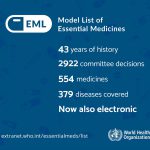
        The World Health Organization has launched a new easy-to-access, digital version of its Model list of Essential Medicines (EML). The move will revolutionize the way this core WHO reference tool is used.

        More than 150 countries currently use the WHO list to work out which medicines best meet their national health contexts and priorities, so they can compile their own national essential medicines lists.

        Essential medicines are those that satisfy the priority health care needs of a population. They are the medicines that need to be available in a functioning health system at all times, in appropriate dosage forms, of assured quality, and at prices individuals and the community can afford.

        Keeping up-to-date lists of the most important medicines a country needs is key to achieving health for all in a sustainable way.

        Since 1977, the WHO list has been revised every 2 years (most recently in 2019) by a group of experts and published in print or PDF formats. It includes information about available dose forms and strengths; specifications as to who should take a medicine; what conditions a medicine can treat and how it should be taken, as well as details about the clinical evidence supporting recommendations being made.

        The new electronic version brings the traditional EML to smartphones and computer screens in a comprehensive, freely accessible, online database. Instead of flicking through pages of information, users can search by simply clicking on the name of a medicine, for example, or a health issue. They can also make their own customized lists by exporting the list – in full or in part – into an Excel or Word version.  

        The electronic EML is the latest step in WHO’s effort to harness digital technologies to drive improvements in global public health, and advance progress towards universal health coverage. 


        WHO launch eEML
        Read More
        https://www.who.int/news-room/detail/27-02-2020-who-launch-e-eml

        Views: 0

      • To eliminate cervical cancer in the next 100 years, implementing an effective strategy is critical

        To eliminate cervical cancer in the next 100 years, implementing an effective strategy is critical

        Vaccination, screening, treatment and palliative care are the key interventions of WHO’s Draft Global Strategy towards the Elimination of Cervical Cancer as a Public Health Problem,
        the fourth most common cancer in women.

        On World Cancer Day, new estimates show that this strategy could save more than 62 million girls and women from a cervical cancer death and prevent 74 million cases within the next 100 years – but only if these interventions are used effectively
        together.

        No single intervention can eliminate cervical cancer

        These estimates, published by the WHO Cervical Cancer Elimination Modelling Consortium (CCEMC) in The Lancet, are based on the draft strategy’s targets to achieve a global coverage of 90% vaccination, 70% screening and 90% treatment by 2030.


        lancet

        Impact of HPV vaccination and cervical screening on cervical cancer elimination: a comparative modelling analysis in 78 low-income and lower-middle-income countries

        Mortality impact of achieving WHO cervical cancer elimination targets: a comparative modelling analysis in 78 low-income and lower-middle-income countries


        Developed by Member States, UN agencies and other partners, the draft global strategy seeks to redress the unequal burden of cervical cancer around the world. Nine in 10 cervical cancer deaths occur in low and lower-middle-income countries, where
        women lack access to health services.

        As Dr Tedros Adhanom Ghebreyesus, WHO’s Director-General has said, “It doesn’t have to be this way. Cervical cancer
        is one of the most preventable and treatable forms of cancer, as long as it is detected early and managed effectively.”

        This new analysis compares the impact of vaccination, screening and treatment of cervical pre-cancer lesions as single or combined interventions. Focusing on 78 countries where cervical cancer mortality is highest, the results clearly show that no
        single intervention will be sufficient to reduce levels of cervical cancer in the next 100 years to below the elimination target of 4 cases per 100,000 women per year.

        Acting immediately on all three fronts is crucial.                                                                                       

        90-70-90: a triple intervention by 2030 and beyond

        Vaccinating girls against cancer-causing types of human papillomavirus (HPV) before the age of 15 is the foundation for bringing every country’s incidence rate of cervical cancer down to the agreed elimination level.

        Right now, however, vaccination is not enough. As a single strategy, vaccination targets would only deliver a 0.1% reduction in cervical cancer mortality by 2030. Scaling up screening and treatment of cervical pre-cancer lesions at the same time would
        reduce mortality by more than one third, or 300,000 deaths, in the same period.

        The evidence shows that when all adult women are screened for cervical cancer at least twice, at ages 35 and 45, abnormalities are more likely to be detected before they become cancerous. When cancer has developed, screening increases a women’s
        likelihood of early and successful treatment, as well as palliative care if recovery is no longer an option.

        Meeting these triple-intervention targets would be a major contribution to target 3.4 of the UN Sustainable Development Goals (SDGs), a one-third reduction in premature mortality from non-communicable diseases by 2030.

        The future of cervical cancer elimination

        WHO’s global strategy towards eliminating cervical cancer aims to set the world on the right track by 2030, but it is just the beginning.

        At this pace, global elimination of cervical cancer is not predicted until 2120.

        While high HPV vaccination coverage is the primary prevention intervention, ensuring every woman has two cervical screenings in her life would accelerate elimination by 11 – 31 years, depending on the country.

        If no action is taken, cervical cancer deaths will rise almost 50% by 2030. Approval of the draft global strategy at the WHO World Health Assembly in 2020, and investment in mechanisms to deliver it, is vital.

        As the new World Cancer Report shows, only 18% of countries that currently provide screening for cervical cancer reached the recommended target of more than 70% coverage. An estimated 55% of low-income countries that reported offering
        cervical cancer screening generally lack accessible radiotherapy or surgery services.

        Elimination of cervical cancer is possible within the lifetime of today’s youngest girls, but the clock starts now and every intervention counts.


        To eliminate cervical cancer in the next 100 years, implementing an effective strategy is critical
        Read More
        https://www.who.int/news-room/detail/04-02-2020-to-eliminate-cervical-cancer-in-the-next-100-years

        Views: 0