Tag: community

  • ICC-WHO Joint Statement: An unprecedented private sector call to action to tackle COVID-19

    ICC-WHO Joint Statement: An unprecedented private sector call to action to tackle COVID-19

    In a coordinated effort to combat the coronavirus COVID-19 pandemic, the International Chamber of Commerce (ICC) and the World Health Organization (WHO) have agreed to work closely to ensure the latest and most reliable information and tailored guidance reaches the global business community.

    The COVID-19 pandemic is a global health and societal emergency that requires effective immediate action by governments, individuals and businesses. All businesses have a key role to play in minimising the likelihood of transmission and impact on society. Early, bold and effective action will reduce short- term risks to employees and long-term costs to businesses and the  economy.

    To aid this collective effort, ICC will regularly send updated advice to its network of over 45 million businesses so that businesses everywhere can take informed and effective action to protect their workers, customers and local communities and contribute to the production and distribution of essential supplies.

    ICC will also contribute to enhancing information flows on the coronavirus outbreak by surveying its global private sector network to map the global business response. This will both encourage businesses to adopt appropriate precautionary approaches and generate new data and insights to support national and international government efforts.

    As an immediate priority, businesses should be developing or updating, readying or implementing business continuity plans. Business continuity plans should aim to reduce transmission, including by: promoting understanding of the disease, its symptoms and appropriate behavior among employees; setting up a reporting system for any cases and contacts; preparing essentials; limiting travel and physical connectivity; and planning for measures such as teleworking when necessary.

    Calls to Action

    • ICC strongly endorses WHO’s call on national governments everywhere to adopt a whole-of- government and whole-of-society approach in responding to the COVID-19 pandemic. Reducing the further spread of COVID-19 and mitigating its impact should be a top priority for Heads of State and Government. Political action should be coordinated with actors in the private sector and civil society to maximize reach of messaging and effectiveness.
    • Governments should commit to making available all necessary resources to combat COVID-19 with the minimum of delay and to ensure that cross-border medical and other essential goods supply chains are able to function effectively and efficiently
    • ICC and the WHO encourage national chambers of commerce to work closely with UN country teams, including WHO country offices where they exist, and to designate mutual focal points to coordinate this collaboration.
    • ICC encourages its members to support their country’s national response efforts and to contribute to the global response efforts coordinated by the WHO through www.covid19responsefund.org.

    As the pandemic evolves, ICC Secretary General John W.H Denton AO and WHO Director General Dr Tedros Adhanom Ghebreyesus will continue to coordinate their efforts.

    Essential information on the COVID-19 pandemic can be found on the WHO’s dedicated site.


    ICC-WHO Joint Statement: An unprecedented private sector call to action to tackle COVID-19
    Read More
    https://www.who.int/news-room/detail/16-03-2020-icc-who-joint-statement-an-unprecedented-private-sector-call-to-action-to-tackle-covid-19

    Views: 0
  • Malaysia gets special consideration in Singapore’s new travel restrictions

    Malaysia gets special consideration in Singapore’s new travel restrictions

    Malaysia gets special consideration in Singapore’s new travel restrictions 1

    SINGAPORE: The new border restrictions on travellers including those from Asean do not include Singapore’s sea and land crossings with Malaysia, meaning Malaysians and Singaporeans can commute from both sides as usual.

    Singapore’s Co-chair of the Multi-Ministry Taskforce on Covid-19, Lawrence Wong, said while the order applies to the whole of Asean, a separate arrangement has been worked out for Malaysia through the bilateral joint working group.

    Special considerations have been put in for Malaysia because of the close proximity and high interdependency between both countries.

    “We do need precautions to be taken, given the high volume of people and vehicles moving in and out of these checkpoints,” he said today when announcing the additional measures that Singapore would be taking on the Covid-19 situation starting midnight on Monday.

    Effective March 16, 2020, 2359 hours, all travellers entering Singapore with recent travel history to Asean countries, Japan, Switzerland, or the United Kingdom within the last 14 days will be issued with a 14-day Stay-Home Notice (SHN).

    Wong, who is also the National Development Minister, said that on land crossing alone 200,000 people move across the checkpoints daily and the imposition of a 14-day SHN requirement would be very difficult and very disruptive for both countries.

    “So the 14-day requirement will not be practical for these travellers and we need to look at other precaution like checking their health. So discussions are ongoing between the two sides,” he said.

    The latest travel order applies to Singapore residents, long-term pass holders, and short-term visitors as well but not those transiting in Singapore without leaving the transit area.

    In addition, they will have to provide proof of the place where they will serve the 14-day SHN, for example a hotel booking covering the entire period, or a place of residence they or their family members own.

    They may also be swabbed for testing for Covid-19, even if asymptomatic because of the risk of community transmission in the countries of their origin and evidence of cases that have been imported from these countries into Singapore.

    In addition to the SHN requirement, from March 16, 2020, 2359 hours, all short-term visitors who are nationals of any Asean country will have to submit requisite information on their health to the Singapore Overseas Mission in the country they are resident before their intended date of travel.

    The submission will have to be approved by Singapore’s Ministry of Health (MOH) before travel to Singapore, and the approval will be verified by the Immigration and Checkpoints Authority (ICA) officers at the Singapore checkpoints.

    Short-term visitors who arrive in Singapore without the necessary approval will be denied entry into Singapore and they are therefore advised to secure the approval before making definitive travel bookings. — Bernama

    Malaysia gets special consideration in Singapore’s new travel restrictions
    Read More
    https://www.thesundaily.my/local/malaysia-gets-special-consideration-in-singapore-s-new-travel-restrictions-BI2129074

    Views: 0

  • Covid-19: 41 new cases reported, tally now 238

    Covid-19: 41 new cases reported, tally now 238

    Covid-19: 41 new cases reported, tally now 238 2

    KUALA LUMPUR: A total of 41 new COVID-19 cases were reported as at noon today, bringing cumulative cases in the country to 238, Health Director-General Datuk Dr Noor Hisham Abdullah said.

    He said all 41 new cases were linked to the tabligh religious gathering, and they involved 37 patient under investigation (PUI) cases while four more are close contact cases.

    “To date, a total 203 cases are still being treated, with five in the intensive care unit (ICU) and requiring ventilator support. The five are also being given anti-viral treatment.

    “Also, as of today, a total 1,321 samples from influenza-like-illnesses (ILI) and severe acute respiratory infections (SARI) have been tested at the Institute for Medical Research (IMR), all public health laboratories and hospitals. Of those, three samples tested positive for COVID-19,” he said in a statement, here today.

    In another development, two earlier cases (case 35 and 61) have recovered and have been discharged from the Sungai Buloh hospital, he said.

    This brings the number of recovered cases to 35 so far.

    Dr Noor Hisham also advised the public to remain calm and not to spread inaccurate information with regard to the tabligh religious gathering that took place from Feb 28-March 1.

    Also, to prevent risk of infection on those from the vulnerable communities and those prone to infection, especially the Orang Asli community, the Health Ministry (MOH) is advising organisations or groups who have plans to conduct activities with these communities to postpone them, he said.

    Dr Noor Hisham said the ministry will continue to provide health services to rural communities through outreach activities.

    “The ministry also welcomes any form of medical aid, contributions or collaborations from any party, including non-governmental organisations,” he said, adding that offers or inquiries can be submitted through the ministry’s email cprc@moh.gov.my.

    Meanwhile in an updated statement issued at 7pm, the MOH said a total 4,942 participants from the tabligh event at the Sri Petaling mosque have been identified.

    Of these, 3,069 reported themselves in at Health Clinics for examination and screening while another 137 were referred to hospitals.

    “Only 1,634 of them experienced respiratory tract infection symptoms and samples were taken, while 2,932 of them were asked to undergo home surveillance for 14 days from the last day of the gathering. Investigations and tracking of the event participants is ongoing,” the statement read. — Bernama

    Covid-19: 41 new cases reported, tally now 238
    Read More
    https://www.thesundaily.my/local/covid-19-41-new-cases-reported-tally-now-238-EC2127446

    Views: 0

  • COVID-19: IFRC, UNICEF and WHO issue guidance to protect children and support safe school operations

    GENEVA/NEW YORK – The International Federation of the Red Cross (IFRC), UNICEF and the World Health Organization (WHO) today issued new guidance to help protect children and schools from transmission of the COVID-19 virus. The guidance provides critical considerations and practical checklists to keep schools safe. It also advises national and local authorities on how to adapt and implement emergency plans for educational facilities. 

    In the event of school closures, the guidance includes recommendations to mitigate against the possible negative impacts on children’s learning and wellbeing. This means having solid plans in place to ensure the continuity of learning, including remote learning options such as online education strategies and radio broadcasts of academic content, and access to essential services for all children. These plans should also include necessary steps for the eventual safe reopening of schools.

    Where schools remain open, and to make sure that children and their families remain protected and informed, the guidance calls for:

    • Providing children with information about how to protect themselves;
    • Promoting best handwashing and hygiene practices and providing hygiene supplies;
    • Cleaning and disinfecting school buildings, especially water and sanitation facilities; and
    • Increasing airflow and ventilation.

    The guidance, while specific to countries that have already confirmed the transmission of COVID-19, is still relevant in all other contexts. Education can encourage students to become advocates for disease prevention and control at home, in school, and in their community by talking to others about how to prevent the spread of viruses. Maintaining safe school operations or reopening schools after a closure, requires many considerations, but if done well, can promote public health.

    For example, safe school guidelines implemented in Guinea, Liberia and Sierra Leone during the outbreak of Ebola virus disease from 2014 to 2016 helped prevent school-based transmissions of the virus.

    UNICEF is urging schools – whether open or helping students through remote learning – to provide students with holistic support. Schools should provide children with vital information on handwashing and other measures to protect themselves and their families; facilitate mental health support; and help to prevent stigma and discrimination by encouraging students to be kind to each other and avoid stereotypes when talking about the virus.

    The new guidance also offers helpful tips and checklists for parents and caregivers, as well as children and students themselves. These actions include:

    • Monitoring children’s health and keeping them home from school if they are ill;
    • Encouraging children to ask questions and express their concerns; and
    • Coughing or sneezing into a tissue or your elbow and avoid touching your face, eyes, mouth and nose.

    Read More
    https://www.who.int/news-room/detail/10-03-2020-covid-19-ifrc-unicef-and-who-issue-guidance-to-protect-children-and-support-safe-school-operations

    Views: 0

  • Data-collection platform improving healthcare globally

    Data-collection platform improving healthcare globally

    Frontline health workers represent the lifeblood of many healthcare systems in low- and middle-income countries around the world. Often overworked and underpaid, these workers operate outside hospital settings to meet the community’s poorest people where they live and work, ensuring healthcare initiatives impact the families that need them most.

    Read More

    Views: 0

  • WHO statement on cases of COVID-19 surpassing 100 000

    WHO statement on cases of COVID-19 surpassing 100 000

    As of today’s reports, the global number of confirmed cases of COVID-19 has surpassed 100 000. As we mark this sombre moment, the World Health Organization (WHO) reminds all countries and communities that the spread of this virus can be significantly slowed or even reversed through the implementation of robust containment and control activities. 

    China and other countries are demonstrating that spread of the virus can be slowed and impact reduced through the use of universally applicable actions, such as working across society to identify people who are sick, bringing them to care, following up on contacts, preparing hospitals and clinics to manage a surge in patients, and training health workers.

    WHO calls on all countries to continue efforts that have been effective in limiting the number of cases and slowing the spread of the virus. 

    Every effort to contain the virus and slow the spread saves lives. These efforts give health systems and all of society much needed time to prepare, and researchers more time to identify effective treatments and develop vaccines. 

    Allowing uncontrolled spread should not be a choice of any government, as it will harm not only the citizens of that country but affect other countries as well. 

    We must stop, contain, control, delay and reduce the impact of this virus at every opportunity. Every person has the capacity to contribute, to protect themselves, to protect others, whether in the home, the community, the health care system, the work place or the transport system. 

    Leaders at all levels and in all walks of life must step forward to bring about this commitment across society. 

    WHO will continue to work with all countries, our partners and expert networks to coordinate the international response, develop guidance, distribute supplies, share knowledge and provide people with the information they need to protect themselves and others.

    WHO statement on cases of COVID-19 surpassing 100 000
    Read More
    https://www.who.int/news-room/detail/07-03-2020-who-statement-on-cases-of-covid-19-surpassing-100-000

    Views: 0

  • End in sight, but flare-ups likely in the Ebola outbreak in the Democratic Republic of the Congo

    End in sight, but flare-ups likely in the Ebola outbreak in the Democratic Republic of the Congo

    Remarks by Dr Ibrahima Socé Fall, World Health Organization Assistant Director-General, Emergency Response


    Good afternoon. 

    I hope that your busy week was interrupted, like mine, with a moment of joy on Tuesday.

    That moment was the celebration of a woman being discharged from an Ebola treatment centre in Beni. Her name is Masiko.

    She was the last person in the Democratic Republic of the Congo confirmed to have Ebola.

    Health workers and other responders sacrificed a lot to get to this point. 

    Since the outbreak was declared in August 2018 there have been 420 attacks on health facilities in DRC, resulting in 11 deaths and 86 injuries among health care workers and patients.

    It’s been a huge amount of work. At the peak of the outbreak, more than 120 cases were being reported each week. 28 health zones were affected, with cases appearing 1200 kilometres apart. In response:

    • 11 labs have been set up to test around 3500 samples each week
    • 11 Ebola treatment centres were set up to care for people with Ebola
    • 300 000 people have been vaccinated
    • 250 000 contacts have been registered
    • 26 000 safe and dignified burials have been conducted
    • More than 3000 health facilities were identified for infection prevention and control support
    • More than 1000 metric tonnes of supplies have been delivered
    • An Ebola vaccine has been licensed, and two treatments found to be highly effective
    • Almost 160 000 million people have been screened for Ebola symptoms at borders or other points of control

    This work is continuing. The outbreak isn’t over. WHO recommends waiting two full incubation periods – that’s 42 days – after the last person tests negative a second time before declaring the end of the outbreak.

    We must stay in active response mode to get us over that finish line.

    We have to be prepared for other cases emerging. It’s is a very real risk.

    Remember that during the Ebola outbreak in West Africa flare-ups of new cases occurred after the end of the outbreak.

    There are four reasons why new cases may emerge during this 42-day period, or even after the end of the outbreak.

    • First, because of the complex security environment, Ebola transmission outside of groups under monitoring is possible.  
    • Second, Ebola virus can persist in used needles, syringes or vials for several weeks.
    • Third, Ebola virus can persist in the body fluids of survivors for many months, and can be transmitted well after recovery, or in rare cases can result in relapse – as we’ve already seen during this outbreak.
    • Finally, Ebola virus is present in an animal reservoir in the region, and there is always a risk of a new spillover to humans.

    This is why it’s critical to maintain surveillance and rapid response capacities.

    And that’s what we are doing. We’re still in full response mode.

    In addition to the activities I already mentioned, I have to underline how critical it is to continue supporting the Survivor Programme, which provides follow-up care for almost all of the 1169 survivors in 26 health areas in North Kivu and Ituri. The programme also helps reduce the risks of re-introduction events. 

    We need to continue this work until the end of the outbreak, to keep the capacity in place to rapidly respond to flare-ups, to keep supporting survivors after the outbreak, and to transition the capacities built in this response toward building a stronger health system. 

    But to be very frank, right now the world risks dropping the baton at the finish line. WHO faces an immediate US $20 million funding gap. If no new resources are received, we will run out of money before the end of the outbreak.

    We appreciate the generosity of donors who have supported the response since August 2018. Now we need to get over the finish line. WHO is calling on the international community to help us end this outbreak, and keep our promises to communities to build a stronger health system.

    If we are forced to scale back operations because of a lack of funds, and then a new case emerges, we might not have the people and resources on the ground that we need to shut down transmission quickly. Just a single case could re-ignite the epidemic.

    That would be a tragedy. An avoidable tragedy. 

    It is important that the global community doesn’t only focus efforts when there is an immediate threat, then walk away when the threat subsides.

    The health system has to be strong to stop much more than Ebola. It has to stop malaria, measles, cholera, and now COVID-19.

    There is a lot more work to do.

    Thank you.


    End in sight, but flare-ups likely in the Ebola outbreak in the Democratic Republic of the Congo
    Read More
    https://www.who.int/news-room/detail/06-03-2020-end-in-sight-but-flare-ups-likely-in-the-ebola-outbreak-in-the-democratic-republic-of-the-congo

    Views: 0

  • Decarbonizing energy supply by using community power

    Decarbonizing energy supply by using community power

    Renewable energy has become a mainstream source of power production. The estimated share of renewables in global electricity generation reached 26 % at the end of 2018, while far less growth occurred in heating, cooling and transport, according to the Renewables 2019 Global Status Report. With the increased use of renewable energy sources (RESs) like solar and wind, citizens and communities are seen as key to the clean energy transition’s success.

    Read More

    Views: 0

  • A Joint Statement on Tourism and COVID-19 – UNWTO and WHO Call for Responsibility and Coordination

    A Joint Statement on Tourism and COVID-19 – UNWTO and WHO Call for Responsibility and Coordination

    As the current outbreak of the Coronavirus Disease (COVID-19) continues to develop, the World Health Organization (WHO) and the World Tourism Organization (UNWTO) are committed to working together in guiding the travel and tourism sectors’ response to COVID-19.

    On 30 January 2020, the Director-General of the World Health Organization (WHO) declared the outbreak of COVID-19 to be a Public Health Emergency of International Concern and issued a set of Temporary Recommendations. WHO did not recommend any travel or trade restriction based on the current information available. WHO is working closely with global experts, governments and partners to rapidly expand scientific knowledge on this new virus, to track the spread and virulence of the virus, and to provide advice to countries and the global community on measures to protect health and prevent the spread of this outbreak.

    Cooperation is key

    The tourism sector is fully committed to putting people and their well-being first. International cooperation is vital for ensuring the sector can effectively contribute to the containment of COVID-19. UNWTO and WHO are working in close consultation and with other partners to assist States in ensuring that health measures be implemented in ways that minimize unnecessary interference with international traffic and trade.

    Tourism’s response needs to be measured and consistent, proportionate to the public health threat and based on local risk assessment, involving every part of the tourism value chain – public bodies, private companies and tourists, in line with WHO’s overall guidance and recommendations.

    UNWTO and WHO stand ready to work closely with all those communities and countries affected by the current health emergency, to build for a better and more resilient future. Travel restrictions going beyond these may cause unnecessary interference with international traffic, including negative repercussions on the tourism sector.

    At this challenging time, UNWTO and WHO join the international community in standing in solidarity with affected countries.

    A Joint Statement on Tourism and COVID-19 - UNWTO and WHO Call for Responsibility and Coordination
    Read More
    https://www.who.int/news-room/detail/27-02-2020-a-joint-statement-on-tourism-and-covid-19—unwto-and-who-call-for-responsibility-and-coordination

    Views: 0

  • WHO launch eEML

    WHO launch eEML

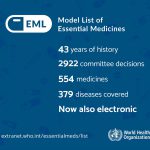
    The World Health Organization has launched a new easy-to-access, digital version of its Model list of Essential Medicines (EML). The move will revolutionize the way this core WHO reference tool is used.

    More than 150 countries currently use the WHO list to work out which medicines best meet their national health contexts and priorities, so they can compile their own national essential medicines lists.

    Essential medicines are those that satisfy the priority health care needs of a population. They are the medicines that need to be available in a functioning health system at all times, in appropriate dosage forms, of assured quality, and at prices individuals and the community can afford.

    Keeping up-to-date lists of the most important medicines a country needs is key to achieving health for all in a sustainable way.

    Since 1977, the WHO list has been revised every 2 years (most recently in 2019) by a group of experts and published in print or PDF formats. It includes information about available dose forms and strengths; specifications as to who should take a medicine; what conditions a medicine can treat and how it should be taken, as well as details about the clinical evidence supporting recommendations being made.

    The new electronic version brings the traditional EML to smartphones and computer screens in a comprehensive, freely accessible, online database. Instead of flicking through pages of information, users can search by simply clicking on the name of a medicine, for example, or a health issue. They can also make their own customized lists by exporting the list – in full or in part – into an Excel or Word version.  

    The electronic EML is the latest step in WHO’s effort to harness digital technologies to drive improvements in global public health, and advance progress towards universal health coverage. 


    WHO launch eEML
    Read More
    https://www.who.int/news-room/detail/27-02-2020-who-launch-e-eml

    Views: 0