History of the movement—Its philosophy—The value of hand training in the development of the brain and its significance in the making of man—A grammar of our many industries hard—The best we do can reach but few—Very great defects in our manual training methods which do not base on science and make nothing salable—The Leipzig system—Sloyd is hypermethodic—These crude peasant industries can never satisfy educational needs—The gospel of work, William Morris and the arts and crafts movement—Its spirit desirable—The magic effects of a brief period of intense work—The natural development of the drawing instinct in the child.
Manual training has many origins; but in its now most widely accepted form it came to us more than a generation ago from Moscow, and has its best representation here in our new and often magnificent manual-training high schools and in many courses in other public schools. This work meets the growing demand of the country for a more practical education, a demand which often greatly exceeds the accommodations. The philosophy, if such it may be called, that underlies the movement, is simple, forcible, and sound, and not unlike Pestalozzi’s “keine Kentnisse ohne Fertigkeiten,” [No knowledge without skill] in that it lessens the interval between thinking and doing; helps to give control, dexterity, and skill an industrial trend to taste; interests many not successful in ordinary school; tends to the better appreciation of good, honest work; imparts new zest for some studies; adds somewhat to the average length of the school period; gives a sense of capacity and effectiveness, and is a useful preparation for a number of vocations.
These claims are all well founded, and this work is a valuable addition to the pedagogic agencies of any country or state. As man excels the higher anthropoids perhaps almost as much in hand power as in mind, and since the manual areas of the brain are wide near the psychic zones, and the cortical centers are thus directly developed, the hand is a potent instrument in opening the intellect as well as in training sense and will. It is no reproach to these schools that, full as they are, they provide for but an insignificant fraction of the nearly sixteen millions or twenty per cent of the young people of the country between fifteen and twenty-four.
When we turn to the needs of these pupils, the errors and limitations of the method are painful to contemplate. The work is essentially manual and offers little for the legs, where most of the muscular tissues of the body lie, those which respond most to training and are now most in danger of degeneration at this age; the back and trunk also are little trained. Consideration of proportion and bilateral asymmetry are practically ignored. Almost in proportion as these schools have multiplied, the rage for uniformity, together with motives of economy and administrative efficiency on account of overcrowding, have made them rigid and inflexible, on the principle that as the line lengthens the stake must be strengthened. This is a double misfortune; for the courses were not sufficiently considered at first and the plastic stage of adaptation was too short, while the methods of industry have undergone vast changes since they were given shape.
There are now between three and four hundred occupations in the census, more than half of these involving manual work, so that never perhaps was there so great a pedagogic problem as to make these natural developments into conscious art, to extract what may be called basal types. This requires an effort not without analogy to Aristotle’s attempt to extract from the topics of the marketplace the underlying categories eternally conditioning all thought, or to construct a grammar of speech. Hardly an attempt worthy the name, not even the very inadequate one of a committee, has been made in this field to study the conditions and to meet them. Like Froebel’s gifts and occupations, deemed by their author the very roots of human occupations in infant form, the processes selected are underived and find their justification rather in their logical sequence and coherence than in being true norms of work. If these latter be attainable at all, it is not likely that they will fit so snugly in a brief curriculum, so that its simplicity is suspicious.
The wards of the keys that lock the secrets of nature and human life are more intricate and mazy. As H.T. Bailey well puts it in substance, a master in any art-craft must have a fourfold equipment: 1. Ability to grasp an idea and embody it. 2. Power to utilize all nerve, and a wide repertory of methods, devices, recipes, discoveries, machines, etc. 3. Knowledge of the history of the craft. 4. Skill in technical processes. American schools emphasize chiefly only the last.
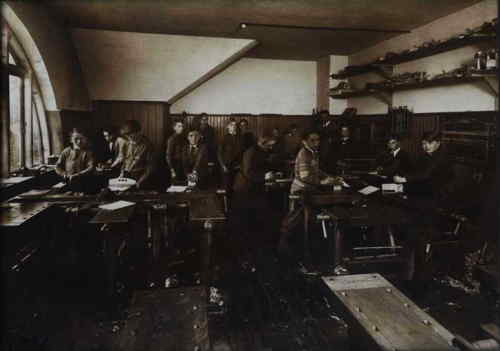 The actual result is thus a course rich in details representing wood and iron chiefly, and mostly ignoring other materials; the part of the course treating of the former, wooden in its teachings and distinctly tending to make joiners, carpenters, and cabinet-makers; that of the latter, iron in its rigidity and an excellent school for smiths, mechanics, and machinists. These courses are not liberal because they hardly touch science, which is rapidly becoming the real basis of every industry. Almost nothing that can be called scientific knowledge is required or even much favored, save some geometrical and mechanical drawing and its implicates.
These schools instinctively fear and repudiate plain and direct utility, or suspect its educational value or repute in the community because of this strong bias toward a few trades. This tendency also they even fear, less often because unfortunately trade-unions in this country sometimes jealously suspect it and might vote down supplies, than because the teachers in these schools were generally trained in older scholastic and even classic methods and matter. Industry is everywhere and always for the sake of the product, and to cut loose from this as if it were a contamination is a fatal mistake. To focus on process only, with no reference to the object made, is here an almost tragic case of the sacrifice of content to form, which in all history has been the chief stigma of degeneration in education. Man is a tool-using animal; but tools are always only a means to an end, the latter prompting even their invention.
Hence a course in tool manipulation only, with persistent refusal to consider the product lest features of trade-schools be introduced, has made most of our manual-training high schools ghastly, hollow, artificial institutions. Instead of making in the lower grades certain toys which are masterpieces of mechanical simplification, as tops and kites, and introducing such processes as glass-making and photography, and in higher grades making simple scientific apparatus more generic than machines, to open the great principles of the material universe, all is sacrificed to supernormalized method.
As in all hypermethodic schemes, the thought side is feeble. There is no control of the work of these schools by the higher technical institutions such as the college exercises over the high school, so that few of them do work that fits for advanced training or is thought best by technical faculties. In most of its current narrow forms, manual training will prove to be historically, as it is educationally, extemporized and tentative, and will soon be superseded by broader methods and be forgotten and obsolete, or cited only as a low point of departure from which future progress will loom up.
Indeed in more progressive centers, many new departures are now in the experimental stage. Goetze at Leipzig, as a result of long and original studies and trials, has developed courses in which pasteboard work and modeling are made of equal rank with wood and iron, and he has connected them even with the kindergarten below. In general the whole industrial life of our day is being slowly explored in the quest of new educational elements; and rubber, lead, glass, textiles, metallurgical operations, agriculture, every tool and many machines, etc., are sure to contribute their choicest pedagogical factors to the final result. In every detail the prime consideration should be the nature and needs of the youthful body and will at each age, their hygiene and fullest development; and next, the closest connection with science at every point should do the same for the intellect. Each operation and each tool—the saw, knife, plane, screw, hammer, chisel, draw-shave, sandpaper, lathe—will be studied with reference to its orthopedic value, bilateral asymmetry, the muscles it develops, and the attitudes and motor habits it favors; and uniformity, which in France often requires classes to saw, strike, plane up, down, right, left, all together, upon count and command, will give place to individuality.
Sloyd has certain special features and claims. The word means skilful, deft. The movement was organised in Sweden a quarter of a century ago as an effort to prevent the extinction by machinery of peasant home industry during the long winter night. Home sloyd was installed in an institution of its own for training teachers at Nääs. It works in wood only, with little machinery, and is best developed for children of from eleven to fifteen. It no longer aims to make artisans; but its manipulations are meant to be developmental, to teach both sexes not only to be useful but self-active and self-respecting, and to revere exactness as a form of truthfulness. It assumes that all and especially the motor-minded can really understand only what they make, and that one can work like a peasant and think like a philosopher. It aims to produce wholes rather than parts like the Russian system, and to be so essentially educational that, as a leading exponent says, its best effects would be conserved if the hands were cut off.
This change of its original utilitarianism from the lower to the liberal motor development of the middle and upper classes and from the land where it originated to another, has not eliminated the dominant marks of its origin in its models, the Penates of the sloyd household, the unique features of which persist like a national school of art, despite transplantation and transformation.[1]
Sloyd at its best tries to correlate several series, viz., exercises, tools, drawing, and models. Each must be progressive, so that every new step in each series involves a new and next developmental step in all the others, and all together, it is claimed, fit the order and degree of development of each power appealed to in the child. Yet there has been hardly an attempt to justify either the physiological or the psychological reason of a single step in any of these series, and the coördination of the series even with each other, to say nothing of their adaptation to the stages of the child’s development.
This, if as pat and complete as is urged, would indeed constitute on the whole a paragon of all the harmony, beauty, totality in variety, etc., which make it so magnificent in the admirer’s eyes. But the “45 tools, 72 exercises, 31 models, 15 of which are joints,” all learned by teachers in one school year of daily work and by pupils in four years, are overmethodic; and such correlation is impossible in so many series at once. Every dual order, even of work and unfoldment of powers, is hard enough, since the fall lost us Eden; and woodwork, could it be upon that of the tree of knowledge itself, incompatible with enjoying its fruit. Although a philosopher may see the whole universe in its smallest part, all his theory can not reproduce educational wholes from fragments of it.
The real merits of sloyd have caused its enthusiastic leaders to magnify its scope and claims far beyond their modest bounds; and although its field covers the great transition from childhood to youth, one searches in vain both its literature and practise for the slightest recognition of the new motives and methods that puberty suggests. Especially in its partially acclimatized forms to American conditions, it is all adult and almost scholastic; and as the most elaborate machinery may sometimes be run by a poor power-wheel, if the stream be swift and copious enough, so the mighty rent that sets toward motor education would give it some degree of success were it worse and less economic of pedagogic momentum than it is. It holds singularly aloof from other methods of efferent training and resists co-ördination with them, and its provisions for other than hand development are slight.
It will be one of the last to accept its true but modest place as contributing certain few but precious elements in the greater synthesis that impends. Indian industries, basketry, pottery, bead, leather, bows and arrows, bark, etc., which our civilization is making lost arts by forcing the white man’s industries upon red men at reservation schools and elsewhere, need only a small part of the systemization that Swedish peasant work has received to develop even greater educational values; and the same is true of the indigenous household work of the old New England farm, the real worth and possibilities of which are only now, and perhaps too late, beginning to be seen by a few educators.
This brings us to the arts and crafts movement, originating with Carlyle’s gospel of work and Ruskin’s medievalism, developed by William Morris and his disciples at the Red House, checked awhile by the ridicule of the comic opera “Patience,” and lately revived in some of its features by Cobden-Sanderson, and of late to some extent in various centers in this country. Its ideal was to restore the day of the seven ancient guilds and of Hans Sachs, the poet cobbler, when conscience and beauty inspired work, and the hand did what machines only imitate and vulgarize. In the past, which this school of motor culture harks back to, work, for which our degenerate age lacks even respect, was indeed praise. Refined men and women have remembered these early days, when their race was in its prime, as a lost paradise which they would regain by designing and even weaving tapestries and muslins; experimenting in vats with dyes to rival Tyrian purple; printing and binding by hand books that surpass the best of the Aldine, and Elzevirs; carving in old oak; hammering brass; forging locks, irons, and candlesticks; becoming artists in burned wood and leather; seeking old effects of simplicity and solidity in furniture and decoration, as well as architecture, stained glass, and to some extent in dress and manners; and all this toil and moil was ad majorem gloriam hominis [To the greater glory of man] in a new socialistic state, where the artist, and even the artisan, should take his rightful place above the man who merely knows.
The day of the mere professor, who deals in knowledge, is gone; and the day of the doer, who creates, has come. The brain and the hand, too long divorced and each weak and mean without the other; use and beauty, each alone vulgar; letters and labor, each soulless without the other, are henceforth to be one and inseparable; and this union will lift man to a higher level. The workman in his apron and paper hat, inspired by the new socialism and the old spirit of chivalry as revived by Scott, revering Wagner’s revival of the old Deutschenthum that was to conquer Christenthum, or Tennyson’s Arthurian cycle—this was its ideal; even as the Jews rekindled their loyalty to the ancient traditions of their race and made their Bible under Ezra; as we begin to revere the day of the farmer-citizen, who made our institutions, or as some of us would revive his vanishing industrial life for the red man.
Although this movement was by older men and women and had in it something of the longing regret of senescence for days that are no more, it shows us the glory which invests racial adolescence when it is recalled in maturity, the time when the soul can best appreciate the value of its creations and its possibilities, and really lives again in its glamour and finds in it its greatest inspiration. Hence it has its lessons for us here. A touch, but not too much of it, should be felt in all manual education, which is just as capable of idealism as literary education. This gives soul, interest, content, beauty, taste. If not a polyphrastic philosophy seeking to dignify the occupation of the workshop by a pretentious Volapük of reasons and abstract theories, we have here the pregnant suggestion of a psychological quarry of motives and spirit opened and ready to be worked. Thus the best forces from the past should be turned on to shape and reinforce the best tendencies of the present.
The writings of the above gospelers of work not only could and should, but will be used to inspire manual-training high schools, sloyd and even some of the less scholastic industrial courses; but each is incomplete without the other. These books and those that breathe their spirit should be the mental workshop of all who do tool, lathe, and forge work; who design and draw patterns, carve or mold; or of those who study how to shape matter for human uses, and whose aim is to obtain diplomas or certificates of fitness to teach all such things.
The muse of art and even of music will have some voice in the great synthesis which is to gather up the scattered, hence ineffective, elements of secondary motor training, in forms which shall represent all the needs of adolescents in the order and proportion that nature and growth stages indicate, drawing, with this end supreme, upon all the resources that history and reform offer to our selection. All this can never make work become play. Indeed it will and should make work harder and more unlike play and of another genus, because the former is thus given its own proper soul and leads its own distinct, but richer, and more abounding life.
I must not close this section without brief mention of two important studies that have supplied each a new and important determination concerning laws of work peculiar to adolescence.
The main telegraphic line requires a speed of over seventy letters per minute of all whom they will employ. As a sending rate this is not very difficult and is often attained after two months’ practise. This standard for a receiving rate is harder and later, and inquiry at schools where it is taught shows that about seventy-five per cent of those who begin the study fail to reach this speed and so are not employed. Bryan and Harter[2] explained the rate of improvement in both sending and receiving, with results represented for one typical subject in the curve on the following page.
From the first, sending improves most rapidly and crosses the dead-line a few months before the receiving rate, which may fall short. Curves 1 and 2 represent the same student. I have added line 3 to illustrate the three-fourths who fail. Receiving is far less pleasant than sending, and years of daily practise at ordinary rates will not bring a man to his maximum rate; he remains on the low plateau with no progress beyond a certain point. If forced by stress of work, danger of being dropped, or by will power to make a prolonged and intense effort, he breaks through his hidebound rate and permanently attains a faster pace. This is true at each step, and every advance seems to cost even more intensive effort than the former one. At length, for those who go on, the rate of receiving, which is a more complex process, exceeds that of sending; and the curves of the above figure would cross if prolonged. The expert receives so much faster than he sends that abbreviated codes are used, and he may take eighty to eighty-five words a minute on a typewriter in correct form.
[Illustration: Letters per Minute x Weeks of Practice.]
The motor curve seems to asymptotically approach a perhaps physiological limit, which the receiving curve does not suggest. This seems a special case of a general though not yet explained law. In learning a foreign language, speaking is first and easiest, and hearing takes a late but often sudden start to independence. Perhaps this holds of every ability. To Bryan this suggests as a hierarchy of habits, the plateau of little or no improvement, meaning that lower order habits are approaching their maximum but are not yet automatic enough to leave the attention free to attack higher order habits. The second ascent from drudgery to freedom, which comes through automatism, is often as sudden as the first ascent. One stroke of attention comes to do what once took many. To attain such effective speed is not dependent on reaction time. This shooting together of units distinguishes the master from the man, the genius from the hack. In many, if not all, skills where expertness is sought, there is a long discouraging level, and then for the best a sudden ascent, as if here, too, as we have reason to think in the growth of both the body as a whole and in that of its parts, nature does make leaps and attains her ends by alternate rests and rushes. Youth lives along on a low level of interest and accomplishment and then starts onward, is transformed, converted; the hard becomes easy; the old life sinks to a lower stratum; and a new and higher order, perhaps a higher brain level and functions, is evolved. The practical implication here of the necessity of hard concentrative effort as a condition of advancement is re-enforced by a quotation from Senator Stanford on the effect of early and rather intensive work at not too long periods in training colts for racing. Let-ups are especially dangerous. He says, “It is the supreme effort that develops.” This, I may add, suggests what is developed elsewhere, that truly spontaneous attention is conditioned by spontaneous muscle tension, which is a function of growth, and that muscles are thus organs of the mind; and also that even voluntary attention is motivated by the same nisus of development even in its most adult form, and that the products of science, invention, discovery, as well as the association plexus of all that was originally determined in the form of consciousness, are made by rhythmic alternation of attack, as it moves from point to point creating diversions and recurrence.
The other study, although quite independent, is part a special application and illustration of the same principle.
At the age of four or five, when they can do little more than scribble, children’s chief interest in pictures is as finished products; but in the second period, which Lange calls that of artistic illusion, the child sees in his own work not merely what it represents, but an image of fancy back of it. This, then, is the golden period for the development of power to create artistically. The child loves to draw everything with the pleasure chiefly in the act, and he cares little for the finished picture. He draws out of his own head, and not from copy before his eye. Anything and everything is attempted in bold lines in this golden age of drawing. If he followed the teacher, looked carefully and drew what he saw, he would be abashed at his production. Indians, conflagrations, games, brownies, trains, pageants, battles—everything is graphically portrayed; but only the little artist himself sees the full meaning of his lines. Criticism or drawing strictly after nature breaks this charm, since it gives place to mechanical reproduction in which the child has little interest.
Thus awakens him from his dream to a realization that he can not draw, and from ten to fifteen his power of perceiving things steadily increases and he makes almost no progress in drawing. Adolescence arouses the creative faculty and the desire and ability to draw are checked and decline after thirteen or fourteen. The curve is the plateau which Barnes has described. The child has measured his own productions upon the object they reproduced and found them wanting, is discouraged and dislikes drawing. From twelve on, Barnes found drawing more and more distasteful; and this, too, Lukens found to be the opinion of our art teachers. The pupils may draw very properly and improve in technique, but the interest is gone. This is the condition in which most men remain all their lives. Their power to appreciate steadily increases. Only a few gifted adolescents about this age begin a to develop a new zest in production, rivaling that of the period from five to ten, when their satisfaction is again chiefly in creation. These are the artists whose active powers dominate.
Lukens[3] finds in his studies of drawing, that in what he calls his fourth period of artistic development, there are those “who during adolescence experience a rebirth of creative power.” Zest in creation then often becomes a stronger incentive to work than any pleasure or profit to be derived from the finished product, so that in this the propitious conditions of the first golden age of childhood are repeated and the deepest satisfaction is again found in the work itself. At about fourteen or fifteen, which is the transition period, nascent faculties sometimes develop very rapidly. Lukens[4] draws the interesting curve shown on the following page.
[Illustration: Motor, creative or productive power. Sensory or receptive interest in the finished product.]
The reciprocity between the power to produce and that to appreciate, roughly represented in the above curve, likely is true also in the domain of music, and may be, perhaps, a general law of development. Certain it is that the adolescent power to apperceive and appreciate never so far outstrips his power to produce or reproduce as about midway in the teens. Now impressions sink deepest. The greatest artists are usually those who paint later, when the expressive powers are developed, what they have felt most deeply and known best at this age, and not those who in the late twenties, or still later, have gone to new environments and sought to depict them. All young people draw best those objects they love most, and their proficiency should be some test of the contents of their minds.
They must put their own consciousness into a picture. At the dawn of this stage of appreciation the esthetic tastes should be stimulated by exposure to, and instructed in feeling for, the subject-matter of masterpieces; and instruction in technique, detail, criticism, and learned discrimination of schools of painting should be given intermittently. Art should not now be for art’s sake, but for the sake of feeling and character, life, and conduct; it should be adjunct to morals, history, and literature; and in all, edification should be the goal; and personal interest, and not that of the teacher, should be the guide. Insistence on production should be eased, and the receptive imagination, now so hungry, should be fed and reinforced by story and all other accessories. By such a curriculum, potential creativeness, if it exists, will surely be evoked in its own good time. It will, at first, attempt no commonplace drawing-master themes, but will essay the highest that the imagination can bode forth. It may be crude and lame in execution, but it will be lofty, perhaps grand; and if it is original in consciousness, it will be in effect. Most creative painters before twenty have grappled with the greatest scenes in literature or turning points in history, representations of the loftiest truths, embodiments of the most inspiring ideals. None who deserve the name of artist copy anything now, and least of all with objective fidelity to nature; and the teacher that represses or criticizes this first point of genius, or who can not pardon the grave faults of technique inevitable at this age when ambition ought to be too great for power, is not an educator but a repressor, a pedagogic Philistine committing, like so many of his calling in other fields, the unpardonable sin against budding promise, always at this age so easily blighted.
Just as the child of six or seven should be encouraged in his strong instinct to draw the most complex scenes of his daily life, so now the inner life should find graphic utterance in all its intricacy up to the full limit of unrepressed courage. For the great majority, on the other hand, who only appreciate and will never create, the mind, if it have its rights, will be stored with the best images and sentiments of art; for at this time they are best remembered and sink deepest into heart and life. Now, although the hand may refuse, the fancy paints the world in brightest hues and fairest forms; and such an opportunity for infecting the soul with vaccine of ideality, hope, optimism, and courage in adversity, will never come again. I believe that in few departments are current educational theories and practises so hard on youth of superior gifts, just at the age when all become geniuses for a season, very brief for most, prolonged for some, and permanent for the best. We do not know how to teach to, see, hear, and feel when the sense centers are most indelibly impressible, and to give relative rest to the hand during the years when its power of accuracy is abated and when all that is good is idealized furthest, and confidence in ability to produce is at its lowest ebb.
Finally, our divorce between industrial and manual training is abnormal, and higher technical education is the chief sufferer. Professor Thurston, of Cornell, who has lately returned from a tour of inspection abroad, reported that to equal Germany we now need: “1. Twenty technical universities, having in their schools of engineering 50 instructors and 500 students each. 2. Two thousand technical high schools or manual-training schools, each having not less than 200 students and 10 instructors.” If we have elementary trade-schools, this would mean technical high schools enough to accommodate 700,000 students, served by 20,000 teachers. With the strong economic arguments in this direction we are not here concerned; but that there are tendencies to unfit youth for life by educational method and matter shown in strong relief from this standpoint, we shall point out in a later chapter.
[Footnote 1: This I have elsewhere tried to show in detail. Criticisms of High School Physics and Manual Training and Mechanic Arts in High Schools. Pedagogical Seminary, June, 1902, vol. 9, pp. 193-204.]
[Footnote 2: Studies in the Physiology and Psychology of the Telegraphic Language. Psychological Review, January, 1897, vol. 4, pp. 27-53, and July, 1899, vol. 6, pp. 344-375.]
[Footnote 3: A Study of Children’s Drawings in the Early Years.
Pedagogical Seminary, October, 1896, vol. 4, pp. 79-101. See also
Drawing in the Early Years, Proceedings of the National Educational
Association, 1899, pp. 946-953. Das Kind als Künstler, von C. Götze.
Hamburg, 1898. The Genetic vs. the Logical Order in Drawing, by F.
Burk. Pedagogical Seminary, September, 1902, vol. 9, pp. 296-323.]
[Footnote 4: Die Entwickelungsstufen beim Zeichnen. Die Kinderfehler,
September, 1897, vol. 2, pp. 166-179.]
Extract from EBook of Youth: Its Education, Regimen, and Hygiene, by G. Stanley Hall
Views: 0