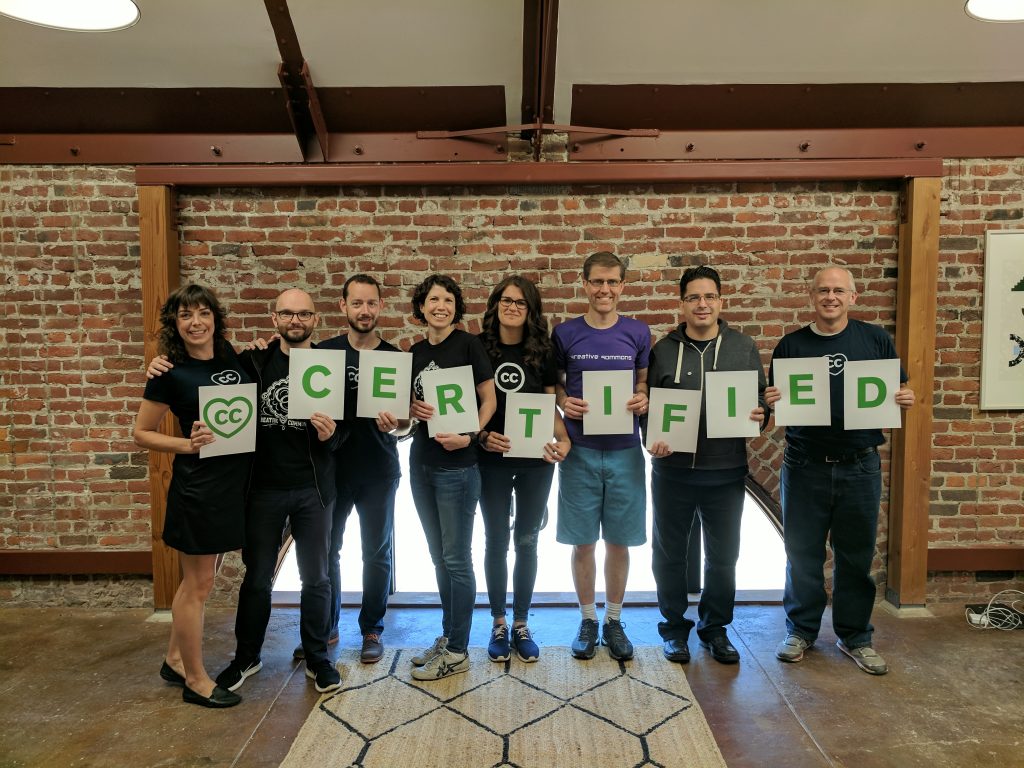
In order to better teach open tools and practices to communities around the world, Creative Commons has developed open educational resources and a certification program called the CC Certificate. CC’s Senior Counsel Sarah Hinchliff Pearson is now leading the project with a group of researchers, writers, and instructional designers. The project is funded by the Gates Foundation and the Institute for Museum and Library Services (IMLS).
The CC Certificate program is a training program that leads people through the basics about the organization, copyright law, and the CC tools. The goal is to equip people with the knowledge and skills they need to advocate for and support adoption of CC licensing in their work and creative pursuits.
There are a wealth of opportunities to tailor the certificate to specific audiences. Initially we’re focusing on two groups: academic librarians and educators. The certificate for these two segments will run as a 12-week online course on Canvas, facilitated by an instructor fluent in the issues and opportunities surrounding CC licensing and open collaboration. The majority of the content will cover the basics of copyright and open licensing, and participants will be expected to choose either the academic librarian or educator track because the final unit will be domain-specific. The content will include online discussions, quizzes, and learning activities throughout to help solidify concepts and allow learners to demonstrate their understanding. The course will be entirely online, but CC may eventually offer an optional in-person session as a capstone offering at the end of the course. Upon successful completion, students will receive a certificate from Creative Commons.
Of course, the underlying course content will be freely available to the public and CC-licensed, including text, images, and videos. The content covers Creative Commons as a whole – the organization, the tools, and the movement. We are treating this as a chance to tell the full story of what CC is and what we do. The materials include sections on the basics of copyright law, many of the ins and outs of CC licenses, practical information about how to use the licenses and how to use CC-licensed work, information about the values connected to use of CC, and case studies about what it looks like in the real world. For a full preview of the course topics, see the current syllabus here.
The full beta test of the 12-week course will begin in January, with the official certification program launching after the Global Summit from April 13-15 in Toronto, Canada. We will be running one library-specific track and one education-specific track during the beta phase and will be asking participants to help us evaluate and shape the content. If you are interested in participating, please fill out this interest form.
We expect the CC Global Network will play a crucial role in this program. In the future, we hope network members can be certified in order to help run the course in their parts of the world.
Over the course of the next year, we will be exploring customization of the project for three different audiences: GLAM professionals, lawyers, and governments. An early, abbreviated version of the certificate beta has already been delivered to more than 150 academic librarians in the US, with great success. We are anxious to expand the program to fit a greater variety of professions, and to work with and empower the future leaders of the commons. Any questions, comments, or suggestions? Get in touch with us via Slack or Twitter.
For even more CC content, please sign up for our email list.
Almost a year ago, we announced that our community’s real time communications were migrating from IRC to Slack. As we pass 1,000 active users, we want to take a moment to give gratitude to our community for making it happen.
We’ve grown consistently since then, but our next big influx of community came this week, when our Open Education Platform launched. #cc-openedu is now our most populous channel outside of #general and #announcements, with 167 participants collaborating daily in the channel. We expect an increasing number of people signing up in all our platforms with the launch of our exciting new Global Network Strategy.
Our community as a whole hosts 250 Weekly Active Users sending approximately 1,000 messages per day. However, certain days are definitely busier than others: after we sent out our invitation to our Global Summit attendees to join us on Slack, our engagement shot up to 1,700 messages in one day in April. The community is friendly and welcoming, and we try to say hello to every member who joins and posts!
35 Public Channels
35 public channels feels like a lot of channels, but the number of access points allows members to hop into (and out of) any of our global communities or programs with ease. The many channels allow us to open up our work to the world and facilitate communication between a variety of users on six continents. (We’re not yet in Antarctica – anyone want to start a chapter?)
In addition to our 1,000 members milestone, we’re nearing another important landmark: The CC Community has sent nearly 200,000 messages! We’re talking a lot between each other – more than 50% of our messages are sent via Direct Messages to develop our close-knit, relational culture of Community Builders.
To call out some of our favorite channels, #cc-openedu is acting as a catalyst and inspiration for other network-platform based communities, with more than 60 users regularly posting messages and a channel membership of 166. The #general and #announcements channels remain incredibly popular, with over 1,000 total members and 100 daily active users, as does, of course, #cc-animals, which provides all the cuteness from the commons. Want to learn more about how we work? #cc-culture-club has you covered! While most of our chatter is about the commons, we can also get silly in the #random channel.
We’ve also been excited to see the growth of users in global communities like #cc-europe, #cc-canada, and #cc-arabworld.
A vision for community growth
Our adoption of Slack has seriously grown our capacity as a network and as a community. We’ve been able to use the platform to chat, connect, and collaborate across disciplines. Through Slack, we’re privileging accessibility and community in order to reach our goals as a connected, growing network.
Our next steps include possible Slack chats, more fun, (like these Slack awards,) and frankly, who knows what else? Our community surprises us every day.
If you haven’t yet joined us, please do! We’d love to meet you.
“To those who think that mash-ups and sampling started with YouTube or a DJ’s turntables, it might be shocking to find that musicians have been borrowing—extensively borrowing, consciously and unconsciously—from each other since music itself began,” write James Boyle and Jennifer Jenkins, two superhero academics have taken on the subject of music and creativity in a new graphic novel. Meticulously researched and incredibly entertaining, the book explores 2,000 years of musical history, from Plato’s admonition that “musical innovation is full of danger to the whole state” to the recent “Blurred Lines” case – and everything in between.
Theft! A History of Music is the newest comic from Jenkins and Boyle, the team behind the 2006 fair use comic Bound by Law.Theft was written in collaboration with the late illustrator and academic Keith Aoki; Boyle and Jenkins developed the graphic designs that were illustrated and inked by Ian Akin and Brian Garvey. The book is licensed under CC BY-NC-SA 3.0 and is available on the website of the Duke Center for the Study of the Public Domain.
In the book’s afterword, you write that you thought you were “done with comic books.” Why this one, and why now? How did the process of writing this book, which took ten years, differ from your previous comic, “Bound by Law?” Why did you decide to take on music as your next subject?
Bound By Law had success far beyond our expectations because it met a need – it explained fair use to a generation of creators and reusers of culture who found the language of copyright law mystifying and felt thwarted by the “permissions culture” of today, which presumes that permissions and fees must be attached to even the tiniest piece of creative culture.
We thought the same was true of music – particularly the permissions culture point. But when we came to write the book we saw that it had to roam much further, through the history of attempts to regulate musical borrowing – whether on grounds of philosophy, religion, race, or property rights. We saw common themes in all of those, common relationships between technology, incentives, law and the fire of sympathetic inspiration, which is impatient with barriers – whether it was a generation of white teenagers being inspired by African American rhythm and blues, or a church composer taking from the songs of the troubadours. As for the ten years it took us to finish, that gets to the pledge we made to our dear departed colleague, Keith Aoki.
In some “superhero” type scenes, your protagonists struggle with the push and pull between power and control vs freedom, with alter-egos employed to demonstrate the impossibility of the decision. How do you, as academics and authors, reconcile the tension between these two forces?
We don’t think that the forces can ever be reconciled once and for all; they are dynamic tensions that actually drive the art. The important thing is to understand that this is a dynamic balance, not a simple equation where more control means more incentives and thus more art.
Jamie still remembers the first conversations with Larry Lessig, Hal Abelson and others about why we needed Creative Commons – we asked the Copyright office how creators could choose to share, to make their material freely available for others to use and build upon. Their answer was “we don’t provide that service.” That is missing a key part of the cultural dynamic – the fact that culture needs raw material on which to build. Creative Commons tried to deal with one aspect of that, namely the sharing commons. But we understood very well that some of that raw material needs to be there because law doesn’t reach it in the first place. For example, E=MC2 or the alphabet aren’t “owned” and if they were you would get less creativity, not more. Yet that does not mean freedom is always the answer. We want artists and composers to have rights over their work and to receive the compensation and attribution they richly deserve. That is in their, and our, interests. But it is also in their interests to have the freedoms to build on the past in interstitial ways that prior musical generations took for granted!
Something I found particularly compelling about the book is the complicated nature of many of the artists’ copyright disputes juxtaposed with lighthearted illustrations and narrative. For example, you discuss a number of surprising stories from the 20th Century, like the clampdown on the kind of sampling in early Public Enemy (the court decision announcing “get a license or do not sample”) or the case finding George Harrison liable for “subconscious” copying. You also include more distant history about Bach, Gutenberg, and even Plato in ways that are easy to understand and often irreverent. What was it like to turn court cases and history into comics? How did you employ storytelling tropes to craft a narrative out of 2000 years of scholarship and history?
Each domain of creativity – from music to comics – has its own dynamics. As academics, fond of long, carefully constructed arguments, we found it a wonderful challenge to fit complex and multifaceted ideas into a comic panel, a picture and a short speech bubble! But designing each of those panels was what made the art so truly satisfying – it was a rush, a creative high. As for law, it can be the subject of both art and humour – look at what Shakespeare and Dickens do with it! The question for us here was whether we could be technically faithful to the details and nuances – this is academic research with references behind every assertion, but it is also an attempt to capture a “conversation” that has been going on for hundreds of years, and do so fairly.
Even a casual reader will notice that the book is well researched. How did you do the research? How did you decide on the narrative structure, from the invention of notation to “Blurred Lines?” What primary sources did you draw on, and how did you do it collaboratively?
Again, there is so much to tell. We worked with composers and musicologists – our colleague, Dr. Anthony Kelley of the Duke music department bears much of the credit there. We taught classes made up of half law students and half composers and asked each group to explain the lines that the other group drew around “allowed” and “forbidden” creativity. We scoured the great books about musical history and borrowing – there are many. We drew on the legal scholars who have touched on this debate – Mike Carroll, another person on the CC founding board has written several of the most important law review articles on the subject. And above all, we listened to how music has been influenced and changed over time.
As for the structure, it emerged out of the chaos of our desire to tell the story and our panic that we wouldn’t be able to do so in a way that showed how fascinating it is. The readers of the book will be the best judge of whether we succeeded.
The book ends with a question – what will music production and rights look like going forward? How will musicians find their way in the 21st century? What do you think is the future of music?
We see several possible futures. Frankly, if we go on our current path – with the permissions culture extending legal claims to the atomic level of musical creativity – then we think that the future will be poorly served. We say in the book that we wouldn’t have got jazz, rock and roll, soul or the blues if we had used the rules we have today. Those musical forms would simply have been made impossible. It is a horrifying thought to think of that dynamic denying us the next great musical form. But we also see a reaction against that cultural sclerosis. We wanted this book to provide the raw material, the balanced information, that helps us decide as a culture which line we wish to go down.


 Theft! A History of Music is the newest comic from Jenkins and Boyle, the team behind the 2006 fair use comic Bound by Law. Theft was written in collaboration with the late illustrator and academic Keith Aoki; Boyle and Jenkins developed the graphic designs that were illustrated and inked by Ian Akin and Brian Garvey. The book is licensed under CC BY-NC-SA 3.0 and is


